When the first AI Security Summit took place in the UK in 2023, Europe was developing the world's first AI regulations and was a leading voice in discussions about where the technology would go. This time However, the EU's Artificial Intelligence Act has been criticized as an example of what not to do.
“The atmosphere in the EU needs to change and focus more on innovation and less on governance and pessimistic forecasts,” said Sriram Krishnan, White House senior adviser on artificial intelligence, at a side event on Wednesday.
EU law “does not favor entrepreneurs who want to create basic technologies,” he added.
Many in the industry gave a grim assessment of the situation. — By passing the Artificial Intelligence Actthey shot themselves in the foot said Amanda Brock, CEO of Open UK, an organization promoting open source technologies in the field of artificial intelligence.
Claiming that the EU passed this bill too quickly and too early, Brock said: You can't make laws about something you don't understand and expect them to be effective.
Since the EU passed the law in 2024, few countries have followed suit. India entered the summit by announcing a “lenient” governance regime, a wait-and-see approach (which assumes possible government interference) only in the case of specific harms, such as the malicious use of deepfake technology. Many other countries are following a similar path.
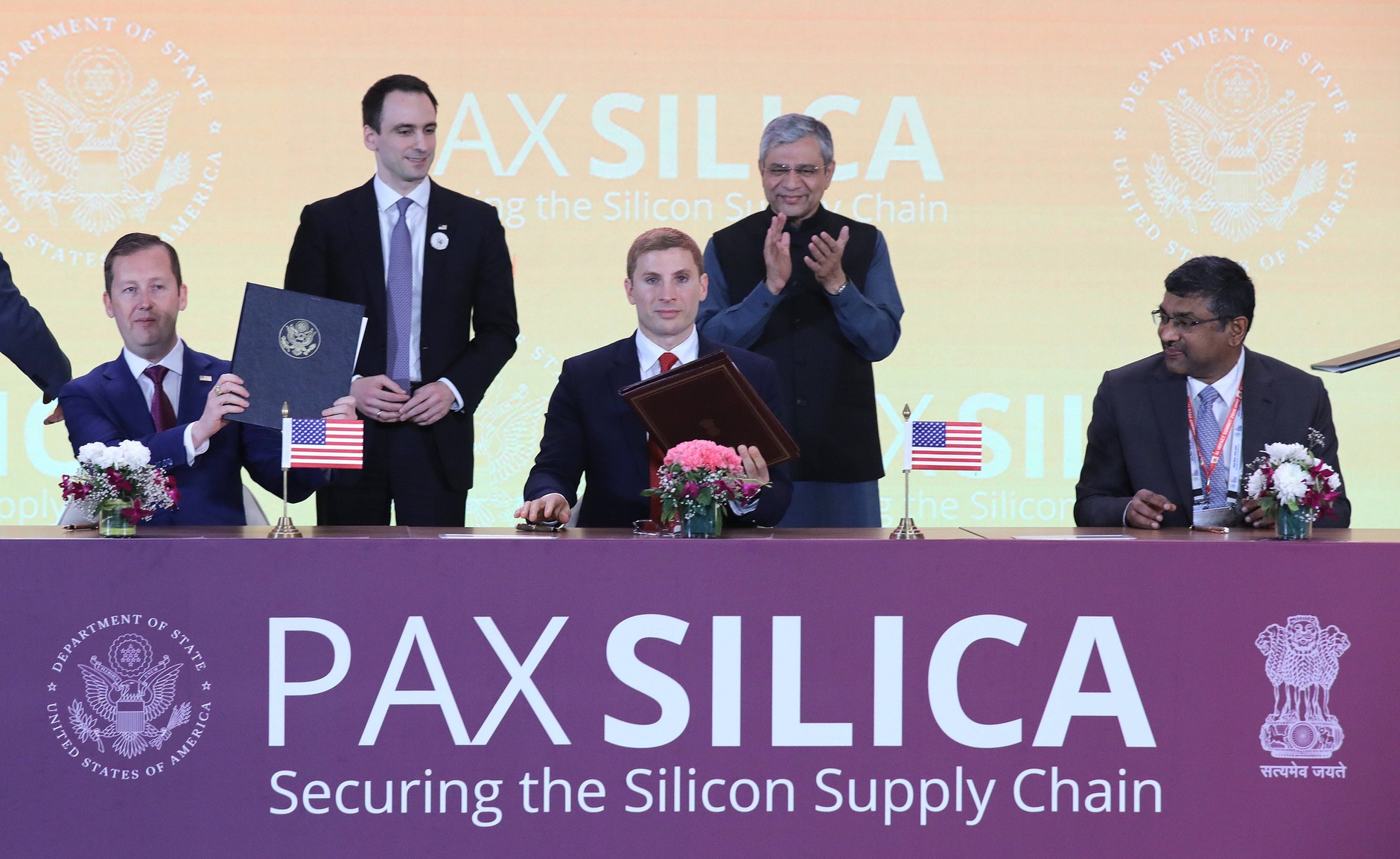
U.S. Ambassador to India Sergio Gor (L), Under Secretary of State for Economic Affairs Jacob Helberg (C), and Secretary of the Ministry of Electronics and Information Technology Sriram Krishnan (R) sign the Pax Silica declaration between the United States and India during the AI Impact Summit 2026 in New Delhi, India, on February 20, 2026.RAJAT GUPTA / PAP
Meanwhile, Brussels is struggling to align its ambitions to be a global regulator and attract investment at the same time. In recent months, EU authorities have scrambled to implement the EU's flagship artificial intelligence law while rolling back security rules after complaints from European companies that the rules were too burdensome.
At the previous summit (dedicated to artificial intelligence) in Paris, the keynote speaker was the President of the European Commission, Ursula von der Leyen.
This time, the Commission's speech at this year's week-long summit in New Delhi is scheduled for Friday afternoon, when many of the international participants will have already left India.
Pessimism
The EU had difficulty finding its place at the meeting participants were much more focused on making deals to stay competitive in the global race than on controlling the technology.
Without the president's speech, the European Commission is organizing two panels on Friday. The first involves work on a voluntary set of rules for the most complex and advanced AI models, such as OpenAI's GPT and Google's Gemini.
The second is on “innovative artificial intelligence solutions” and will present the Commission's plans to build factories in Europe to provide autonomous computing power.
Defending the EU position
— For Europe, leadership in AI means a combination of investment, scale and responsible management said EU technology chief Henna Virkkunen in a statement ahead of the summit. She is one of the few Union representatives present in Delhi. Virkkunen declined to comment publicly on Krishnan's statements.
Italian MEP Brando Benifei of the Socialists and Democrats, who also traveled to New Delhi, dismissed the US position as “quite isolated”, while admitting that “there are different approaches to the level of regulation around the world.”
One area where the EU could gain support is in voluntary guidance advising companies on how they should formulate risk assessments said Amber Sinha, executive director of digital rights group EDRi. “But I don't see many other common points,” he added.
French President Emmanuel Macron – one of the few European leaders attending the summit this year – failed to convincingly defend the Artificial Intelligence Act in a speech on Thursday, responding to criticism.
— Europe does not blindly focus on regulations, Macron tried to argue.
There were also participants who argued that the path chosen by Brussels was still the right one, while acknowledging that the EU was struggling to promote its rules as a global standard.
“In today's global digital technology environment, when things are so polarized, it's really hard for any one region to set those standards,” said Mark Surman, CEO of Mozilla (whose flagship product is the Firefox web browser), which advocates for an open internet and trusted artificial intelligence.
The EU's Artificial Intelligence Act, like its General Data Protection Regulations (GDPR), are “the right kind of standards” but “face a really uphill battle,” Surman concluded.