On Friday morning, we learned the preliminary readings of the PMI indices in Europe (the final readings, as usual, will be published at the beginning of next month). In the euro zone, the manufacturing PMI index in February amounted to 50.8 points, which means an increase from 49.5 points in the previous month. This reading is better than the forecasted 50.8 points. This is the first time since August 2025 that the manufacturing PMI was above 50 points. But last year's result above 50 points was the only one since June 2022.
50 points is an important barrier that separates expansion (readings above this limit) from recession (below) in the sector. Not only is it important whether it is below this cut-off level, but an important indication is whether a change is taking place: a rising PMI, even if it is below 50 points, suggests improvement in the sector.
See also: Big fake news on the Internet. We explain the fraud scheme. Public institutions are reacting
The PMI index for the services sector improved in February to 51.8 points from 51.6 points in the previous month. This reading is consistent with forecasts (51.9 points). This sector of the European economy is doing better than industry and for two years the PMI index measuring activity in it has been above the 50-point barrier.
The total PMI (Composite) index, combining the industrial and services sectors, in the euro zone increased slightly in February to 51.9 points from 51.3 points recorded in January. This is the highest level in three months.
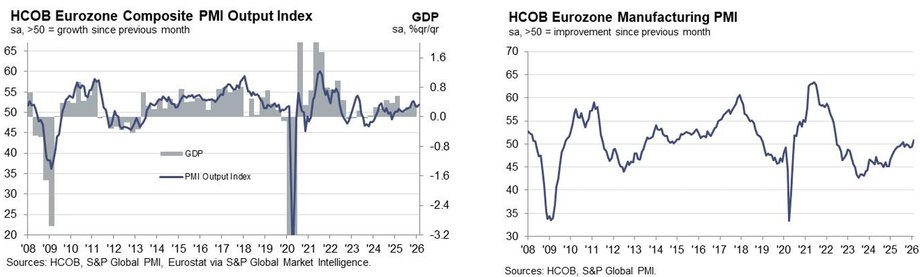
PMI indicators in the euro zone improved according to the preliminary reading in February, which may herald economic recovery.
|
S&P Global
“The pace of growth in economic activity in the euro area reached its highest level in three months in February. The improvement in the pace of expansion was most noticeable in the industrial sector. At the same time, growth in the total number of new orders remained moderate and unchanged from January, and companies again showed reluctance to hire additional workers. Entrepreneurial sentiment weakened but was still the second highest in 21 months,” S&P Global reported.
Manufacturing PMI German increased to 50.7 points from 49.1 points, which is a positive surprise because only a slight rebound to 49.5 points was forecast. This is the first time since mid-2022 that this indicator on the Rhine is above the 50-point barrier. The PMI index for the services sector in Europe's largest economy jumped to 53.4 points from 52.4 points, which is also a positive surprise (52.2 points were expected).
However, we France both indexes were below 50 points. Both were at the level of 49.6 points: industrial fell from 51.2 points (stabilization around 51 points was expected), and services increased from 48.4 points (an increase was forecast to 49.1 points).
This could be a breakthrough. Cautious optimism
“It may be premature, but this could be a turning point for the manufacturing sector as the headline PMI rose to a ceiling suggesting expansion. This time around, the overall fundamentals for continued growth appear slightly better than in August 2025. Most PMI sub-indices are at higher levels than in August, such as purchasing volumes, future production forecasts and inventory indicators. New orders are growing at a moderate pace after three months of decline. This indicator must show better results in the coming months so that we can be more confident about the prospects of this sector in the coming quarters,” wrote Cyrus de la Rubia, chief economist at Hamburg Commercial Bank.
He added that the manufacturing sector is on a more stable path and could contribute to overall growth this year instead of being a drag on the economy.
See also: The government is focusing on Deregulation 2.0. Four pillars of change under the supervision of Maciej Berek
Commenting on data from the services sector, he pointed out that growth in this area remains at a moderate pace, supporting overall economic development in the euro area. “Compared to the fourth quarter, however, the overall growth rate has slowed somewhat. Nevertheless, the euro area economy appears stable as the number of new orders for both service providers and manufacturing companies has increased, which should lead to further growth in production over the next few months. Germany is making an important contribution to this development, which is associated with increased public spending on infrastructure and defense, as well as stronger foreign demand,” de la Rubia pointed out.
He added that taking into account the stable growth in economic activity and still high inflation of services, the ECB will not be willing to change its position and will maintain interest rates (the cycle of reductions is probably over, the last reduction was in June 2025).