When a Ukrainian drone slipped through a jagged hole in the roof of a bombed-out warehouse in southern Ukraine, its operator expected to find something familiar: armored vehicles, crates of ammunition, perhaps fuel reserves, Business Insider reports.
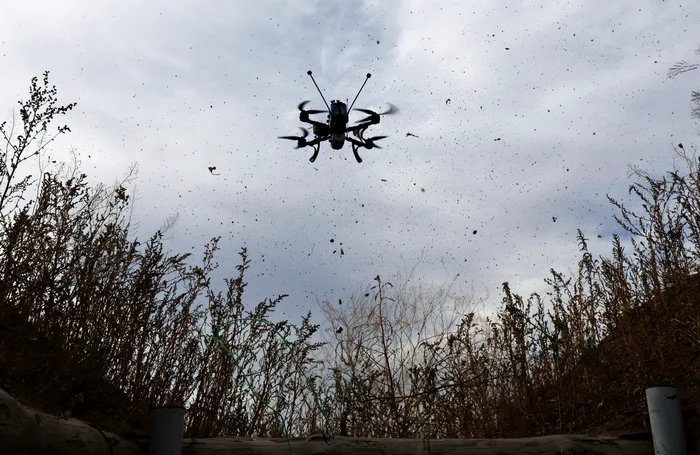
PHOTO EPA-EFE
Instead, the camera captured a scene that looked more like a rural garage than a military logistics center—four civilian cars, two motorcycles, and two horses.
“We didn't expect to see that. It was unusual,” said the Ukrainian drone pilot, who introduced himself with the call sign Cosmos.
Cosmos is part of Wild Division, an FPV drone unit of Ukraine's 82nd Air Assault Brigade. His team had identified the warehouse, located approximately 15 kilometers from the contact line, as a possible Russian logistics center. Such locations often hide ammunition or fuel stocks. Cosmos' fiber optic drone was equipped with explosives to destroy any military resources found inside.
They expected to come across some armored vehicles. What they discovered, however, became a symbol of developments in Russia's war effort.
Horses on the front line
Footage from the warehouse went viral on social media in Ukraine last week, highlighting what Ukrainian soldiers have regularly reported: Russian troops' use of unconventional means of transport, including horses and bicycles, for assault or logistics missions.
Cosmos said his mission took place in early February and was the first time he had personally seen horses used so close to the front line.
Other Wild Division members had already seen similar images. A high-profile incident in the Zaporizhia region last month showed Russian infantrymen attempting to cross the front line on horseback before being targeted by Ukrainian drones.
The use of livestock and cheap civilian vehicles reflects the transformation of the battlefield under the influence of drones. A horse or compact civilian car has a lower profile than a tank or armored personnel carrier, which can make them harder to detect from the air.
But for Ukrainian officers, the implications are deeper.
A different calculation of losses
The commander of the battalion to which Cosmos belongs, a major known by the code name Fizruk, said that he was also surprised by the discovery.
“I thought it was a location for transport vehicles, some sort of transfer hub”he said.
The civilian cars discovered appear to be Niva models — inexpensive off-road vehicles made by the Russian brand Lada. According to Fizruk, their presence indicates not only possible resource constraints, but also how Moscow calculates costs in a war of attrition.
“They treat them as inevitable losses, as if they will be destroyed anyway”he said. “A Niva costs, say, $2,000. A Hummer, which the Armed Forces of Ukraine use in many places, costs $20,000 or maybe more.”
From this perspective, sending more cheap vehicles into high-risk raids can be seen as an economic decision. “Why pay $20,000 for a single vehicle when you can buy 10 Niva for the same money?”, he added.
Russian strategy frequently involved repeated assaults with small groups of infantry, advancing on foot or in poorly protected vehicles. Western officials estimate that the human cost is extremely high. NATO recently estimated that up to 25,000 Russian soldiers could be killed on the battlefield in Ukraine every month.
Adapting to a drone war
After identifying the vehicles and animals in the warehouse, Cosmos aimed his drone loaded with explosives directly behind one of the cars. His unit later hit other vehicles inside. When the Russian troops moved their transport, the Wild Division identified another depot and attacked that one as well, he said.
“The enemy usually hides near these places,” Cosmos explained. “We're checking all targets. Sometimes we can see enemy infantry or see their vehicles.”
The war in Ukraine has increasingly become a contest of adaptation — not just technological, but also logistical and tactical. As drones dominate the skies, traditional armored columns are being replaced by shorter-distance movements with improvised means.
For Cosmos, who has been piloting drones for a year, the image of horses tethered in a military warehouse remains a surprising image on a 21st century battlefield where fiber-optic drones and beasts of burden coexist.