Just a year ago, the battlefield in Ukraine was at its most dangerous when the guns started firing. Today, the major risk often lies before and after the confrontation, when the military shifts positions while Russian drones patrol above them.
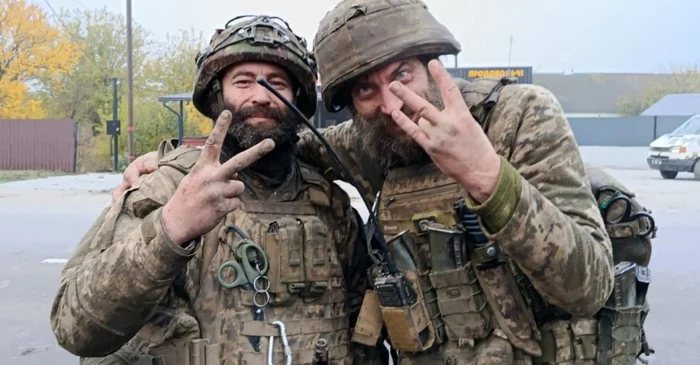
Oleksandr Tishayev and Oleksandr Aliksieienko have been in front-line positions for 165 days/FOTO:X
For two Ukrainian soldiers – Oleksandr Tishayev and Oleksandr Aliksieienko – this reality turned a mission that should have lasted about a month into a 165-day period marked not only by Russian attacks, but also by severe shortages of food, water and mental exhaustion.
Tishayev told the Kyiv Independent in an interview in Zhitomir that they joked among themselves that they would leave the position “in October or on a Wednesday”, suggesting total uncertainty about the timing of the withdrawal. Finally, the two were able to leave on October 28, almost six months after arriving there in the spring of 2025.
During the mission, the soldiers were subjected to constant strikes and even gas attacks. However, the most severe problem arose when water and food supplies ran out. At a critical moment, they had to squeeze the moisture out of wet wipes to stay alive. “The stress was constant. How can you stay lucid?” Aliksieienko said.
The Zaporizhia direction is currently one of the most active areas of the front. Russian forces use infiltration tactics, advancing in small groups and gradually consolidating positions. Tishayev, 48, and Aliksieienko, 43, observed the same tactics near the village of Mala Tokmachka.
The two held positions in May with the expectation of a quick turnover. In reality, there are 165 days left. The changing way in which drones influence frontline operations means that such extended missions are becoming more common.
In 2024, a two-week deployment was considered long, according to soldiers. In less than a year, the Russian military has massively stepped up its use of FPV drones, sometimes with fiber optics, making Ukrainian electronic response limited. “In 2025, you stay in the same position for at least a month – and that's in the optimistic scenario,” Tisaiev said. He added that actual rotations are almost impossible.
“Like Rabbits”
The position of the two was at an intersection constantly monitored by drones and Russian artillery. Surrounded by open land and burned forest, they had little opportunity to hide. To cover their tracks, they constantly changed routes, with Tishayev saying they felt “like rabbits sneaking through places where people can barely walk.”
In the first days of the deployment, Russian attacks injured Aliksieienko – shrapnel and concussion – and Russian forces used gas, in violation of international conventions. Aliksieienko was unconscious for more than three hours before Tishayev managed to give him first aid. Recovery took days, during which he could barely stand up. The injuries still give him severe headaches.
The main fear, however, remained the drones. “An FPV drone today is like a high-precision projectile. If it locks onto you, it almost always hits,” Tisaiev said. Drones flew almost continuously over their position, preventing them from moving, and resupply was extremely difficult. Ukrainian drones trying to deliver food, water and medicine were often shot down before reaching the ground.
Even when packages got through, soldiers couldn't always retrieve them without risking giving away their position. “Many times we had to choose between eating and simply surviving,” Tishayev explained.
Stocks ran out in the first two weeks. Then they switched to a strict regime: a sip of water at 6 in the morning and another at 6 in the evening. When even this was no longer possible, they resorted to the liquid in wet wipes. Dehydration accentuated fatigue, and sleep was rarely possible. Even in the quiet moments, the tension was too great to take as a sign of safety. Bulletproof vests, ten kilograms each, remained almost permanently on them.
The way back
The soldiers tried 30 times to leave the position, but were forced to return each time when the fog lifted. On the morning of October 28, visibility remained low. “I came out of the shelter, it was quiet and foggy, and I said: 'I think we will go home today,'” Tisaiev said.
They covered 12 kilometers in almost three hours. Aliksieienko, although wounded, walked on his own two feet. They could not afford breaks longer than a few minutes. A week before, Russian forces had tried to storm the sector, and soldiers feared running into Russian troops left isolated after the attack.
Finally, a vehicle with Ukrainian soldiers reached them and evacuated them.
Today, Tishayev is on leave with his family, including his twin seven-year-old sons. He is going to return to Zaporizhia. Aliksieienko spent three weeks in hospital and is still recovering. He plans, he says, “to tidy up the house some more.”
Both admit that they can't sleep peacefully, suddenly waking up with the reflex to search for the weapons they no longer have with them.
Asked whether such a prolonged standoff could have been avoided, the soldiers said that under the conditions at the time, a retreat would have been impossible even if the command had intended it. However, they hope that the rotation procedures can be improved in the future.
“Better sacrifice a hundred meters of destroyed land. People's lives are not justified for that,” said Tisaiev.