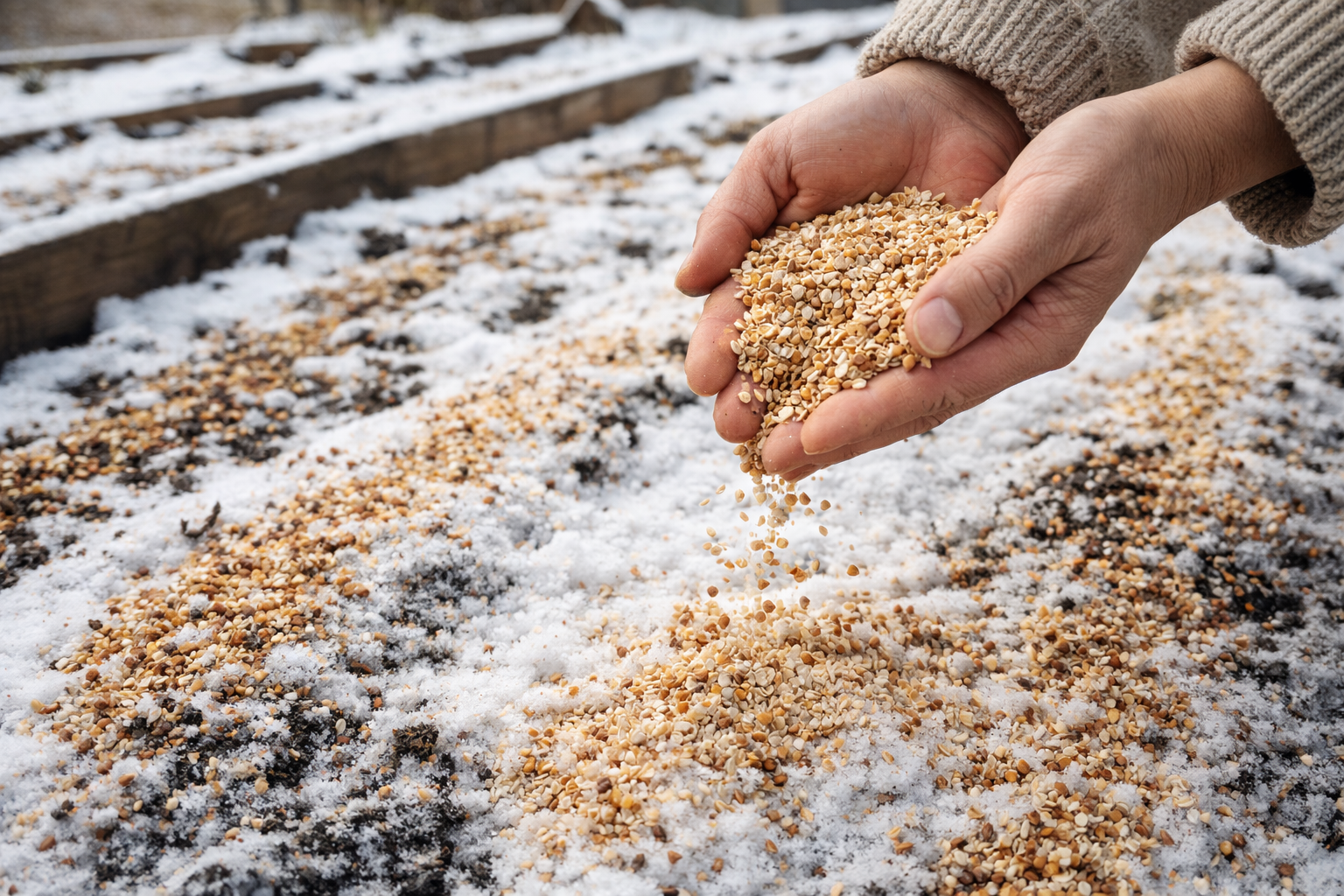
While there is snow on the site, the soil can be prepared in advance for the new season. In spring it will become more loose, moist and nutritious. To do this, organic cereals and herbal supplements are distributed over the snow.
When snow melts, it acts as natural irrigation. It evenly moistens the soil and helps organic matter gradually penetrate into the top layer of soil. This technique is used to improve the water and nutrient regime of the soil.

Cereals are added not as the main fertilizer, but as a source of organic matter for soil microflora.
What can you scatter on the snow in February:
Rice – a source of starch, which serves as food for soil microorganisms and helps form humus.
Buckwheat — contains mineral elements and easily decomposes, increasing the biological activity of the soil.
Oatmeal — rich in macro- and microelements, improves the structure of the top layer of soil.
It is better to grind the cereal before adding it. Scatter them evenly over the snow at the rate of 0.5–1 cup per 1 m². Once the snow melts, it will draw organic matter into the soil.
In spring, this provides loose soil with good air permeability, active soil microflora, sufficient moisture and higher yield potential without the use of chemicals.
Fertility is directly related to the work of microorganisms. In winter, the added organic matter becomes food for them, and as the soil warms up in the spring, they begin to actively process it into humus.