US prepares to open new front in fight to control critical minerals: 'They're putting money behind their rhetoric'


The United States is using offtake contracts and federal government-backed financing to compete with China in the short term to secure supplies of copper, cobalt and other critical minerals from Africa, diplomats, executives and analysts told Reuters. The statements were made ahead of the Mining Indaba, the biggest mining conference organized annually on the black continent.
Washington is focusing its attention on Zambia, Guinea and the Democratic Republic of Congo. Despite the war with rebels backed by neighboring Rwanda, DR Congo provides more than 70% of global cobalt supply and produced an estimated 3.3 million metric tons of copper in 2024.
Instead of placing US operators in high-risk countries, however, the US is turning to offtake structures and other trade arrangements, such as the one it has with Swiss trading company Mercuria and agreements with Congolese state mining company Gécamines, to direct production to US-aligned chains.
Offtake contracts typically involve a country or company securing rights to a portion of a mine's output in exchange for financing or other forms of support.
“We are already seeing how US involvement is reshaping mineral flows in Africa,” Thomas Scurfield, a senior analyst at the nonprofit NRGI, told Reuters ahead of the Mining Indaba conference in South Africa this week.
“The United States is putting money behind its rhetoric, but it remains to be seen whether it can compete with China's scale and speed,” Scurfield added.
'US unleashes financial might' in race for Africa's minerals
Both the US and China are expected to seek new commitments at the mining event in Cape Town, with Washington already probing officials about its mineral interests.
And the US strategy targets several critical minerals for a wide range of industries.
Xiao Wenhao, an analyst at Shanghai Metals Market, told Reuters that China's cobalt supply chain also faces risks as export restrictions imposed by Congo clash with expanding cooperation between the US and the African country.
Elsewhere, London-based Pensana scrapped plans to build a rare earths refinery in Britain to process feedstock from its mine in Angola, moving the project to the United States. The company cited stronger “incentives” and price guarantees offered by the US.
“This is the US deploying its financial power, not its industrial presence,” said Control Risks analyst Vincent Rouget. “Through offtake channels and commercial structures, Washington can redirect Congolese copper to American buyers without taking on the political or operational risks of running the mines in the DRC,” he explains.
Chinese companies still control many of Congo's largest copper and cobalt assets, including Tenke Fungurume and Kamoa-Kakula, and have directed most production to China for refining for more than a decade.
Beyond copper and cobalt, Congo is beginning to emerge as a supplier of zinc, germanium and gallium.
The new offtake agreements position Gécamines as a major exporter of zinc and a major buyer of germanium and gallium concentrates, with the company recently recording its first locally processed germanium export.
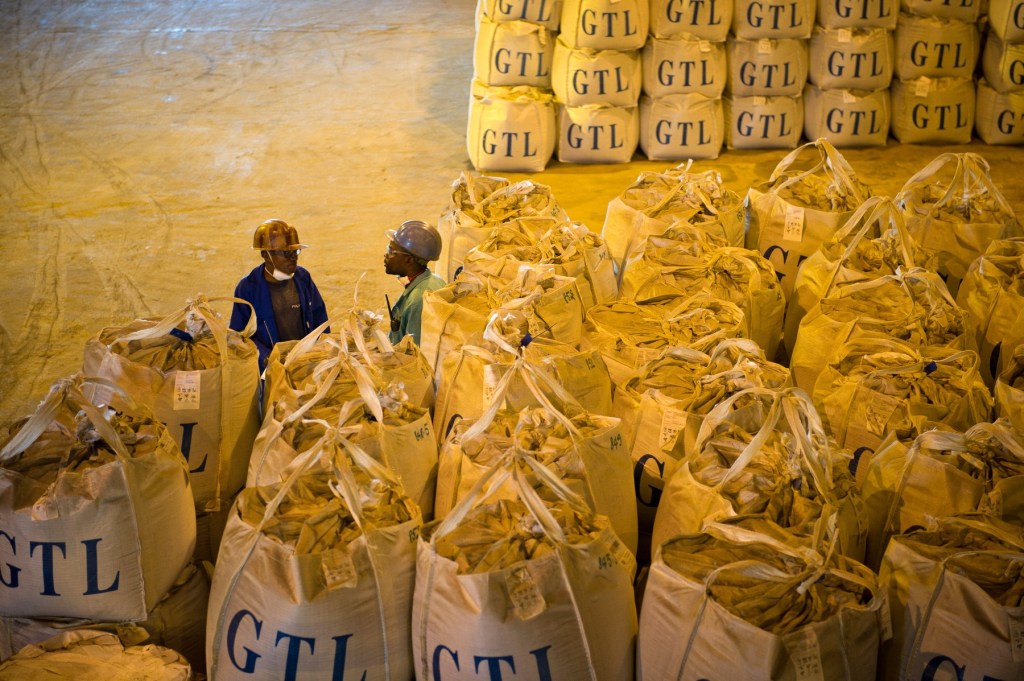
China versus the West in Africa
The contrast in how capital is mobilized remains strong.
U.S. company KoBold Metals told Reuters it has concessions for more than 3,000 square kilometers in the lithium and copper belt, but will not advance projects that are involved in litigation because of its corporate governance standards.
Chinese operators, on the other hand, continued to advance in contested terrain, consolidating their speed advantage in market entry.
At Manono, one of the world's largest untapped lithium deposits, KoBold says it will not move forward until ownership issues are resolved, while Chinese rivals Zijin develop infrastructure on the northern block.
If it gets the southern block without litigation, KoBold says production could begin within three years.
In Guinea, the China-backed Winning Consortium Simandou has pushed ahead with construction of a railway and port at the huge Simandou field despite ownership disputes, effectively forcing the British-Australian company Rio Tinto into line.