Is China actively testing nuclear weapons? “They hid it from the world”


The American politician's announcement is a consequence of the expiration of the New START treaty, which limits the number of deployed nuclear warheads of the United States and Russia. DiNanno notes that the provisions of this 2010 agreement are outdated today, as we have a country that was not covered by the treaty and is constantly expanding its nuclear potential.
This is of course about China. It is no secret that the Middle Kingdom is actively developing its nuclear capabilities and, as the American politician claims, it is also doing it using real tests.
The surprising philosophy of the authorities in Beijing
While the Soviet Union was very active in building weapons of mass destruction and undertook such efforts immediately after the end of World War II, the Chinese authorities were initially more skeptical about the new technology. Mao Zedong (chairman of the Communist Party of China from 1943 to 1976) called it a “paper tiger” and claimed that wars were won with people, not even with such a terrifying and destructive arsenal as nuclear weapons.
It was only a few years later, in 1954, that Beijing changed its approach. According to some historians, the spark that initiated the Chinese nuclear weapons program was the first crisis in the Taiwan Strait in 1954-1955 (a short armed conflict between China and Taiwan), or more precisely, American President Dwight Eisenhower's threats against the Middle Kingdom. The decisions of the White House to deploy nuclear weapons on the island of Guam in 1951 and in Japan in 1954 could also have been important.
>> See also: How the Chinese atomic bomb was created. A fascinating story that few people know
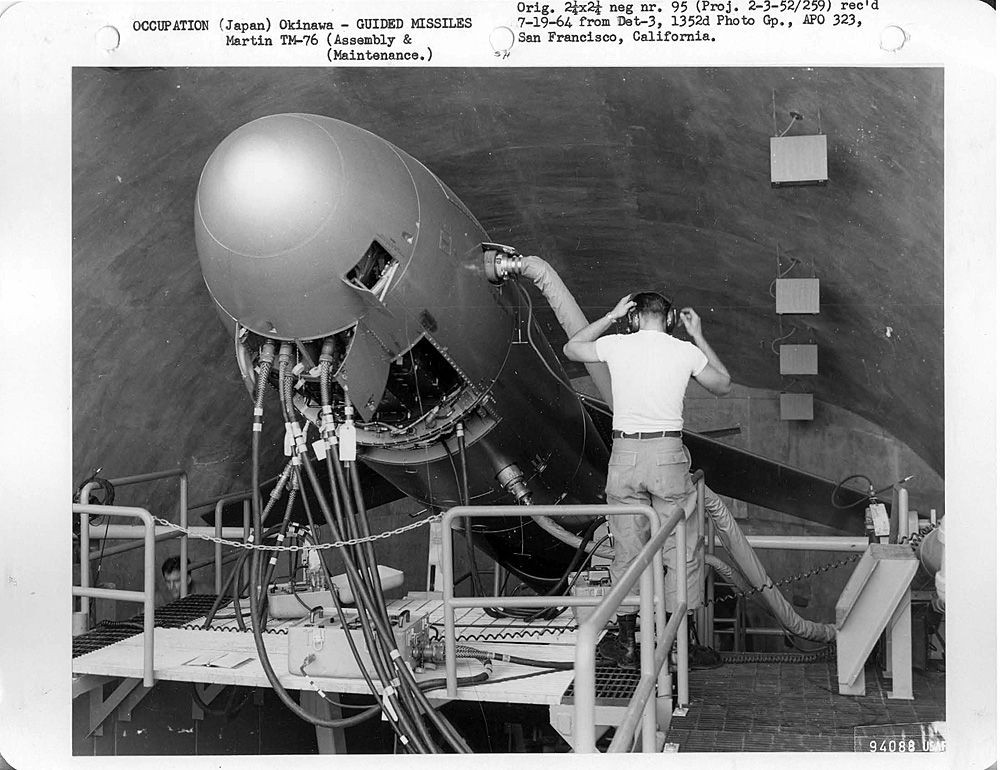
The photo shows American technicians working on the American Mace-B missile in OkinawaPublic domain
Officially, the Chinese program started in January 1955 and from the very beginning it was developed in close cooperation with the Soviet Union. This initiative accelerated two years later, in 1957, when the position of Russian leader Nikita Khrushchev was undermined by an attempt by a Prostlinist group within the party to seize power. Seeking to strengthen his position, Khrushchev asked the authorities in Beijing for political support. He received it in exchange for signing a treaty that assumed the transfer of nuclear technology from the USSR to China – including a model of the Soviet atomic bomb and two R-2 short-range ballistic missiles.
However, nuclear cooperation between the USSR and China did not last long. Starting from 1956 and Khrushchev's famous speech in which he distanced himself from Stalin's policy on the Moscow-Beijing line there were increasing political frictions. They were caused by, among others: a Russian attempt to warm up relations with the United States, which Mao Zedong strongly displeased.
This ideological and political crisis was further deepened by the second crisis in the Taiwan Strait in 1959, and in the same year the Soviet Union stopped implementing the provisions of the treaty signed two years earlier regarding cooperation in the construction of Chinese nuclear weapons. As part of it, Russian scientists held only one lecture in China on such weapons, and in June 1959, Moscow officially withdrew from the previous agreements. A year later, there were no Russian engineers working on this program in China.
China is going its own way
Starting in June 1959, China began building an atomic bomb on its own and just a few months later they managed to achieve the so-called reverse engineering on the model of the 1951 Soviet atomic bomb, which Moscow gave to China in 1958. Interestingly, in mid-1961, voices appeared within the Chinese authorities calling for the cancellation of the entire program and the transfer of its resources to the production of conventional weapons. Ultimately, however, the votes to continue the work, supported by Mao himself, won, and the entire program received even greater priority and even greater resources to implement it as quickly as possible.
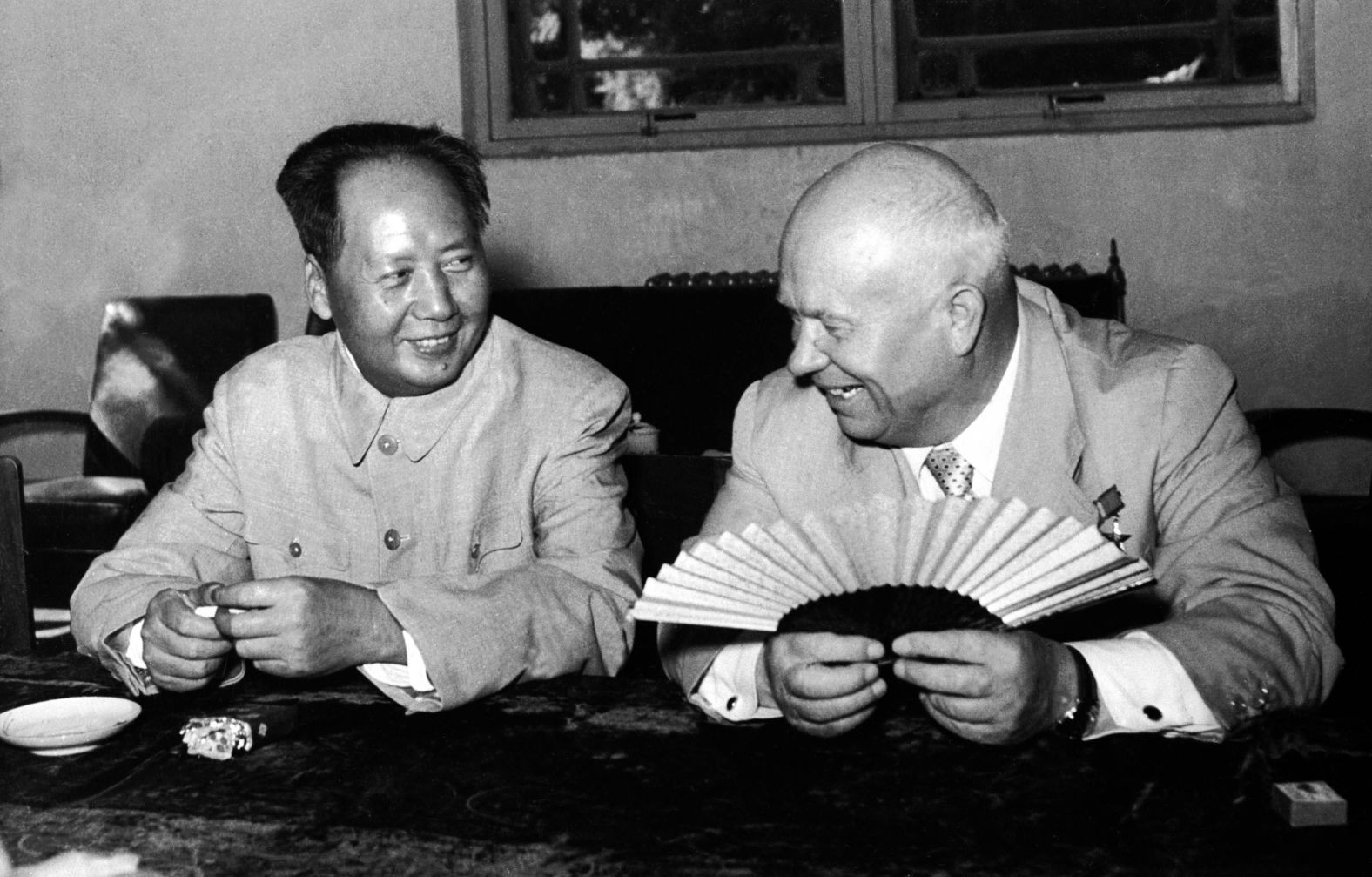
Mao Zedong and Nikita Khrushchev in a 1958 photo.Public domain
Of course, Chinese work on nuclear weapons has not escaped the attention of the Americans. According to William Foster, one of the American high-ranking politicians of that period, the Kennedy administration was considering a surgical strike against Beijing's nuclear program. Various options were considered, including cooperation with Taiwan and even the Soviet Union, but Moscow was reportedly not interested in such cooperation. Information about the White House's plans also reached Beijing, where they began to consider delaying the first atomic bomb test, which was then only a matter of time. Ultimately, however, in September 1964, Mao Zedong decided that delaying the test was not in China's interests.
The purpose of the atomic bomb is to scare others (…). If we're going to scare people with it, it's better to show it as soon as possible.
China's first nuclear bomb testnamed 596 after part of the date of the launch of China's independent nuclear program in June 1959, took place on October 16, 1964, and thus the Middle Kingdom officially became the fifth country in the world to have such technology.
Just a dozen or so months later, Chinese engineers also developed the Teller-Ulam scheme, allowing the production of thermonuclear charges, and in May 1966, the first test of this type of weapon with a power of 120 KT was carried out. China managed to switch from an atomic bomb to a thermonuclear (hydrogen) bomb in less than two years, which is a record in the history of work on this type of arsenal. For comparison, it took the Americans over 7 years.
The first test of a Chinese hydrogen bomb with a power counted in megatons. June 1967:
China is one step away from nuclear defeat
Just a few years after the first nuclear weapons test, the Middle Kingdom was almost forced to use its new technology in real combat conditions. In 1969, there was a serious border conflict between China and the Soviet Union, which led to such a major crisis between Moscow and Beijing that the authorities in Moscow were close to ordering a massive nuclear strike on China's largest cities and facilities related to its nuclear program. On August 20, 1969, a meeting between the Russian ambassador and Henry Kissinger reportedly took place, during which the United States was informed about preparations for this type of operation.
>> See also: Russia is quietly building the fleet of the future. The Americans were far behind
According to Chinese intelligence, the Russians were to be attacked on October 20, and the situation was so serious that the evacuation of the authorities from Beijing began on October 14. Evacuation orders were also issued for thousands of Chinese planes, hundreds of ships and almost a million Chinese soldiers. Ultimately, however, it ended in fear, among others. thanks to the intervention of President Richard Nixon. On October 15, Moscow was informed that China is under the US nuclear umbrella and in the event of an attack, it will respond with a nuclear strike on 130 Russian cities.
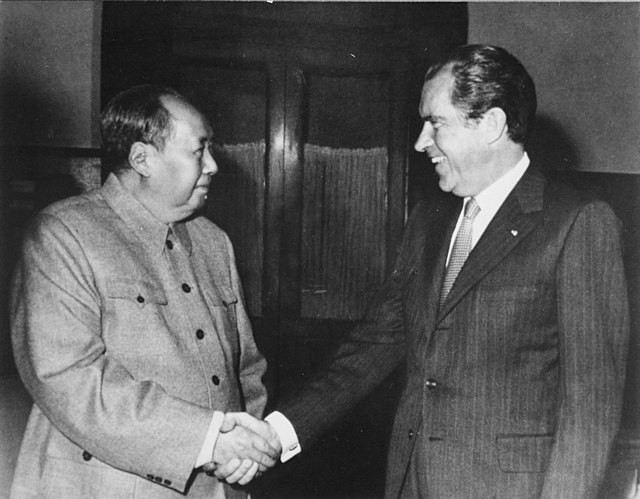
Chinese leader Mao Zedong and US President Richard Nixon in Beijing, February 1972.The White House / Wikimedia Commons
The reaction of the Americans meant that China and Russia soon resumed diplomatic talks, which ended with a reduction in the combat readiness of Russian troops in early 1970. The conflict also contributed to the initiative to build nuclear shelters in China, including the so-called The Underground City near Beijing – a huge tunnel complex that was worked on until 1979. In 2000, part of it even became a tourist attraction.
Another interesting fact related to the Chinese nuclear weapons program, which is somehow related to the reports of Thomas G. DiNanno, is the fact that the country has conducted only 47 official tests of weapons of mass destruction. For comparison, the Americans conducted over a thousand such tests and the Russians over 700, including the test of the largest nuclear charge in history, the so-called Tsar's bomb. Beijing has a relatively modest database of data collected during its tests, so it is not surprising that the Chinese authorities are very interested in conducting further tests, based on which they could develop their nuclear potential even faster. Experts also say clearly – it is China that would have the most to gain if the United States and Russia returned to real nuclear tests.
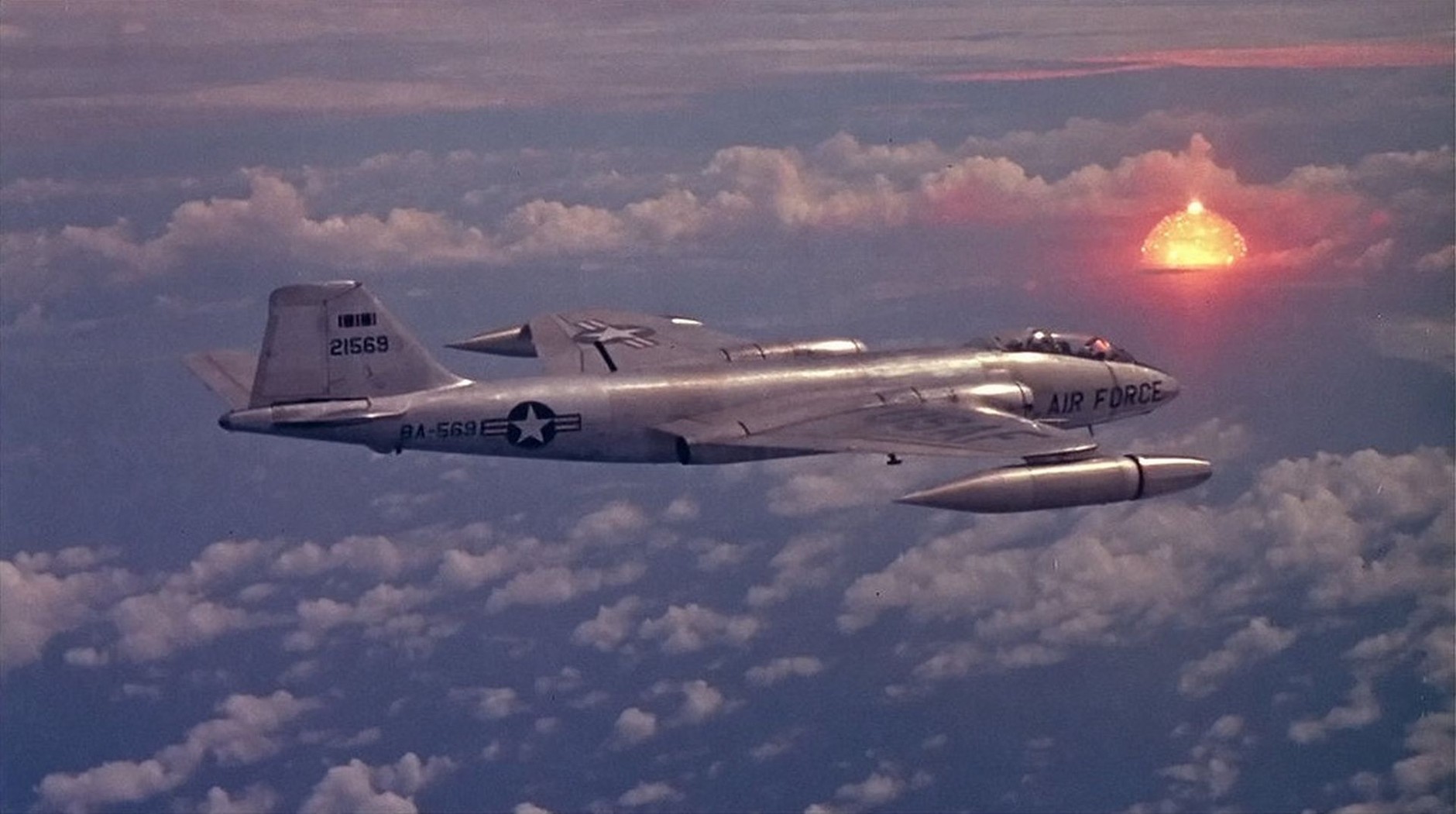
A US bomber during Operation Hardtack I nuclear testsPublic Domain/US Federal Government
Regarding the statement of the American undersecretary, it is worth explaining what the decoupling method is, which the Chinese allegedly used to hide the 2020 test. It involves detonating a nuclear charge in a large underground chamber, thanks to which the shock wave of the explosion is dampened by the free space around the charge. Under ideal conditions, the seismic signature of such an explosion, typically a few kilotons at most, can be reduced by 30 to as much as 100 times compared to a normal underground nuclear weapons test.
>> See also: China is close to building a “nuclear triad”, the US is concerned
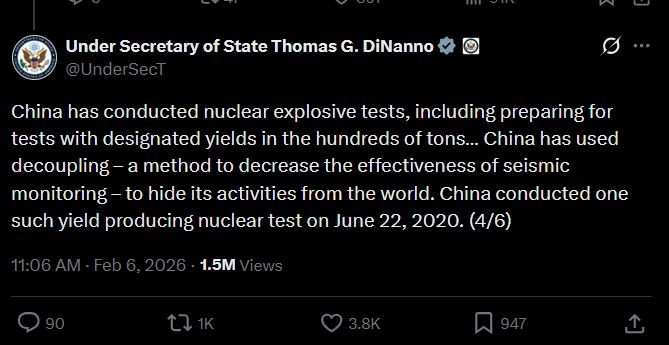
China is actively testing nuclear weapons, US authorities reportX/Under Secretary of State Thomas G. DiNanno
From what we know, China currently has approximately 600 thermonuclear warheads. According to experts, by 2035 this number may increase to up to 1,500 warheads.