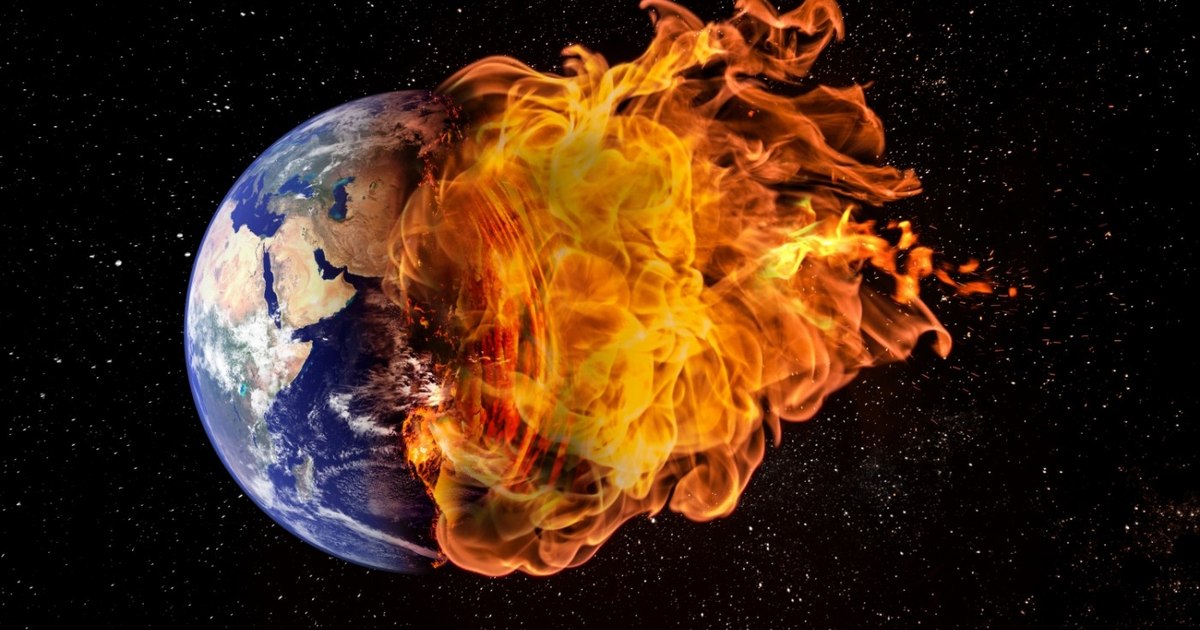
Meteorological agencies and climate scientists have indicated the possibility of an El Nino phenomenon forming in the Pacific Ocean later this year – a phenomenon that could cause global temperatures to rise to record levels in 2027.
Global warming PHOTO: Shutterstock
The cycle of ocean temperatures in the Pacific – known as the El Nino Southern Oscillation (ENSO) – is linked to extreme climate events around the world. El Nino occurs when warmer-than-average waters gather in the eastern equatorial Pacific and extend to the coast of the American continent.
The phenomenon tends to increase global temperatures and in Australia may be associated with drier and warmer conditions. Both the US government's National Oceanic and Atmospheric Administration (NOAA) and Australia's Bureau of Meteorology have said some climate models are predicting an El Nino phenomenon this year, but both warned that these results are accompanied by uncertainties, The Guardian writes.
The Australian bureau's latest Southern Hemisphere forecast said “some models suggest the possibility of El Nino beginning in June”. The bureau warned that this is a “very long term” for predicting such a phenomenon.
Dr Andrew Watkins, a climatologist at Monash University and former head of the bureau's long-range forecasting department, said: “We have a large amount of warm water built up in the western tropical Pacific.
Typically, when the trade winds weaken, it will flow eastward and warm areas off South America. The models predict this will happen in the Australian autumn, which is quite common.” He said the “precursors are there” for an El Nino, but it was too early to say whether the phenomenon would develop.
“Like flipping a coin”
Associate Professor Andrea Taschetto, an ENSO expert at the University of New South Wales, said the current La Nina phenomenon – where warmer waters are closer to Australia – was coming to an end and it was difficult to make predictions beyond this point. She said the odds of El Nino developing or ENSO being neutral between June and August are currently about 50/50, or “like flipping a coin.”
The past three years have each been among the three warmest years ever recorded on the planet. Dr. Zeke Hausfather, a research scientist at the US-based independent research group Berkeley Earth, said the El Nino phenomenon, which formed in mid-2023 and lasted until April 2024, likely contributed about 0.12 degrees Celsius to the increase in global temperatures in 2024.
“If El Nino develops later this year, it is likely to peak between November and January and will primarily impact global surface temperatures in 2027 rather than 2026. We therefore forecast that 2027 will likely set a new global temperature record if a moderate to strong El Nino develops.”
Watkins agreed that if El Niño develops, it will have a stronger impact on global temperatures in 2027.
“I would hesitate to bet against the hottest year on record” he said. Watkins stated that global warming caused primarily by the burning of fossil fuels is now “so strong” so that “it simply overcomes the year-to-year variability in air temperature.”
“I don't think we're surprised by anything anymore”he said. “It may not take a strong El Nino to get these higher temperatures.”