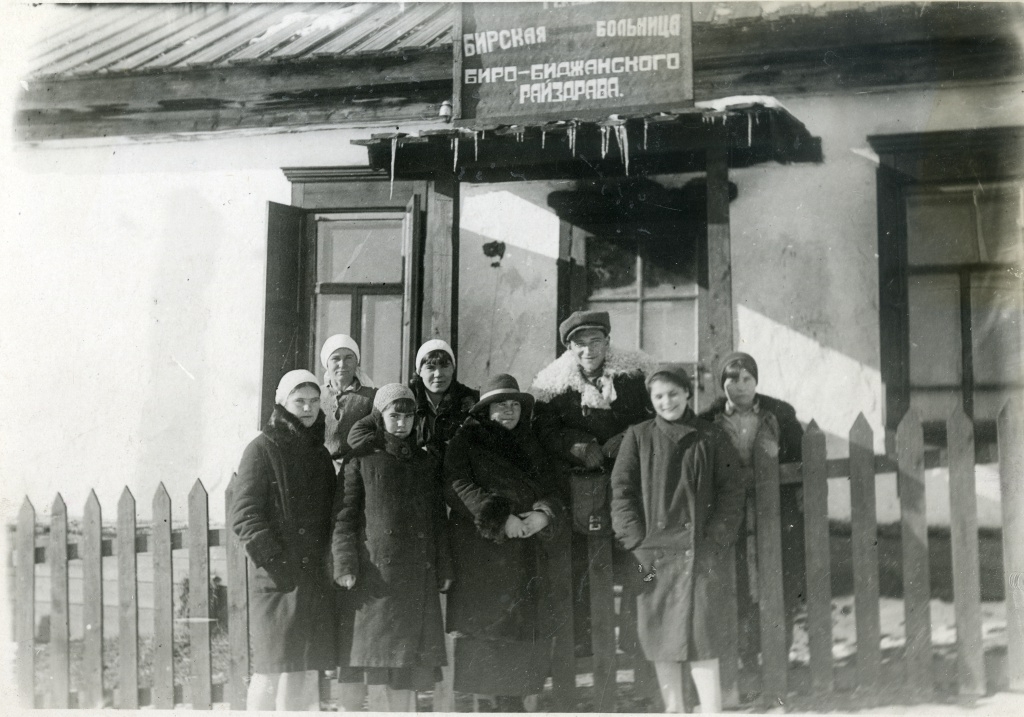
Hospital. Art. Bira. Early 1930s
Photo: Heritage JAO
January 29, 1939
The newspaper “Birobidzhan Star” (12+) published a thematic selection of articles “For the exemplary work of medical institutions”: doctors of Birobidzhan on some health issues.”

The head physician of the city hospital, I. Babkin, writes about the insufficient organization of advanced training for doctors.
“Soviet medicine has achieved unprecedented successes during the years of Soviet power. These successes are increasing and growing every day. Science is moving forward, and the doctor has no right to lag behind. He is obliged to study, improve his qualifications, because without this he risks turning into Chekhov’s paramedic,” the author emphasizes.
I. Babkin notes that: “There are many ways to improve your qualifications: daily work on yourself, reading the latest medical literature, participation in scientific medical meetings, conferences, practical work in clinics and hospitals and, finally, advanced training courses for doctors, which are widely practiced in our country.”

Resettlement paramedic station. Tikhonkaya station. Photo: Photo: Heritage EAO
Birobidzhan doctors are sent to advanced training courses, but all other ways to improve their qualifications are not used.
“The whole trouble is that the Union of Medical Workers and the Bureau of the Medical Section did not sufficiently address the issues of advanced training of doctors, did not organize scientific meetings, conferences, lectures, and reports on specialties.”
The head physician of the city hospital, I. Babkin, proposes to begin systematically reading reports on medical topics for doctors. Noting that: “We have the conditions for improving the qualifications of doctors; we only need the interest of the doctors themselves and the strong leadership of the city health department.”
The same topic is raised by doctors from the city clinic Zaprudnaya and Aramzon in the article “They are not helping us study.”
“Highly qualified specialists work in the Birobidzhan hospital. They work with us temporarily, but the city health and regional health care do not use their stay here for training, to improve the skills of young doctors.”
Doctors of the city clinic are appealing to the regional health department with a request to provide the clinic doctors with the opportunity to work in the city hospital and to send experienced hospital specialists for outpatient appointments at the clinic. This way young doctors could improve their skills.
I. Veresov and A. Zalivnoy write about the working conditions of the city clinic in the article “We need a new clinic.”
“The construction of medical institutions here in Birobidzhan still lags far behind the growth of the city and its population. The fact that the city, in fact, does not have a clinic suggests that the city council, regional executive committee and health departments have not raised this issue urgently enough with higher-level organizations.
The city clinic has been housed in an old, small, cramped wooden barracks for several years now. But is it possible to compare the population of the city now with what it was 5-6 years ago? If in 1933 the clinic with four doctors served 80 patients a day, now with 12 doctors it serves 360-380 patients a day, and the building has not changed.
Due to the lack of premises, some specialists are seen in one office at the same time (an ophthalmologist and a therapist), and another doctor works in the same office from 3 o’clock in the afternoon. All medical procedures are performed in the surgical room, which, of course, interferes with the surgeon’s work…”
The authors give many more arguments, proving that this premises cannot meet the demands of medical care in a rapidly growing city.
“The regional executive committee needs to raise the issue with the government about appropriating funds for the construction of a clinic, or opening another outpatient clinic in the city in one of the new buildings of the regional health department.”
Ts. Gatova and doctor M. Zaprudnaya also wrote about problems in the work of the city clinic: inappropriate premises, poor conditions for serving patients, and a lack of qualified personnel.
Doctor M. Zaprudnaya, in her note “There are no conditions for a surgeon to work,” is concerned that the surgeon’s office is completely unsuitable for its purpose, and the management of the clinic is not making efforts to eliminate the shortcomings in providing surgical care to the population.
“In the dressing room, all procedures are carried out simultaneously with the dressings: cupping, injections, temperature measurement, etc. There is no changing room, and patients enter the dressing room in a coat. In addition to all this, the dressing room is insufficiently equipped: there are no necessary surgical instruments, equipment and equipment for sterilizing the dressing material.”
In the note “Attentive to the sick,” Ts. Gatova, in addition to the shortcomings of the premises and the surgical room, emphasizes that “… many city residents complain about home care. Often doctors arrive only a few days after the call.”
“Looking closely at the work of the city clinic, you become convinced how little attention the city health workers pay to the organization of medical care for the population.”
January 29, 1947
The plenum of the Leninsky District Committee of the All-Union Communist Party (Bolsheviks) discussed the issue of preparations for the elections to the Supreme Soviet of the RSFSR and obliged the primary party organizations to more widely deploy mass agitation work among the workers, aimed at the organized conduct of elections, the successful implementation of the tasks of the second year of the five-year plan by the workers of the region.