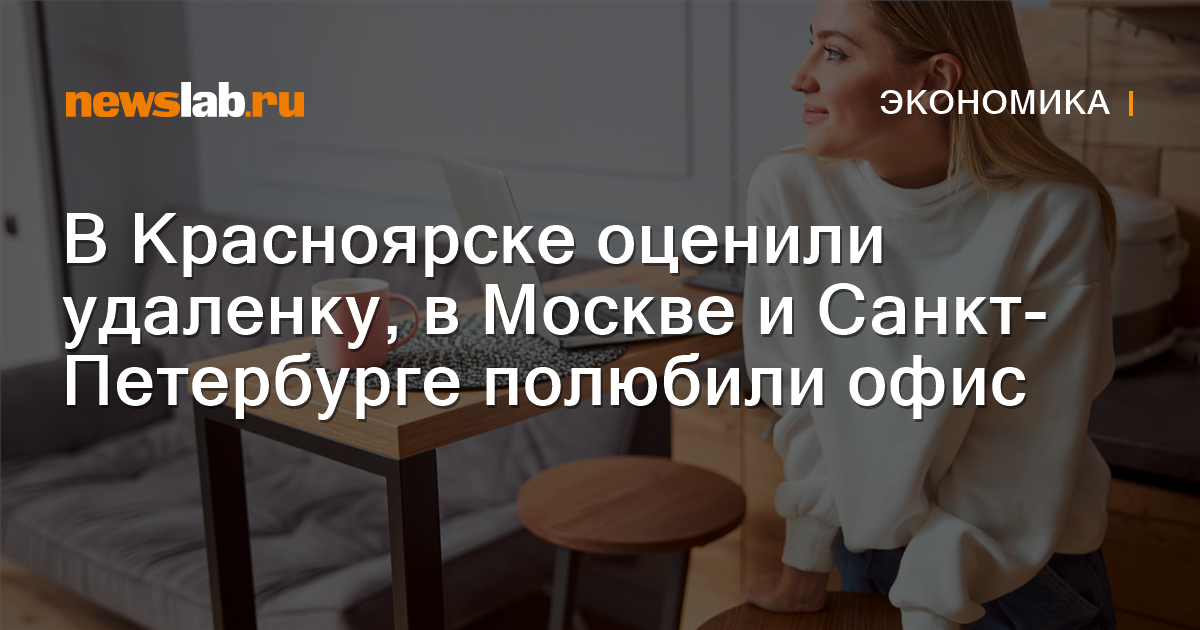
In Krasnoyarsk they appreciated remote work, in Moscow and St. Petersburg they fell in love with the office

May 20 10:00
T2, a Russian mobile operator, analyzed the labor mobility of Russians in 15 million-plus cities and recorded changing patterns. In the regions, the remote format has become more actively used, while residents of the two capitals, on the contrary, are increasingly returning to the office. Krasnoyarsk is among the cities with high demand for remote work: 49.4% of T2 subscribers work from home.
Almost half of the observed audience uses the remote format: the share of such workers in cities with a population of over a million is on average 49.2%. Big data T2 specialists have identified new patterns in the working life of Russians.
Until recently, remote work and a hybrid work format belonged to Moscow and St. Petersburg, but the trend has reversed. In the regions, the use of remote work has become more active; their residents are significantly ahead of Moscow and St. Petersburg in terms of penetration of the format. It can be assumed that the situation on the labor market and fatigue from remote work lead to the fact that employees in the capitals are more likely to agree to work in the office.
Working from home is most popular in the regions: in Nizhny Novgorod – 59%, Krasnodar – 56%, Omsk – 55.5%, Samara – 54%, Rostov-on-Don – 53.3%. In the capitals the situation is different. In Moscow, the share of remote workers is 41%, in St. Petersburg – 39%.
In Krasnoyarsk, the remote work format is firmly established – it was chosen by 49.4% of T2 subscribers. Another 17.6% work close to home, less than 1 km away, 12.7% work within 1–5 km, and 20.3% travel further than 5 km.
Labor mobility varies not only between cities, but also across generations. The core of remote workers is extensive and covers people from 25 to 54 years old. At the same time, it is young people who show their readiness not only to work from the office, but to cross long distances to do so. Workers aged 25-34 are the most mobile – their share is 28% daily. This is due not only to a compromise in favor of work that meets expectations, but also to a liking for the office – as an increasingly comfortable space that allows you to communicate with colleagues and sometimes solve problems faster. Representatives of other age categories more often choose to work closer to home.
Advertising. T2 MOBILE LLC. erid: 2VfnxxicSg2