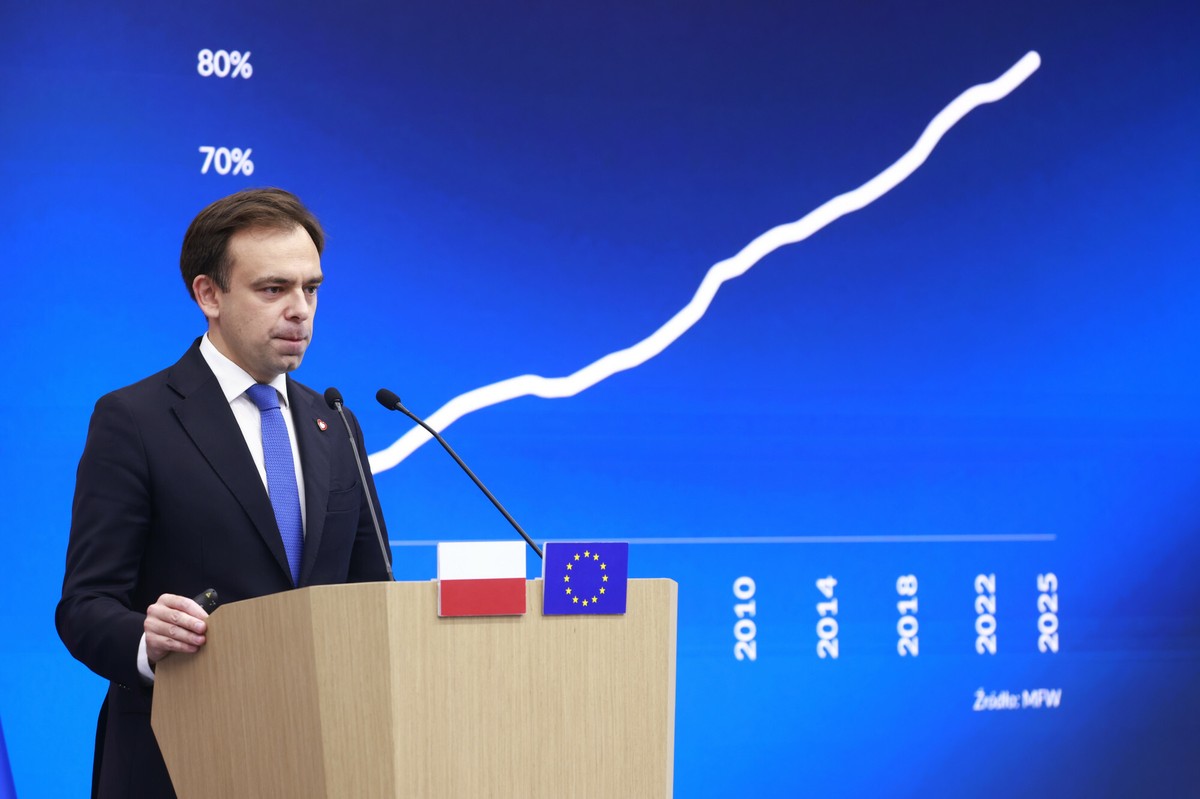
23 percent borrowing needs have already been met, but in the previous five years at the beginning of the year it was 37 percent. But this time, as much as PLN 690 billion will be available for borrowing on the market. We have recently heard about planned bond issues in dollars and euros, but the safest debt for the stability of the economy and currency is the one incurred in the native currency, i.e. in zloty. The Ministry decided to make the offer more attractive for individual buyers.
Inflation dropped quite quickly last year, so in line with this trend, the ministry gradually lowered interest rates. Effect? Bond sales dropped. Some buyers apparently found the interest rates no longer attractive. Throughout last year managed to sell savings bonds for PLN 74.9 billion compared to PLN 82.6 billion a year earlier. In the last two months of 2025, demand amounted to PLN 5.1-5.3 billion. It's not enough. The government needs even more money.
“Attractive interest rates”
As a result, the interest rate on savings bonds offered for sale in February it will remain unchanged – reported the Ministry of Finance.
“In February, the interest rate on 1-year floating-interest bonds will be 4.25% and 2-year floating-rate bonds will be 4.40% in the first monthly interest period. The interest rate on 3-month fixed-rate bonds will be 2.50% per annum and 3-year bonds will be 4.65%. The remaining bonds, in the first annual interest period, will bear interest as follows: 5.00 percent 4-year and 5.60 percent 6- and 12-year family bonds intended for beneficiaries of the Family 800 plus program will bear interest at 5.20 percent and 5.85 percent, respectively.
“We also leave bond margins at unchanged, attractive level“- added the ministry.
Interest depends on rates
The interest rate on 1-year and 2-year bonds is determined monthly and is calculated as the sum of the reference rate of the National Bank of Poland and the margin. In the case of instruments offered in February, it is: 0.00%. for 1-year bonds and 0.15 percent for 2-year-olds.
Currently, the reference rate is 4%. and the Monetary Policy Council did not decide to reduce it at the January meeting, although inflation dropped significantly to 2.4% and core inflation to 2.7%.
Interest linked to inflation
The interest rate on 4-year bonds changes every year and is calculated on the basis of the sum of the inflation rate from the last 12 months and an unchanged margin of 1.50%. The same interest rate mechanism also applies to 10-year bonds, but in this case the margin remains unchanged at 2.00%.
They also remain unchanged preferential margins for family bondsthe interest rate of which is calculated according to the same principles as in the case of 4- and 10-year bonds and amounts to: 2.00 percent, respectively. for 6-year bonds and 2.50 percent for 12-year-olds, it was recalled.
— We continue to keep retail bond rates unchanged in February. This means you can continue to safely multiply your savings on attractive terms. Treasury Bonds are a savings product that is understandable and intuitive. The equivalent of PLN 100 is enough to buy bonds and start practically using their advantages. We choose a bond from the available offer, pay the amount we want to save and our money starts earning money, said Deputy Minister Jurand Drop, quoted in the material.
From January 27, you can purchase a new issue of treasury bonds by way of exchange. Holders of bonds redeemed in February can take advantage of the option of automatic exchange of redemption proceeds for new bonds. In exchange, the purchase takes place at a lower price, thanks to which it is possible to obtain additional profit – new bonds are purchased for PLN 99.90 per unit (except for 3-month OTS bonds). The price difference is an additional profit, it was also stated.