Electricity prices will no longer be frozen – from the new year, we will pay market rates for electricity, although, as part of regulated tariffs, they will still be approved by the President of the Energy Regulatory Office. The decision has already been announced. Market observers and decision-makers, including at the government level, have long hoped that prices would be below the current freezing threshold, i.e. PLN 500 per megawatt hour. After liberalizing prices, consumers would not experience a cost shock.
And so it happened. As announced by the President of the Energy Regulatory Office, Renata Mroczek, The average price in electricity tariffs will be PLN 495 per MWh net from January 1. For households benefiting from a frozen energy price, this means a drop of 1%.
The new tariffs entered into force on January 1, 2026.
The rest of the article is below the video:
However, the world does not end with regulated tariffs. At least some consumers may benefit from dynamic prices, especially if they concerned not only the sale of energy, but also its distribution. The matter is analyzed in a new publication by Forum Energii.
Read also: Faster return, greater savings: what does investing in photovoltaics really look like?
Dynamic tariffs support the system
Energy sellers are obliged to offer dynamic tariffs from August 2024. The assumption is simple – electricity prices change every hour (and in the future even every 15 minutes), depending on the current situation on the wholesale energy market.
To put it simply, when there is a lot of energy and comes from cheap renewable sources, consumers can save a lot (in the case of negative prices – even make money). However, when demand increases and electricity becomes more expensive on the exchange, prices go up.
Dynamic tariffs therefore reward flexibility in consumption, which supports an electricity system with a large number of uncontrollable weather-dependent sources.
Shifting energy consumption to cheaper hours helps balance demand and supply, relieves the grid and peak sources (operating at the highest demand) and prevents wasting green electricity from renewable energy installations. Today, the flexibility promoted by dynamic tariffs is one of the key directions of energy transformation.
According to Forum Energii experts, the current benefits of such solutions for consumers – those who actually have the opportunity to manage their energy consumption – are not sufficient.
The savings could be much greater if not only energy prices but also their distribution changed dynamically. The cost of electricity itself is only slightly over 40%. our bills – the rest is covered by its delivery and other fees included in distribution tariffs.
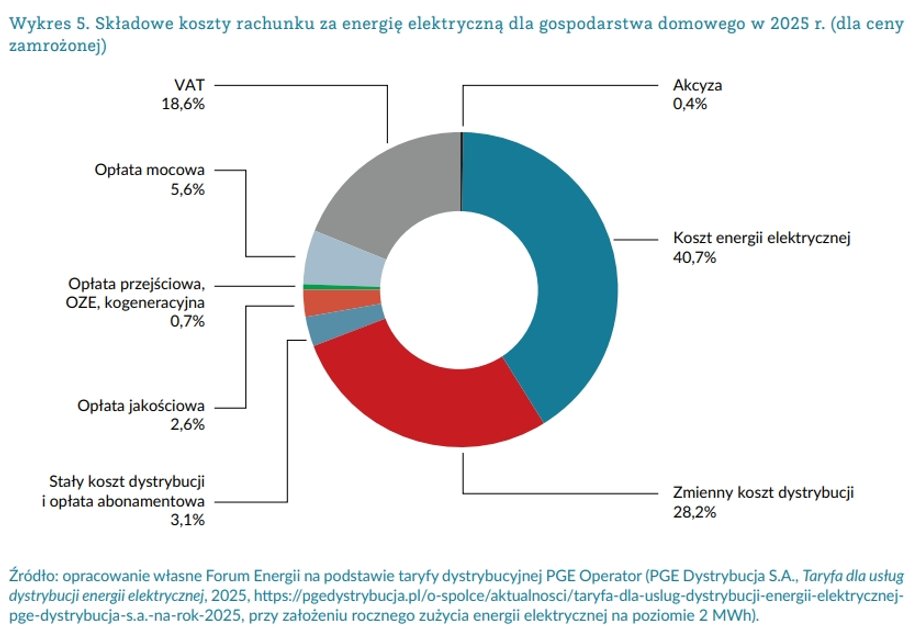
Structure of electricity bills
|
Energy Forum / Energy Forum
Over 40 percent possible savings
As we read in the report, the combination of dynamic energy prices and distribution could reduce annual expenses by over 40%.
The authors therefore recommend introducing the obligation for distribution system operators to offer dynamic tariffs. In turn, energy sellers would have to enable their customers to combine both types of dynamic tariffs. Today it is impossible to use both at the same time.
It is worth remembering that dynamic tariffs already differ from each other – individual sellers have different offers, which may be more profitable for some customers and less for others. The key factor is the energy consumption profile, whether a given household has energy-intensive devices such as heat pumps and when they are charged.
Read also: How to change your energy supplier? It's simpler than it seems
Software helps
To actually make a profit, automatic consumption management is essential. It is true that, as experts write, “a completely free way to increase the benefits of dynamic prices is to change habits” (e.g. washing and washing dishes during the day, not in the evening), in the long run, the matter is made much easier by intelligent software.
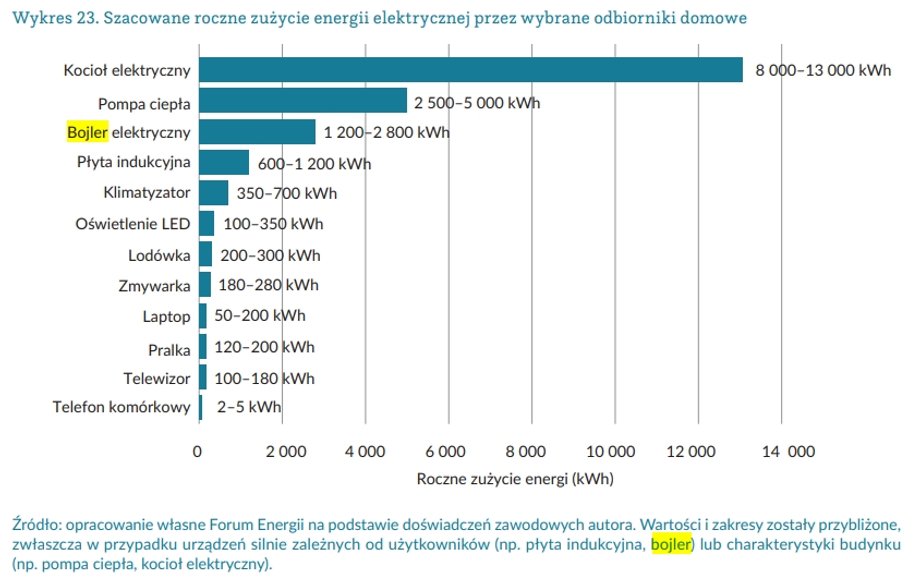
Power consumption of home appliances
|
Energy Forum / Energy Forum
It's not just about complex systems that manage energy consumption at the entire home level; sometimes, appropriate settings of specific equipment, such as washing machines and dishwashers, are enough. “End recipients should not waste time on continuous monitoring of the stock exchange situation and making decisions,” write the authors of the report. Dynamic tariffs do not have to mean constant bustle about electricity – we all have more urgent matters.
Maximum prices protect customers
The greatest risk in dynamic tariffs are price increases – during stock market spikes, the recipients covered by them pay much more than those covered by a flat price under a regulated tariff.
Such a perspective may have a discouraging effect, which is why the Energy Forum suggests a solution that is increasingly raised in the debate – a price maximum or a limit on average costs on the bill (energy costs and its distribution).
At the same time, dynamic tariffs with an upper limit would be the default solution offered to customers who could possibly choose a flat tariff. The logic of the system would be reversed – today dynamic tariffs are a curiosity for those interested, not a matter of course.
The profitability of tariffs would also be increased if all sellers guaranteed access to negative prices, when there is so much energy that its producers pay consumers for consumption. This opportunity to earn money is one of the most attractive elements of dynamic tariffs, but today not all trading companies allow it.
Tariffs only for selected devices
Many expert recommendations also concern support for specific technologies, e.g. energy storage, which allows it to be resold to the grid by prosumers. Today, this can only be done if you have your own photovoltaic micro-installation, while home storage without them would also be useful for the system at times of greatest demand. Therefore, experts recommend granting subsidies also for warehouses without photovoltaics.
Another technology needed, according to the Energy Forum, to popularize dynamic tariffs are submeters that measure the consumption of individual devices. Submetering would allow such contracts to be concluded only for specific equipment that makes it profitable, such as heat pumps or electric car chargers. They would be covered by dynamic prices, while the rest of the household electricity consumers – a refrigerator or a router – would remain in a flat tariff.
“This way, users would not have to be forced to change all their habits, but at the same time it would be possible to build flexibility in the system“- experts argue.
Distribution system operators should provide customers with full data on their consumption.
Dynamic tariffs may also be encouraged by appropriately set subscription fees and competition between sellers. The authors of the report write that the market game should also take place outside the areas coinciding with the distribution of given entities – for example, Tauron should also offer its dynamic tariffs in the areas of PGE or Enea distribution companies. Consumers will be helped to make optimal decisions by an efficient offer comparison service from the Energy Regulatory Office, preferably in the form of a transparent application.