The school of humanity from a neighborhood at the end of Romania. How teachers managed to give special needs children a chance at education


A school in the extreme north of Romania offers a lesson in humanity and empathy in society. For almost two decades, the “Sfânta Maria” School in the municipality of Botoșani, a mass education unit, has been successfully integrating numerous children with special educational requirements.
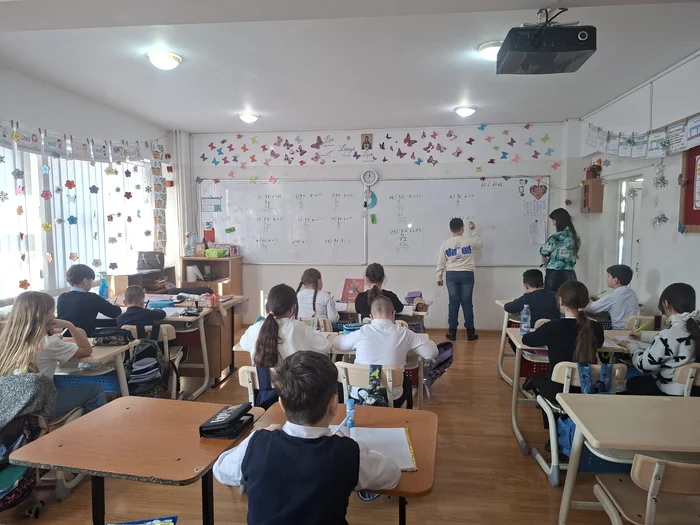
“Sfânta Maria” school offers a chance for education to all children PHOTO Cosmin Zamfirache
In Romania, there are over 100,000 children with Special Educational Needs (SEC), i.e. disorders on the autistic spectrum, Down Syndrome and other disorders. About 55,000 of them are integrated into mainstream education, a real challenge for both children and their parents, as well as for teachers. According to the data provided by Help Autism, 1 in 4 children with autism do not go to kindergarten or school, even though they are of the required age. “In 2021 alone, 3,000 students dropped out of school, studying at home”say those from helpautism.ro.
The challenges consist both in the attitude of some parents of typical children, who do not see with good eyes the integration of a child with autism, for example, in a mainstream school, often considering that the learning process in the classroom could be made more difficult, but also in the light of the fact that the Romanian education system is not sufficiently prepared to integrate and offer equal opportunities to these children in education. Support teachers are a rarity in many counties or non-existent in rural areas.
Students with SEN are in some cases marginalised, albeit subtly. The lack of specific educational means and pressure from other parents often fall on the shoulders of teachers and teachers, who end up being overwhelmed by the situation. That is precisely why many families of children with CES go through a real emotional ordeal and sometimes give up on integration. But there are also schools where humanity and empathy manage to overcome all shortcomings and offer these children a real chance for education and integration. One of these is the “Sfânta Maria” Secondary School in the municipality of Botoșani, where children with CES are welcomed, helped and integrated with sustained efforts by the teachers. The teachers' approach served as a lesson in humanity for the other students, who learned to help, protect and accept them.
The neighborhood school where all children receive an equal chance at education
“Sfânta Maria” secondary school, or School number 16 as it is also known, is an educational unit in a border neighborhood of Botoșani municipality. It was established in 1989, in the last months of the communist regime, to serve the working-class neighborhoods on the outskirts of the city. For a long time, it kept its status as a border school and in 2014 it was one step away from losing its legal personality and becoming just a structure of another school.
It was saved through the intervention of parents' groups and the school was reborn through investments, new educational approaches and the integrative character. Many children with autism or Down Syndrome from the municipality of Botoșani or with integration problems in mainstream schools have found a hopeless chance at the neighborhood school on the outskirts of the city. They were received, accepted, understood and helped to overcome many challenges of a society and an educational system unprepared for such a situation. In addition, the school was able to secure funding for important equipment, from new school furniture to modern teaching technologies.
“We went more on the principle of humanity”
Children with special educational needs were received here even if they were not assigned to that school, i.e. they came from other areas of the city. The school had become famous for the experience it had with these children and for the empathy and outstanding results of the teaching staff. This is how it ended up that in many classes the number of three students with CES, imposed today by the new legislative provisions of Education, was exceeded.
“Years in a row, you know that we went more on this principle of humanity. There were many times when we received students who were not part of our school district. The law before did not impose the maximum number of children with CES in each class, and then we said let's do a good thing for these parents, humanitarian speaking. Let's give a chance, first of all, to the children and then to the parents so that they don't feel marginalized. In addition, we were known for the experience we had with children with CES, because we have been educating these children for years.”says Carmen Bădărău, director of “Sfânta Maria” Botoșani Secondary School. Children with CES are helped to learn according to their needs, to integrate in the classroom, to feel loved and understood. The subjects are taught in such a way as to meet the needs of typical children as well as, differentiated, those with CES.
“Parents should often learn from children”
Through the attitude of the teachers the children in the class learn the precious lesson of empathy. Learn to live with it, to accept it. In many cases, children with special educational needs are taken care of by other children: they help them put their things in their schoolbags, make sure they don't forget anything or help them with their lessons. In some cases, they go home together or bring them from home to school.
“At the end of the lessons, see how these typical children help children with special educational needs. How they put their things in their backpacks and help them to be able to go home together. It's a lesson in humanity”says Carmen Badărău.
Andrei, a young man with Down syndrome, a former graduate of the school, also had an extraordinary experience. “The colleagues loved him, we had no complaints. On the contrary, children came and took him from home to school”stated Dan Pălimaru, Andrei's father.
In fact, the director of the “Sfânta Maria” school says that the prejudices come mainly from the parents and not from the typical children: “I want to tell you that most of the time parents should learn from children and not children from parents. More often than not, the empathy, understanding and humanity of the students exceeds the humanity of the parents. That is, you will not find reasons to offend children. Rather, I believe that these things can be learned from the family. And if the family of typical children tries to explain to them at home how things are, surely the attitude in the classroom and also between the parents will be different”.
“My colleagues are doing a titanic job”
Although the results are exceptional, and children with CES receive this extraordinary chance for integration and education in mainstream education, for the teachers at “Sfânta Maria” Secondary School, everything comes after intense work. Basically, they are left to manage almost on their own in this situation, without help from the state.
At the beginning of each year, they find themselves having to develop adapted programs for children with CES, in parallel with the programs for the typical ones. “It's a big challenge because they are teachers from a mainstream school. We, at the “Sfânta Maria” School, have the same status as teachers from other schools in the country. We do not have special school status. And yet my colleagues are doing a titanic job. It is not easy to make adapted programs for each student with special needs at the beginning of each school year. He has to work independently with them, to make adapted programs, for each individual requirement, plus for typical children. Which often have different learning levels”adds the school principal. Teachers and students say that coping requires a lot of empathy and a willingness to give love and warmth to these children with SEN.
“Our basic training is not specific to these children. They need in-service support teachers, speech therapists, psychopedagogues and so on. But we try to cope and make an extra effort, subtly, if we have 2-3 or even 4 children with CES in the class. But for that you have to be willing to receive these children with love and warmth, because otherwise you fail in the education process”says Marian Voinescu, primary education teacher at “Sfânta Maria” Secondary School. Teachers note that there has been a significant increase in the number of cases of children with CES in recent years. The new legislation in the field of Education specifies that in each class there must not be more than three children with CES and that they must come only from the school district. In other words, more and more schools must strive to become inclusive and able to offer children with SEN a chance for education and a respectable life without marginalization.