As reported by the International Energy Agency in the “World Energy Employment 2025” report, in 2024 employment in the global energy sector increased by 2.2%, with 1.3%. for the entire economy. The industry has reached the level of 76 million employees, yet it is struggling with a serious competence gap.
The rest of the article is below the video:
Read also: Coal consumption is stable. Things may change a bit by the end of the decade
First of all, there is a shortage of technical workers. The most scarce professions include: electricians, network fitters, photovoltaic installers, plumbers/gas fitters, welders and heat pump and air conditioning (HVAC) technicians.
Similar challenges affect Poland. According to Randstad data, the domestic renewable energy sector employs over 212 thousand people. Forecasts indicate a fourfold increase by 2050. However, the staffing gap is clear and concerns both “blue” and “white collar” workers.
The green transformation drives changes in the labor market
The development of the labor market in the energy sector undergoing decarbonization is not accidental. The gradual transformation of the entire economy towards climate neutrality not only creates a need for new positions and professions, but also leads to a change in thinking about professional roles in general.
Alicja Piekarz, sociologist and director of the Climate and Energy program at the Polish Green Network Association, explains that it is about taking into account the pro-environmental perspective in virtually every industry.
— There is more and more talk about green competences, related not only to specific knowledge and skills, but also to a specific attitude. There are also more and more professional areas in which they are important. Construction industry workers, heating installation fitters, lawyers, property managers, officials – all of them, to a greater or lesser extent, should take these competencies into account in their work today, and a few years ago little was thought about them – says the expert, referring to the regulatory and market environment, which is somehow designed to implement, for example, energy efficiency or reducing the carbon footprint. The new requirements therefore require supplementing knowledge in various formulas, including professional training.

Today, green competences are sought after, among others, in the renovation and construction industry
|
ungvar / Shutterstock
— Several years ago, the so-called energy-efficient buildings constituted “luxury”, and passive buildings constituted a marginal percentage of newly constructed properties in Poland. Today, the vast majority of new investments are designed with lower energy consumption in mind – Piekarz illustrates the trends that result in changes in the labor market.
He recalls the forecasts of the Lewiatan Confederation, which a few years ago predicted the emergence of approx. 300 thousand positions related to various segments of the green transformation.
New markets for industry
A significant part of them will be directly related to new production needs – infrastructure and devices for the production of clean energy, but also, for example, water retention, will have to be built.
Our interlocutor sees this as an opportunity for new prospects for the traditional industry, which can specialize in production for new industries.
— A good example is wind energy. As it develops, the importance of the so-called local component. The demand for local production is, in turn, associated with the emergence of potential new jobs. Specialized staff are also needed at further stages of farm operation and servicing — states.

The wind energy industry needs qualified staff, among others
|
Irene Miller / Shutterstock
Green management
In addition to opportunities for qualified manual workers and technical experts, the specialist also notices trends related to management and the creation of new business strategies.
— This has been seen for a long time in various industries. A good example is the IT sector. Engineers can create new technologies, but they are not always able to present their application or make them organizational standards. This requires people with other competences – says Piekarz.
Experts responsible for bringing a sustainable perspective could therefore be useful in guiding processes and creating new green products or services.
— Another example is broadly understood design, especially of buildings. In addition to people who can make technical drawings, they also need people who will help integrate a given facility with the operation of a renewable energy installation, as well as those who will impose energy efficiency standards throughout the entire process (from the design idea to monitoring the use of a given building) and conduct talks with investors – says the expert.
Key staff shortages in the renewable energy industry in Poland
According to Randstad, Poland ranks second in Europe in terms of the number of jobs in photovoltaicssecond only to Germany. In 2023, the industry employed 113,000. specialists. Experts predict that this number will double by the end of the decade.
Assembly and service specialists remain the most deficient group of workers – photovoltaic panel installers, heat pump installers and wind turbine service techniciansespecially blade repair specialists. Offshore wind energy at the investment stage, it needs approx. 34 thousand employees, and in the operational phase of the farms in the Baltic Sea it may employ up to 70,000. people.
Installation designers form the foundation of the energy transformation. They are among the most wanted power grid designers – both industrial and distribution – who are necessary to modernize infrastructure and connect new energy sources.
High demand also remains high designers of photovoltaic installations and sanitary and electrical. They are crucial in large infrastructure projects, such as offshore wind farms or future nuclear power plants construction and construction engineersincl hydraulic engineers.

Installation of a home photovoltaic micro-installation
|
anatoliy_gleb / Shutterstock
Demand is also evolving towards competences related to new technologies. The demand for nuclear energy engineers and small modular reactors (SMR), specialists from energy storage (battery technologies) and hydrogen technology engineers. They are also in deficit automation specialistsnecessary for the implementation of farm control systems and operators of smart energy networks (smart grids).
The sector also needs experts in energy digitization – data analysts energy to optimize the operation of renewable energy installations, Internet of Things specialists (IoT) and industrial data engineers (Industrial Data Engineers), who transform sensor data into investment decisions.
Also missing energy auditorsresponsible for the energy efficiency of buildings and enterprises, managers for connections to the power grid — a key position for renewable energy developers — as well as project managers, lawyers specializing in energy law and ESG specialists.
Read also: The TSL industry has a problem with drivers. The stakes are rising, people are missing
Salaries in the renewable energy sector
The high demand for specialists translates into attractive earnings. According to the Hays Poland 2026 salary report, the best paid include managers responsible for connections to the power grid (PLN 25-40 thousand per month), project managers in the renewable energy construction phase (PLN 18-35 thousand) and power designers (PLN 10-18 thousand). Wages in the industry increased by an average of 5-6% last year, with network connection specialists receiving higher raises.
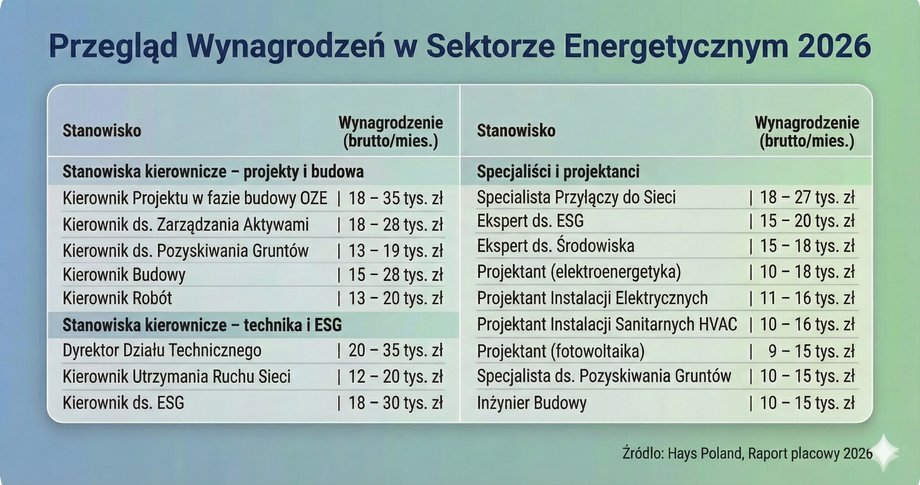
Current wages in the energy sector according to the Hays report
|
Zuzanna Staszewska-Jedynasty / Own work/AI
Companies are taking the initiative in staff training
Due to the shortage of qualified employees, energy companies are becoming more and more active in educating future staff. An example is the initiative of PGE Baltica, which took patronage over the renewable energy technology class at the General and Technical School Complex in Ustka – from the 2026/2027 school year, students will be prepared to work on offshore wind farms. The company finances the equipment of the studio, provides experts to conduct classes and organizes apprenticeships for students.
At the same time, polytechnics are launching new fields of study related to energy, and companies reach for specialists from related industries. They are increasingly open to engineers from the mining, shipbuilding or oil and gas sectors, offering retraining and adapting skills to the specificity of renewable energy.
Support for such activities is provided by public programs and interest-free loans for education.
Public education will set the standard
As for the need to develop green competences, Alicja Piekarz states that there are many training offers on the market today, but it is worth looking at their quality, carefully checking the substantive program and looking for recommended options. He adds that it is also worth remembering that the proposed courses are often related to specific technologies of individual companies.
— There's nothing wrong or strange about it; it is natural that entrepreneurs want to train in this area, which they will later use themselves. However, here comes the aspect of systemic education and the question of role vocational educationespecially in the field of renewable energy or construction, in standardizing knowledge and equipping graduates with solid competences to start their professional path – Piekarz argues.
However, getting vocational education back on its feet is not easy. — The development of curricula itself must take into account many different factors, including the availability and experience of teaching staff. We also cannot forget about the need to develop universal, transversal competences, and not only specific specializations, we hear.
Transformation beyond divisions
Green competences and jobs, new industries and branches of the economy both in the production sector and in services – all these issues are also closely related to the issue of just transformation of enterprises and regions today related to the extraction and combustion of fossil fuels. People leaving the mining industry, related companies or coal-fired power plants should be provided with an alternative. It turns out that there may be more people willing to use them than it often seems.
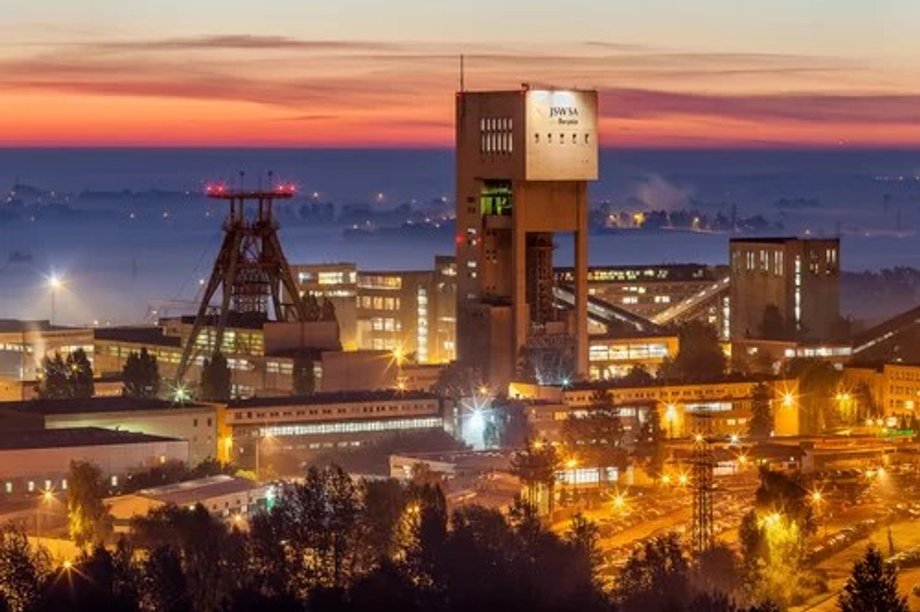
Borynia-Zofiówka hard coal mine, Jastrzębska Spółka Węglowa
|
JSW / JSW
— At the request of the BoMiasto association, we carried out the study “Barbórka 2.0: the future of work in Silesia” – adds Alicja Piekarz. The study was intended to check attitudes towards changes and what will replace emission-intensive industries.
— It turned out that young men, even though they are considered a group more skeptical about the pace of the energy transformation process, are largely willing to work in clean industry, regardless of political preferences. For people, the most important issues are employment stability. Attachment to the mining-based industry as such is less important, the expert concludes.
According to the study, 82 percent respondents believe that working in the so-called clean industry could be attractive to them. Even more, 87 percent. respondents agree with the statement that energy-saving and emission-reducing manufacturing companies create attractive jobs for other inhabitants of the region.