Day in the history of the Jewish Autonomous Region
Photo: Regional Library
December 25, 1913
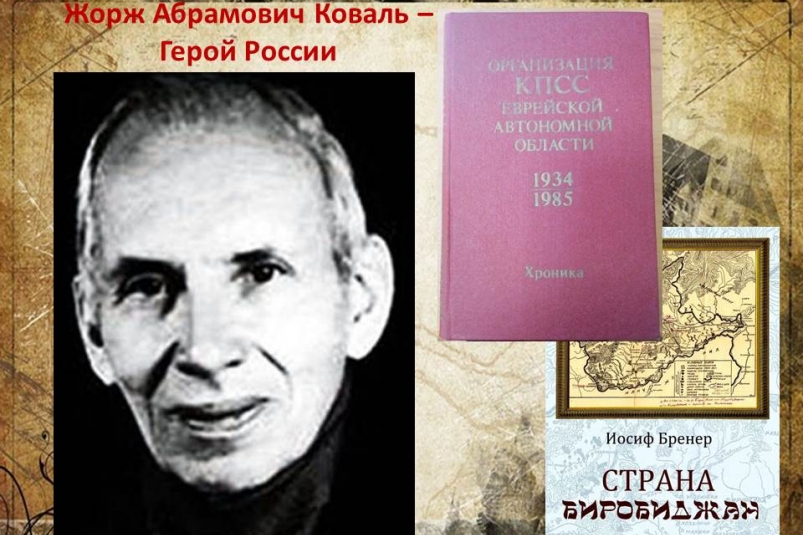
Georges Abramovich Koval, Soviet atomic intelligence officer, was born. The future intelligence officer was born in Sioux City, Iowa, into a large Jewish family of emigrants from the city of Telekhany from the Minsk province.

Georges Abramovich Koval. Photo: Photo: Heritage EAO
The family did not live well. When the Great Depression began in America, his father lost his job and Georges was unable to continue his studies. Anti-Semitism intensified in the country at that time. The Koval family, having lived in America for more than 20 years, decided to leave for the USSR to build a socialist Biro-Bidzhan.
In 1932, the family ended up in Tikhonkaya, and from there they were sent to the Ikor commune. The life of the Kovals in Russia begins with the construction of Sotsgorodok.
Georges, together with his father, became involved in the life of the commune, doing any kind of menial work: uprooting forests, splitting logs into shingles for covering roofs, working as a driver and mechanic. In 1934, Georges entered the Moscow Institute of Chemical Technology. In 1939, he successfully graduated from college and entered graduate school.
In November 1939, Georges was drafted into the army and almost immediately sent to a GRU special school. Thus begins the long journey of the Soviet intelligence officer Georges Koval. The further biography of Georges Abramovich Koval is full of “blank spots”.
December 25, 1917
Proclamation at the III Congress of Soviets of Workers', Peasants' and Soldiers' Deputies of the Far Eastern Territory on the territory of the region of Soviet power.
December 25, 1937
In accordance with the order of the Dalkray Executive Committee, mechanical repair workshops were built in Birobidzhan, producing metal beds and repairing mechanical equipment.
December 25, 1965
A regional hospital complex was built in the village of Amurzet, Oktyabrsky district. The hospital with 50 beds was built by construction and installation department No. 5 of the Khabarovsktselinstroy trust. By order of the head of the health department of the executive committee of the regional Council of Workers' Deputies dated April 14, 1975 No. 77, the Amurzetsky district hospital was renamed the Amurzetsky central district hospital.
December 25, 1935
In I. Brener’s book “The Country of Birobidzhan” (0+) it is said that on December 25, 1935, the regional executive committee adopted resolution No. 521 “On commemorating the centenary of the birth of Mendele-Moikher-Sforim,” according to which it was decided to name Mendele the first street of the new city on the right side of Bira, running from Sopka towards Birofeld, calling this street “Name Avenue Mendele”. It was also decided to establish a scholarship named after Mendele Moykher-Sforim in the amount of 200 rubles at the pedagogical college and to ask the regional executive committee to initiate a petition to the People's Commissariat of Education of Ukraine to transfer the region to the Odessa Museum of Jewish Proletarian Culture named after. Mendele Moyher-Sforima.
Many years later, the avenue, named after the great Jewish writer, whom no one could remember in later years, would be named after Karl Marx.
December 25, 1955
The Bureau of the Regional Committee of the CPSU and the Executive Committee of the Regional Council of Workers' Deputies awarded the Trudovaya Niva collective farm with a Certificate of Honor for its achievements in collective farm construction and in connection with the 25th anniversary of its organization.
December 25, 1979
A meeting of the regional party and economic activists was held, at which the issue of the tasks of the regional party organization was discussed. It is noted that a certain system of training and retraining of ideological personnel has developed in the Jewish Autonomous Region. They regularly undergo training at regional and interregional courses, systematic training has been established for lecturers of party committees, propagandists, educators, press, radio, culture, cinema and sports workers. The adopted resolution drew the attention of party committees, ideological institutions and organizations, and all ideological personnel in the region to further increase the effectiveness of ideological and political work, the introduction of a scientific, comprehensive approach to solving the problems of communist education of the working people.