Europe, by imposing 19 packages of sanctions, has tried to make it more difficult for Russia to export restricted oil from the Gulf of Finland. But new analysis shows that oil is still flowing — and through Denmark.
Russia is not only doing well on the battlefield and in the geopolitical game for the favor of the United States. Its oil sector is doing equally well.
Between January 1 and December 1, 2025, Russia transported oil worth a total of DKK 420 billion through Denmark [ok. 244 mld zł]. This is equivalent to as much as one third of the Russian military budget for 2025, which is estimated at almost PLN 725 billion.
The data comes from a new analysis prepared by the independent think tank Center for Research on Energy and Clean Air (CREA) commissioned by Danwatch.
New data show the scale of transit, which not only undermines the effectiveness of European sanctions, but also actually feeds the Russian war machine. We reveal how Europe allows Putin to keep making money and why no one wants to turn off the tap.
As Jens Wenzel Kristoffersen – a naval commander and an independent military analyst associated with the Danish Defense Academy – emphasizes, these numbers show that Danish territorial waters have become a key point of conflict with Russia.
This is a direct source of financing for the war in Ukraine. Russia must come to the conclusion that neither the EU nor Denmark are partners that should be taken particularly seriously if it is happening on such a scale before our eyes.
says Kristoffersen.
The analysis also shows that European ambitions to stop Russia's “shadow fleet” have failed. Moreover, today oil is transported more frequently on sanctioned ships than on non-sanctioned ships.
In practice this means that more raw material passes through Denmark on sanctioned vessels than on “clean” ships. This happens, among others, because many tankers operating in the Baltic Sea have been subject to restrictions over time.
The purpose of the sanctions was to eliminate these ships from the oil trade, but the trade continues in full swing.
The Danish Minister of Foreign Affairs, Lars Lokke Rasmussen, also reacted to the results of the analysis. In an interview with Danwatch, he admitted that he was under no illusion that the “shadow fleet” had already been defeated.
— We do a lot and the results are visible. Russia's revenues from oil exports have fallen in recent months to the lowest level since the invasion of Ukraine began, he emphasizes.
Numbers that speak for themselves
Between January 1 and December 1, 66 million tons of crude oil and almost 60 million tons of petroleum products, such as gasoline, were transported from Russian ports through the Great Belt Strait in the Baltic Sea.
The exact valuation of the cargo is difficult, but according to Russian export data, its value was approximately EUR 25 billion. [ok. 109 mld zł] in the case of oil and EUR 30 billion [ok. 131 mld zł] in the case of petroleum products.
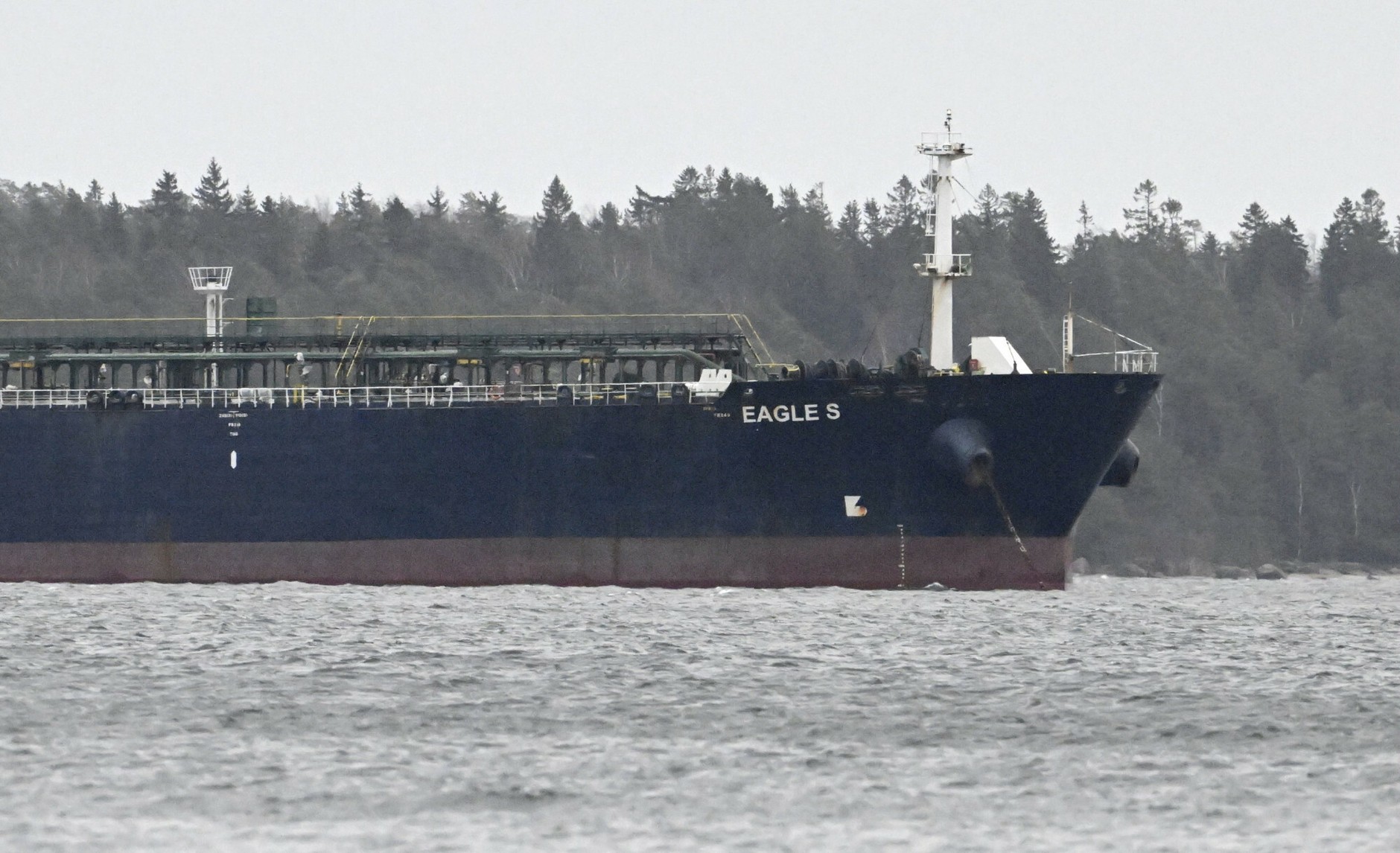
Eagle S tanker belonging to the Russian shadow fleet (illustrative photo)Heikki Saukkomaa/Lehtikuva Oy/East News / East News
In total, this gives a value of approximately PLN 244 billion. On an annual basis this means that cAbout 125 to 150 tankers with Russian oil pass through Denmark every month, or an average of almost five fully loaded ships a day.
Oil keeps Russia alive
Russia's war economy is deeply dependent on uninterrupted oil exports. Without it – as Jakob Tolstrup, a political scientist at Aarhus University who specializes in Russian politics, says – “the Russian economy simply stops”, plunging the country into a deep crisis.
Oil is Russia's main source of income. It is the most important export product it has
– he explains.
After the West introduced collective sanctions, Russia was forced to redirect exports mainly to India and China. The problem is that before the invasion of Ukraine, Europe was the largest recipient of Russian oil, which is why much of the oil infrastructure is located in the Gulf of Finland.
“When you put all these elements together, a picture emerges of Denmark's gigantic, illegal oil exports,” Tolstrup concludes.
This means that oil has to be transported from the Baltic Sea all the way to India, while China largely relies on pipelines or supplies from Vladivostok. Additionally, Russia offers India and China significant discounts to encourage them to increase their purchases.
— We know that Russia earns much less from oil today than before the war. Therefore, it is all the more important to liquidate this raw material. This is a strategic issue, Tolstrup points out.
The Baltic Sea is out of control
Danwatch revealed that Russian exports are carried out in an increasingly opaque and risky manner. The lion's share of transport was taken over by the “shadow fleet” – ships flying under false flags, with fictitious documentation, often without real technical inspection or insurance.
This is not only a matter of financing the Russian war machine, but also a real threat to Denmark's security
– emphasizes Kristoffersen.
He describes the situation directly as hypocrisy: Denmark, on the one hand, is tightening sanctions and, on the other hand, it is allowing sanctioned ships to pass freely through its waters.
— Russia will not suffer any consequences. Denmark — as a small country — has neither the strength nor the courage to stop it, fearing a Russian reaction, he says.
“Potential conflict zone”
Blocking the flow of tankers through the Great Belt would benefit Russia huge consequencesbut – as Tolstrup notes – it would almost certainly be met with a harsh reaction from Moscow.
— However, you cannot pretend that the problem does not exist. This is a huge, illegal oil export and a huge political dilemma, he emphasizes.
The Danish authorities are obliged to enforce the sanctions, but their actual implementation increases the risk of Russian retaliatory actions.
Denmark is becoming a potential conflict zone. It's a balancing act between security and political risk – and there are no easy decisions here
– sums up.
In 2025, shipping with Russian oil through the Baltic Sea will become possible more dangerous, legally questionable and increasingly entangled in a hybrid conflict. Reports of armed Russians on tankers, warnings from the services and the risk of clashes with NATO show that the problem is no longer solely economic.
As Kristoffersen emphasizes, there is a huge gap between words and actions.
— Four tankers a day is not a challenge that the state cannot cope with. Every ship should meet clear safety requirements. If he does not meet them, he should not be allowed in, he concludes.
I’m Ashley Davis as an editor, I’m committed to upholding the highest standards of integrity and accuracy in every piece we publish. My work is driven by curiosity, a passion for truth, and a belief that journalism plays a crucial role in shaping public discourse. I strive to tell stories that not only inform but also inspire action and conversation.