

Beyond the million-dollar question of Russia's bona fides in the negotiations, another issue that has been largely overlooked is what Ukrainians think and what they would be willing to accept in exchange for peace, Politico writes in an analysis of Zelensky's difficult position as negotiations progress.
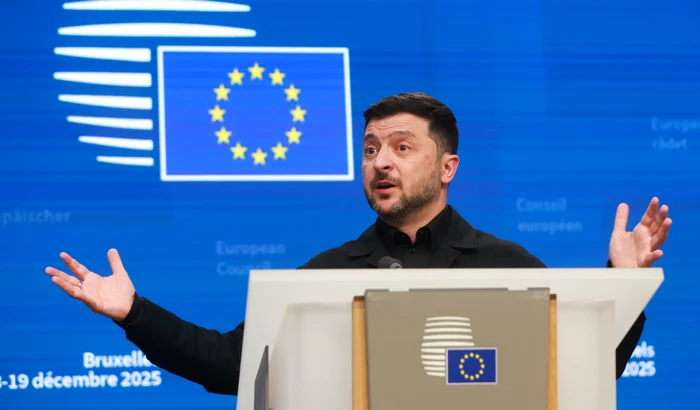
Ukrainian, European and US leaders hailed what they see as significant progress in peace talks this week aimed at ending Russia's nearly four-year war against Ukraine.
US President Donald Trump has spoken optimistically about the prospect of a peace deal, saying Russia and Ukraine are closer to a deal than they have ever been. Russian officials also said the countries were “on the verge of an agreement”, despite categorically rejecting parts of what was tentatively agreed between Ukraine and its Western allies.
Even Ukrainian President Volodymyr Zelensky expressed moderate optimism, while warning that “many difficult questions remain unanswered, not least those related to territories and Russia's desire for peace.”
But it begs the question: How realistic can it be to expect Zelensky to sell Ukrainians a peace deal that would involve the withdrawal of Ukrainian troops from the disputed territories in the Donbas basin, Kherson and Zaporizhia – territory for which Ukrainian soldiers fought hard and many paid with their lives?
While intense negotiations were underway in Berlin this week, the International Institute of Sociology in Kyiv published a survey. According to him, 75% of Ukrainians consider completely unacceptable any “peace plan” that provides for territorial concessions on the part of Ukraine.
Factor of security guarantees –
Probably only reliable security guarantees supported by the US would be convincing enough for the Ukrainians to accept such a huge sacrifice as territorial concessions. And Zelensky could be put in the difficult position of making that argument to Ukrainians, perhaps a plea for an imperfect “territory for lives” exchange.
A compromise solution proposed by American negotiators such as the transformation of the still unoccupied territories of Donbas into a “free economic zone” would be more digestible since in this scenario these territories would not simply be handed over to Russia.
So far, Zelenskiy has rejected any kind of territorial concessions and has negotiated intensively to keep unconquered Donetsk territories under Ukrainian control. However, he did not rule out the idea of a free economic zone, saying on Tuesday that “the Americans are trying to find a compromise. They are proposing a 'free economic zone' [în Donbas]. And I want to emphasize once again: a «free economic zone» does not mean under the control of the Russian Federation”.
Otherwise, Zelenskiy's position is that an acceptable deal cannot ask Ukraine to do more than freeze the conflict along the current front lines.
Seventy-two percent of respondents in the cited KIIS poll said they would support such an agreement, as long as reliable Western security guarantees are provided at the same time, and Ukraine and the rest of the world do not officially recognize Russian-occupied territory in eastern Ukraine as part of Russia.
But what would happen in a scenario where Zelenskiy would have no other alternative, for example risking losing support from the US, which would insist on making a deal with the Russians to end the war?
How Ukrainians would react to an unfavorable agreement
Ukrainian lawmakers from both Zelenskiy's ruling Servant of the People party and opposition factions, whom POLITICO has polled on the issue for months, are adamant that President Zelenskiy could not “sell” such a deal to Ukrainians if he tried.
First, they said, Ukraine's parliament is unlikely to approve such a proposal. “I don't think parliament will ever vote on something like this,” said opposition lawmaker Oleksandra Ustinova. “It would be perceived as a capitulation.”
According to the KIIS poll, 63% of Ukrainians are ready to continue resisting Russia as long as necessary. And while that's down from 71% to 73% between May 2022 and February 2024, it's also a significant increase from 57% to 54% between December 2024 and March this year.
“Despite the war fatigue, despite all the problems we have, I'm pretty sure there aren't many people who would be willing to pay any price to stop the war,” said Yehor Cherniev, deputy chairman of the National Security, Defense and Intelligence Committee and a member of Zelenskiy's party.
Building political consensus around a deal that would involve territorial concessions and troop withdrawals will be difficult, confirmed a former senior Ukrainian official, who spoke on condition of anonymity to speak freely. “Zelensky is going to have to talk to people he hates in the political and military elites who don't trust him. He's going to have to persuade them to make sure they all agree on the same message and that together they argue that the deal is the best we can get.”
Or that would be a considerable challenge for the Ukrainian leader.
During the 2019 election campaign, Zelenskiy attacked his predecessor Petro Poroshenko for signing the failed Minsk accords, which were highly unpopular and which Russia did not implement, the official recalled. And if Zelensky somehow tries to argue that territorial concessions are necessary, those who oppose the ceding of territories would certainly remind him of this episode.
The official also questioned whether Zelenskiy has the ability or temperament to build a broad enough political consensus, especially in the absence of Andri Ermak – his former chief of staff, who was embroiled in a corruption scandal and forced to resign last month. Despite all his flaws, Ermak was a true political mechanic, writes Politico


