
Chancellor Merz's warning and historical parallel with Czechoslovakia in 1938: If Ukraine falls, Russia will not stop

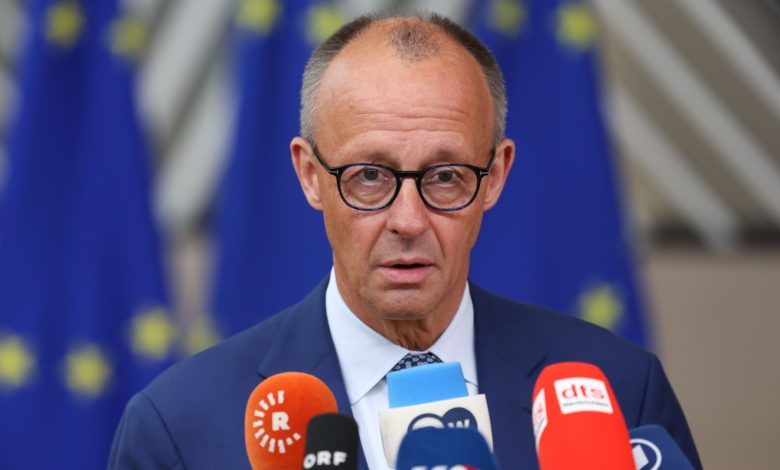
German Chancellor Friedrich Merz claimed on Saturday that Russian President Vladimir Putin “will not stop” and that, if Ukraine falls, the Russian army will not stop at its borders, just as Hitler did not stop after the Munich agreement of 1938 by which he obtained the German-speaking Sudeten region that belonged to Czechoslovakia, EFE and DPA agencies report.
“We know this since 2022: this is a war of aggression by Russia against Ukraine and against Europe. And if Ukraine falls, (Russia) will not stop, just as in 1938 the Sudetenland was not enough (for Hitler). Putin is not stopping. And anyone who does not believe this should carefully analyze his strategies, his documents, his speeches, his public appearances,” Merz tried to convince, in the speech given at Munich at the congress of the Christian Social Union (CSU), the Bavarian sister party of his Christian Democratic Union (CDU), writes Agerpres.
“This is about a fundamental change of the borders in Europe, about the restoration of the former Soviet Union within its old borders, with a serious threat, including a military one, for the countries that were once part of that empire,” the head of the German government believes.
The parallel made with Czechoslovakia
He insisted on the parallel he tried to draw with the agreement signed at the Munich Conference in September 1938 between Germany, Italy, the United Kingdom and France, whereby the Sudeten region of Czechoslovakia was ceded to Germany.
Despite that concession, in March 1939 Hitler broke the agreement and occupied all of Czechoslovakia, and on September 1 of the same year he invaded Poland, starting World War II.
“This is actually the pattern we should have seen in 2014,” when Russia annexed Crimea and began supporting pro-Russians in Donbas militarily, Merz continued his argument.
The priority, in Merz's view
Therefore, he argued, the most important priority in foreign and security policy is to recognize this reality, guarantee continued aid to Ukraine and connect all this with the unity of Europe, including the United Kingdom.
“We must try to maintain NATO and the Western alliance as long as possible, but at the same time invest in our own defense capabilities so that deterrence works again. And let no one say that this is an outdated or obsolete concept,” Friedrich Merz indicated.
All of this, he continued, is taking place in the context of an “almost tectonic shift in the centers of political and economic power” in the world, which puts freedom, peace, the rule of law, democracy, liberalism and our open societies at stake.
Decades of 'Pax Americana' for Europe 'over'
The decades of “Pax Americana” for Europe are “largely over”, the German Chancellor also believes. “This no longer exists as we knew it. And no nostalgia helps (…) This is it: the Americans are now defending their own interests in a very, very tough way. And this cannot mean anything other than the fact that we, in turn, now have to defend our interests”, insisted Friedrich Merz, who previously described as “unacceptable” some of the criticisms leveled at the European Union in the new US national security strategy.
In this document, the United States points to the EU's economic decline, the regulatory excess of Brussels, the undermining of the identity and sovereignty of national states, which together with illegal migration risks erasing European civilization, as well as the censorship of freedom of expression, the suppression of political opposition and the unrealistic expectations of the war in Ukraine that the European leaders who support Kiev have.
“A large majority of (citizens n.red) Europeans want peace, but this desire is not translated into policies, largely because of the undermining of democratic processes by these governments,” the US administration also notes.
What Putin says
Putin, for his part, reproached Ukraine's European allies for making absolutely unacceptable demands for Russia in order to block the peace process initiated by Trump.
“We don't want war with Europe, but if Europe wants it and starts it, then we are ready right now. There must be no doubt here,” the Kremlin leader warned two weeks ago.
“We have no intention of attacking Europe. We have said it a hundred times,” insisted Putin, according to whom the Europeans live with the “illusion” that they could inflict a “strategic defeat” on Russia.


