A new Motorway in Romania: The high-speed road could work as another option to bypass Bucharest / The contract was signed


A new high-speed road will be built in Romania and will connect the capital with the future new bridge over the Danube that will be built between Giurgiu and Ruse. The future road could have a route that would allow its transformation, practically, into a bypass of the Capital on the south-west area, especially for freight traffic coming from Bulgaria and going west. The feasibility study, for which the contract was signed on Thursday, will determine both the route and the road category, whether it will be a highway or an expressway.
The National Road Investment Company signed, on Thursday, the contract for the Feasibility Study of the Bucharest-Giurgiu High Speed Road, “the first expressway to be designed at the border of Romania with Bulgaria, a strategic objective for the connectivity between the two countries”.
The contract was signed with the association of companies Activ Proiectare Infrastructură SRL (the leader of the Association)- Emay Uluslararasi Muhendislik ve Mușavirlik Anonim Şirketi and has a value of 33 million lei and a total duration of 18 months, of which 16 months for the Study, respectively two months for technical assistance necessary to prepare the contract for design and execution.
“The Feasibility Study will determine the route variants, the profile of the high-speed road (motorway or expressway), the structure and the connections with other investment objectives, such as the future Bridge over the Danube Giurgiu-Ruse”, declared the general director of CNIR, Gabriel Budescu.
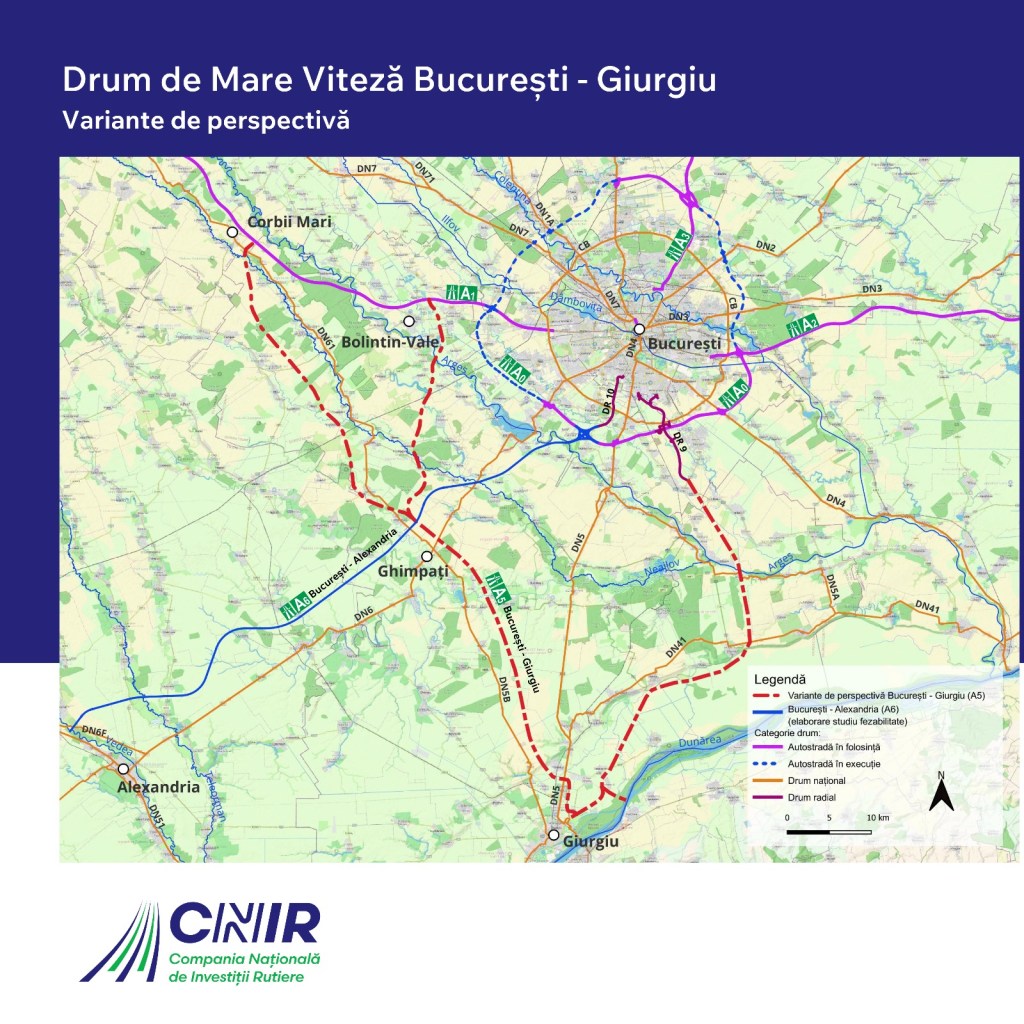
Bucharest – Giurgiu highway – route variants / Source: CNIR
Several route options considered. A variant also turns the road into a bypass route for Bucharest
A component of the Feasibility Study that will be done will analyze several route options.
Among these, a variant that could be analyzed is the one in which the Bucharest – Giurgiu high-speed road continues south-west of the Capital and reaches the A1 Bucharest – Pitesti highway, practically becoming a part of a future Ring 2 highway belt for Bucharest, explains the CNIR director in an interview for HotNews.ro.
“In the multi-criteria route analyses, we want to analyze the connection from (No. Autostrada Bucharest-Alexandria), where we figured out a potential node; from the (belt) A0; from the radial road from Măgurele. But I also want to do an analysis, a connection with the A1, to see from the traffic point of view what each option would mean.
I estimate that a lot of traffic coming from the Giurgiu-Bucharesti connection goes to Pitesti, Sibiu, etc., and then at some point it might turn out to be more profitable to take this Bucharest-Giurgiu route to the A1, not to come all the way to (highway) Alexandria, but from Alexandria we take it to the A0, to the A1, etc. I want to see on the traffic side what it means to do all these options. We put them in the national transport model and simulate each one to see where it attracts the most traffic and what would be the predominant flow”, explained Budescu.
“In the area between Alexandria and the A1, this second highway ring for Bucharest would be created”
“Practically, on this area between (the highway to) Alexandria and the A1, the second highway ring would be created. An aspect that I have raised in various media since 2021. And here I make a parenthesis – on the current A0 highway, in the traffic study on which it was tendered in 2017, when I came to CNAIR, it is written that the 3rd lane is necessary on the A0 North from 2025 and on the south side from 2030”, said the director of the new infrastructure company.
It should be noted that the A0 North is not completely ready even now, but only the approximately 50 km of the A0 South that connects the A1 to the A2 and allows bypassing Bucharest from west to east.
“In order to make the third lane, we should use the emergency lane, make the lanes narrower, reduce the speed to 100 km/h, the junctions will be congested anyway, there are quite a few. And then a solution would be to think BIG as the Americans say. Let's see the 2nd option, if we can do it, where we can do it and implement it in stages. No one says that there must be another belt tomorrow, another highway. We will analyze it,” said Budescu.
Expressway or highway? It will have three lanes in each direction
The feasibility study will also determine what kind of high-speed road it will be – expressway or highway. That will result from the traffic study. The still unofficial sign, if it were a motorway, is the A5, as it was for a long time in the older plans from Transport.
“I think there will be a highway,” said Budescu, noting that it will be considered to be a high-speed road with three lanes in each direction, an element rarely found on highways in Romania.
 The “ostrich-camel” of the Romanian infrastructure. How the company that manages the construction of highways wants to solve an expensive problem