The tomb of Mircea the Elder from Cozia was reopened after almost a century. What archaeologists wanted to know


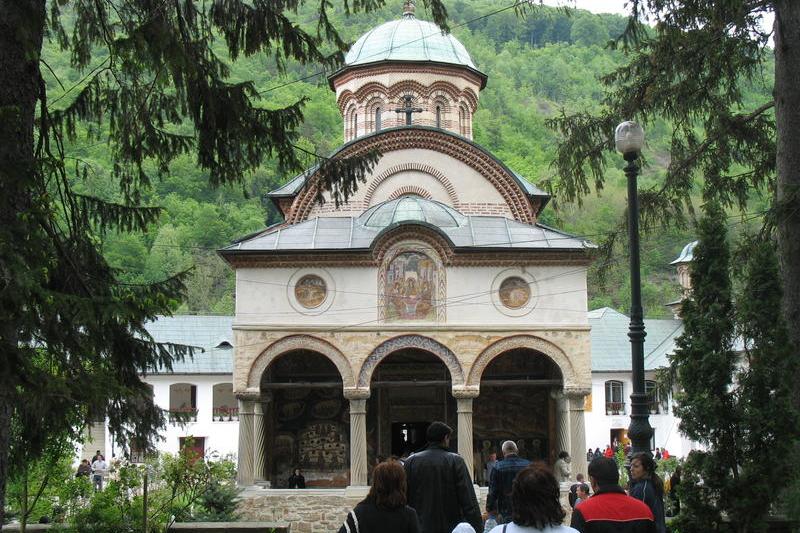
Cozia Monastery…, Photo: USER UPLOADED
A team of archaeologists and anthropologists reopened the tomb of Mircea the Elder, located at the Cozia monastery, to determine if the sarcophagus is the original one, given that there were suspicions that it had been moved at the beginning of the 20th century. After examining the sarcophagus, archaeologists have come to the definite conclusion that this is the original one, informs Agerpres.
Specialists from the County Museum “Aurelian Sacerdoţeanu” Vâlcea, but also from the Institute of Archeology “Vasile Pârvan” and from the Center for Anthropological and Biomedical Research “Olga Necrasov” from the Iaşi Branch of the Romanian Academy participate in this research project, which aims, on the one hand, to relieve the archaeological load of the monuments that make up the monastic complex from the Călimăneşti resort in order to restore them, and on the other hand to check the sarcophagus, unique among the noble and noble tombs in the country due to its shape, in the conditions where there are assumptions that it would have been moved at the beginning of the last century.
“There are in the archives of the National Heritage Institute several requests from around 1930 to move the sarcophagus from the Cozia Monastery to the National Museum of History, and then we sought to verify through this research whether it was moved. But no, it was not moved. It is the original one and is in a good state of preservation. It is a stone sarcophagus, unique in Romania, being provided with a cephalic niche, specific to graves in Europe Apusene from the period of the 5th-15th centuries AD The tomb was investigated for the first time in the interwar period, as part of a restoration project initiated in 1927. Next to the sarcophagus of the ruler Mihai Viteazul is also the tomb of the nun Teofana. In 1938, the remains of the ruler and Teofana were deposited in marble boxes. and placed in this sarcophagus”, said archaeologist Ion Tuţulescu.
The tomb was desecrated several times
Prince Mircea the Elder died on January 31, 1418 and was buried on February 4 of the same year at his foundation in Călimăneşti, as he wished. Over the years, however, his tomb was desecrated several times, as was the church where it is located.
“The first truthful information related to the desecration of the tomb is from 1821, when the Etherist troops, retreating to Transylvania after the defeat at Drăgăşani, looted the monastery and implicitly the resting place of the ruler. Another desecration is mentioned during the German occupation between 1916-1918. In a document from March 1919, the superior of the monastery, Protosinghel Anastasie Popescu wrote to the Ministry of Culture that “the Cozia monument is in a sorry state, because of the enemy armies that in the invasion on the edge of Olt looted and desecrated this holy place, turning the church and the chapel into a horse stable, and the houses devastating them and leaving them in complete ruin”. The troops that occupied Cozia broke the stone memorial on the grave of Mircea cel Bătrân, which was redone in 1936, with an inscription made by Nicolae Iorga. In 1938, the stone was changed, placing the current gravestone on the voivode's grave, which was brought from Bulgaria,” said the archaeologist from Vâlcea.
Located in the Olt Valley, the Cozia Monastery is considered the most important foundation of Mircea the Elder (1355-1418), although there are also sources that indicate his father, Radu I (1330-1383), as the founder of the monastery (known in his time as Nucet). The consecration service of the place took place on May 18, 1388, being officiated by Saint Nicodim from Tismana, the one who reorganized the monks from Oltenia and founded the monasteries from Vodiţa and Tismana, and the first abbot assigned to lead the monastic community of Cozia was Hieromonk Chir Gavriil, his disciple.
The Cozia Monastery complex, a historical monument of national importance, is composed of the church dedicated to the “Holy Trinity”, dated 1388 and with interventions to add the porch on the west side between 1705-1707, the chapel dedicated to the “Assumption of the Virgin Mary”, located in the southeast corner of the monastery premises and dated 1583; the chapel dedicated to “All Saints Sunday”, located in the northeast corner of the monastery complex and dated to 1710, with partial reconstruction interventions between 1958-1959; the refectory from 1853 and the buildings that make up the premises, respectively the north, south and east sides, dating from the 14th, 16th and 18th centuries.