This is how you make money in the uniformed school. One detail attracts attention [KWOTY]


The Ministry of Finance has just prepared a broad analysis of Poles' tax returns, in which a separate chapter is devoted to uniformed services. We decided to take a closer look at their situation. The differences are visible to the naked eye.
Read also in BUSINESS INSIDER
What attracts attention at first glance is this privileged position of officers in terms of taxes and contributions.
Representatives of services, which include, among others: The Police, Internal Security Agency, Central Anticorruption Bureau, Intelligence Agency, State Fire Service, Prison Service, Border Guard and many others simply do not have to pay social security contributions, including: retirement or disability pension.
This is completely different than on a full-time job, where the so-called social contributions pregnancy the most. The services do not have this problem, because in their case only health insurance contributions and, of course, income tax advances are obligatory.
Moreover, not all remuneration is subject to health insurance contributions, but only the salary. Any additions, or even “thirteen” are exempt from it.
See also: They went to Scandinavia to work 20-30 years ago. Today they have such pensions [KWOTY]
Difference in contribution burden
What does this mean in practice? This is clearly visible in the study prepared by Paweł Chrostek, an analyst at the Ministry of Finance, based on citizens' PIT declarations.
Although the data referred to in the report comes from 2022, little has changed since then. Earnings have certainly increased, but the ratio of charges to income has not. And even if they do, the differences are certainly not great.
Let's get down to specific numbers. The analysis of PIT forms of service officers shows that depending on the income of the so-called mediocre in their case, the tax and contribution wedge was between 12.3 and 16.5 percent in 2022. The point is to actually burden their income with mandatory public and legal charges.
However, the median ranged from 13.1 to 15.4 percent. revenue and decreased compared to 2021. This is the result of the introduction of the Polish Order. The exact numbers can be seen in the table below.
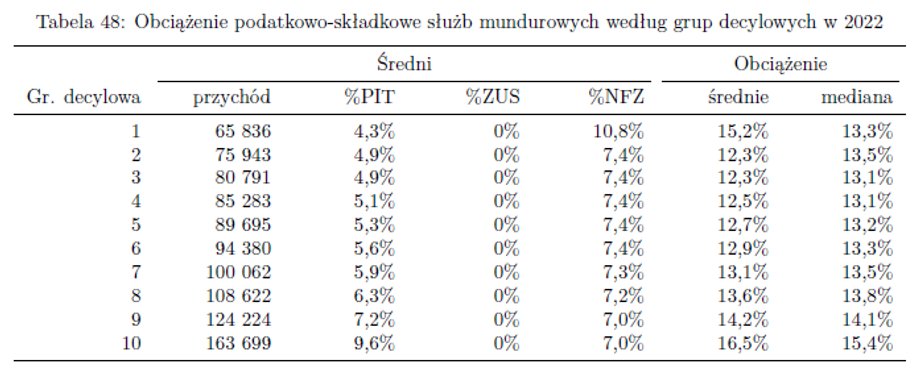
Tax and contribution burden on remuneration in uniformed uniforms
|
Ministry of Finance
The data also shows that the median annual revenue in the uniformed services in 2022 was almost PLN 89.7 thousand. zloty. That's about 7.5 thousand. PLN per month.
Full-time employees have no such preferences
Okay, but is it a lot or a little? Let's compare this with the data for employment contracts, which is by far the most popular source of income among Poles.
Let's start with the median income. In 2022, it amounted to only 63.1 thousand. PLN per year, i.e. just over 5.2 thousand. PLN per month. Let us remind you that this was the case in the uniform 89.7 thousand respectively PLN per year and PLN 7.5 thousand PLN per month, i.e. nearly 50 percent. more.
But we're talking about gross revenue here. When it comes to what actually contributed to the account, the differences are even greater. It turns out that the tax wedge for full-time employees is more than twice as high as for the services.
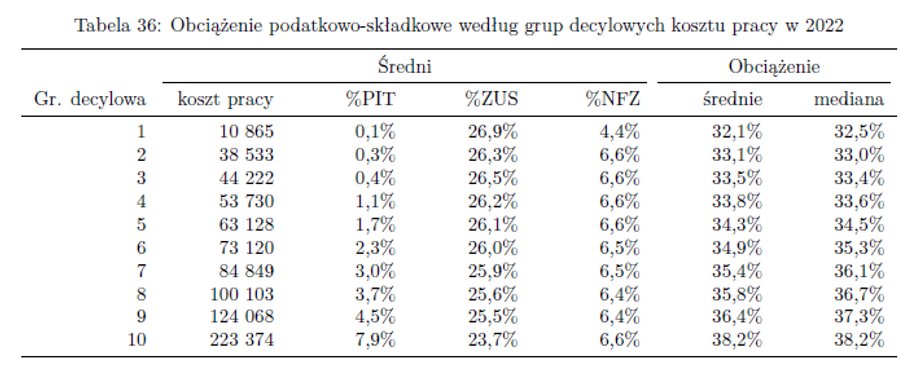
Tax and contribution burden in employment contracts
|
Ministry of Finance
The table shows that the average varies, depending on income, between 32.1 and 38.2 percent. compared to 12.3 and 16.5 percent. for officers. It is similar in the case of the median.
All thanks to ZUS, which is by far the largest burden on employees' gross salary.
However, it is worth noting that 10 percent the richest full-time workers can boast significantly higher earnings than 10 percent. the richest representatives of the services. The difference is colossal and amounts to nearly 60,000. PLN per year.
See also: Poles earned German pensions. That's how many euros they get [KWOTY]
Uniform almost like pensioners
Interestingly, the tax and contribution wedge for service officers is much more similar to that applicable to retirees and pensioners than to the “full-time” one.
Data from the Ministry of Finance show that ZUS benefits were charged in 2022 at a level ranging from 9.1 to 14.4 percent. This can be seen in the table below.
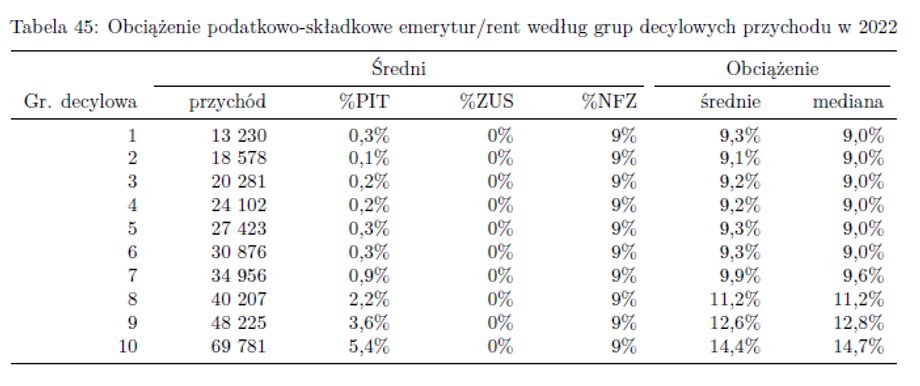
The tax and contribution burden on retirees and pensioners
|
Ministry of Finance
It is worth remembering, however, that retirees – like officers – no longer pay social contributions on their benefits. However, the relatively lower burden is the result of much lower income.
As you can see in the table above, the median income of retirees and pensioners is only PLN 27.4 thousand. PLN per year. That's about a third of what's in uniform. After the changes under the Polish Order, many retirees de facto do not pay income tax, which is also clearly visible in the table.
See also: Uniformed pensions. The whole truth about benefits for services