The leader of an armed and Israel-backed anti-Hamas group has been killed in the Gaza Strip, the group confirmed Thursday, in what could be a blow to Israel's post-war plans in the devastated territory, CNN reports.
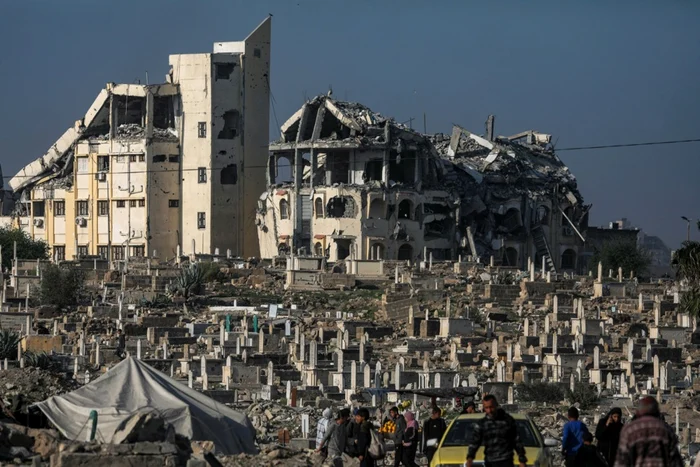
PHOTO EPA-EFE
Yasser Abu Shabab, who led a militia that controlled a swath of territory in Rafah, southern Gaza, was killed while trying to “de-escalate a conflict” between family members in a public square. An Israeli source previously said his death was the result of “internal conflicts”.
Two Israeli sources revealed that Israel tried to evacuate Abu Shabab to a hospital in the south of the country, but he died of his serious injuries.
Ynet cited a “senior militia source” who said a confrontation broke out between families and militia groups that escalated and shots were fired. Ynet later quoted an Israeli security official as saying he was allegedly beaten to death in a dispute over cooperation with Israel.
Abu Shabab was the leader of the most important of the many Israeli-backed armed groups in Gaza, and his death could prove a setback for Israel's still unclear plans for the enclave's future. This leader, who was in his early 30s, appeared to be expanding his influence in southern Gaza as he sought to create a zone free of Hamas. Israel intended to use Abu Shabab's militia to weaken Hamas as an alternative to the militant group's Islamist leadership.
Israel also planned to use Abu Shabab's organization, dubbed the Popular Forces, to secure reconstruction projects inside occupied Gaza as part of the next phase of the ceasefire agreement. In the final months of the war, he helped control the flow of aid from the Kerem Shalom crossing in southern Gaza.
The message of Hamas
Hamas, which had previously vowed to eliminate Abu Shabab, called him a traitor but did not explicitly claim responsibility for his death. The militant group said he faces “the inevitable fate of anyone who betrays his people and his homeland by accepting to be a pawn for the Occupation.”
In a statement, Hamas congratulated all those who denounced Abu Shabab and others as “collaborators” with Israel.
“We emphasize that the Occupation, just as it failed to protect its agents, cannot protect any of its collaborators,” Hamas added.
The Popular Forces clarified that Abu Shabab was not killed by Hamas.
“We strongly deny any misleading information suggesting that he was assassinated by thugs from the Hamas terrorist group, as it is far too weak to remove the General Leader,” the group said in a statement.
Images circulating on several online groups in Gaza showed a number of Palestinians celebrating the death of Abu Shabab. An image obtained by CNN shows Abu Shabab with a red “X” on his face alongside the adjective “pig”.
An anti-Hamas militia in Gaza
Abu Shabab was the leader of one of several loosely organized Palestinian gangs supported by Israel in Gaza, and its members remain largely in the Israeli-occupied part of the enclave.
His group, which he claimed had hundreds of members, carried out raids in Hamas-controlled territory before quickly retreating under Israeli protection, according to Muhammad Shehada, a Gaza expert at the European Council on Foreign Relations.
In the absence of a post-war governance plan for the Palestinian enclave, Israel supported these armed groups, which occupied small portions of territory in various parts of the strip. Israeli Prime Minister Benjamin Netanyahu called the gangs “a good thing”, despite criticism from his political rivals who accused him of arming “the equivalent of ISIS in Gaza”.
The ongoing operation to arm the groups, including Abu Shabab, was authorized without the approval of the security cabinet, two Israeli officials told CNN in June.