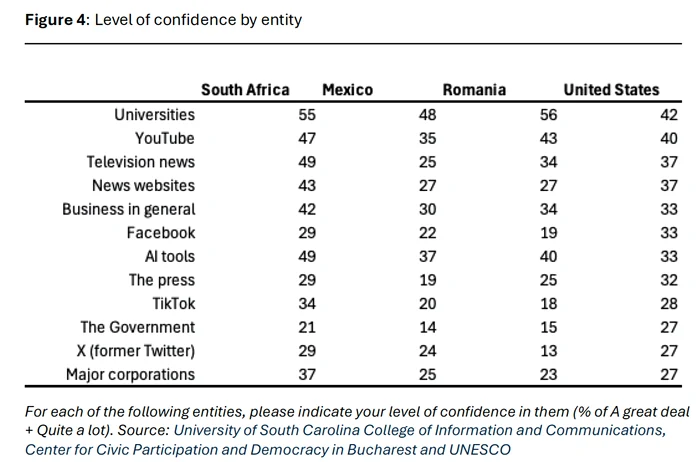
62% of Romanians say they have noticed an increase in misinformation during the 2024 election campaigns. Americans who responded to the same survey in their country said almost the same. And one in two people believe that AI tools like ChatGPT are contributing to this phenomenon. And, despite all that, Romanians have more trust in AI (40%) than in the press (25%), news sites (27%) or the government (15%).
These are results drawn from an extensive comparative sociological study of how citizens in different regions of the world use and evaluate artificial intelligence, which I coordinated as part of the UNESCO World Trends in Freedom of Expression and Media Development 2025 report.
The research was carried out in partnership with the College of Information and Communications at the University of South Carolina and with the support of UNESCO, covering four countries from different geographical and political zones: the United States, Romania, Mexico and South Africa. It is one of the first cross-national surveys to directly link public perceptions of AI to broader themes such as democracy, information integrity and media trust. And it is only the first step – next year we will measure again, because the trends in this field change incredibly fast!
The results depict a world at the intersection of fascination with, and fear of, the rapid rise and consequences of AI. Almost all respondents – over 97% in all 4 countries – say they have heard of artificial intelligence, but perceptions, expectations and fears about AI differ substantially from country to country. In Romania and the United States, concerns are mainly focused on disinformation and possible manipulation of elections, amid highly polarized recent electoral cycles. In contrast, in Mexico and South Africa, anxieties are more strongly related to economic consequences (job losses, rapid labor market transformations), but there is also a higher level of optimism about the democratic potential of AI.
One of the most surprising results is that in most of the countries included in the study, people tend to place a higher level of trust in artificial intelligence tools than in governments, business or traditional media. This paradox—skepticism of traditional institutions and media combined with trust in technology—raises uncomfortable questions about how credibility is built in the age of algorithmic dominance.
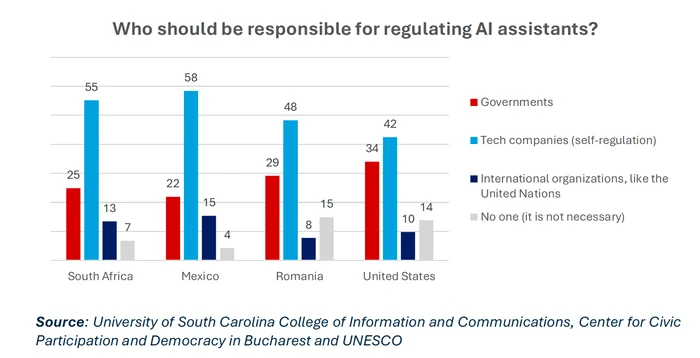
When it comes to regulation, respondents generally prefer a mixed formula: both self-regulation by technology companies and stronger public oversight. Romanians and Americans stand out for stronger support for a clearer involvement of the state (of national governments) in the supervision and regulation of AI.
As we pointed out in the report, artificial intelligence is no longer a distant topic, reserved for experts or the future. It has already become a visible and influential factor in everyday life, increasingly clearly influencing the way citizens inform themselves, participate in public debates and construct their idea of ”truth”. Half of the respondents already use ChatGPT and other similar tools not only for information, but also to create content that they then post online. In other words, people have become accustomed to creating content with artificial intelligence, and they already recognize that this is becoming the norm. Algorithms influence more and more what we read (on social networks) but also on the sources we used to believe to be credible (traditional media sources).
The results of the study show how urgent the need is for transparent AI governance and international cooperation so that the growing influence of artificial intelligence strengthens – and does not undermine – democratic processes.
I presented these conclusions for the first time at the Bucharest Security Conference 2025, during a dedicated workshop, entitled “AI and Democracy after the Super Electoral Year”, organized by CPD SNSPA. The session functioned as a preview of the UNESCO World Trends report, ahead of its official launch in December 2025.
The discussion was moderated by Tom Reichert, dean of the College of Information and Communications at the University of South Carolina. Randy Covington, acting UNESCO Chair at the same university, detailed the main conclusions of the report, which he also coordinated. The intervention of Ana Cristina Ruelas, expert from UNESCO, was focused on the role and future of journalism in the context of technological transformations. A special video message sent by HE Ambassador Simona-Mirela Miculescu reinforced the idea of the need for a legislative framework to prevent abuses related to the use of AI and, at the same time, advocated for the strengthening of academic cooperation between UNESCO departments in different universities.