
The number of scarce professions is decreasing, but there is still a shortage of specialists


In the latest edition of the Professions Barometer, the number of professions considered to be in deficit dropped to 17. At the same time, as many as 151 were classified as sustainable professions, and the surplus group was once again not indicated.
However, this apparent stabilization of the labor market is not due to easier access to employees. This is primarily the result of changing economic dynamics: uncertainty, cost pressure, reduction of investment plans and freezing of recruitment.
— The decline in the number of shortage professions should be treated primarily as a symptom of cooling demand for labor, rather than a structural recovery of the market or a sudden influx of candidates. – emphasizes Mateusz Żydek, labor market expert at Randstad.
He adds that the statistics are influenced by the noticeable increase in unemployment in some regions, as well as employment reductions. — This is a signal of business caution, which may herald a slight increase in unemployment with a simultaneous freeze in recruitment, rather than a real improvement in the availability of talents. – he adds.
Read also: Experts wanted. New recruitments in the medical sector
Shortage professions in Poland in 2026.
The same professional groups have remained in deficit for years:
- truck and bus drivers
- electricians and power engineers
- welders
- nurses and midwives
- caregivers of the elderly
- public service employees
The list also includes doctors, teachers of various specialties, warehouse workers, psychologists and therapists, and independent accountants.
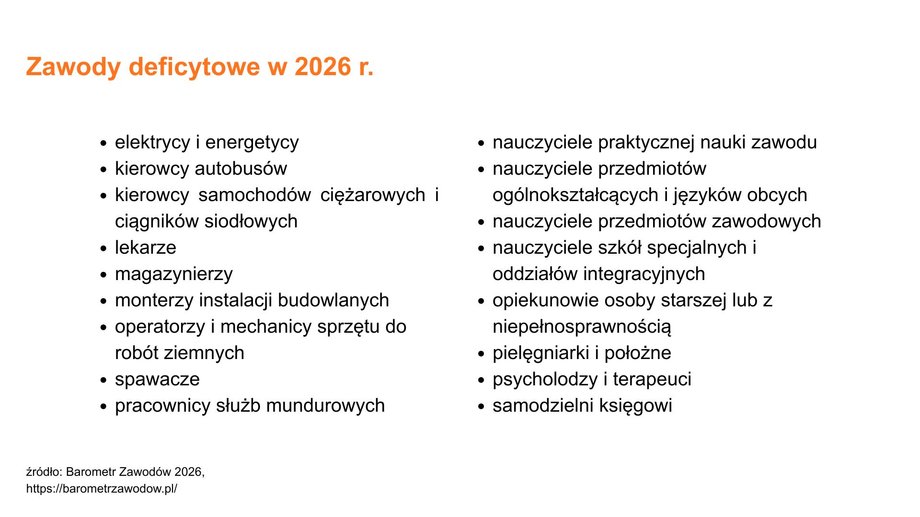
Occupations in short supply according to the Occupation Barometer for 2026.
— The deficits that have persisted for years are the result of a combination of the generation gap, neglect in vocational education and working conditions. – says Mateusz Żydek.
— There is a lack of young graduates in technical professions who could replace retiring employees. Companies are still too slow in investing in the transfer of competences and the development of qualifications. In turn, in transport, medical care and public services, the key problem is the relationship between responsibility and workload and the amount of remuneration.
Read also: Industry 4.0: how to attract Generation Z to work in factories
The most difficult situation concerns the care sector – demand is growing faster than the system is able to train new specialists.
Is equilibrium in the labor market real?
The growing number of jobs in the “balance” category may suggest that recruitment is more efficient today than in previous years. However, companies see a completely different picture.
— Statistical balance is often illusory and does not translate into the comfort of HR departments. A larger number of CVs only means more administrative work in selecting candidates who do not match their competencies, and not a real selection of talents. – explains Mateusz Żydek.
In large cities and counties with a large share of industry, there is a lack of qualified specialists, and recruitment processes are still time-consuming. In addition, employees with stable employment decide to participate in recruitment less often, fearing changes during the economic slowdown.
It is also worth remembering that the barometer is based on data from unemployment registers, which mainly include people with lower qualifications and traditional professions. Labor office registers practically do not include specialists from industries that recruit outside the public system – for example, IT specialists, data analysts or high-technology engineers. This means that the actual deficits in these groups may be much larger than official data show.
Which industries will have the biggest staffing problems?
As Mateusz Żydek emphasizes, 2026 will be the time when two big forces converge: the aging of society and the energy and climate transformation.
— The health and senior care sectors will experience the most severe shortages. This is an inevitable result of the aging of society and the lack of generational replacement in medical professions – assesses.
The second high-risk area will be the energy industry – especially renewable energy and specialized construction. — Accelerating infrastructure and climate investments will clash with an insufficient supply of qualified technicians and engineers.
The third risk zone is basic physical professions: production, logistics, warehouses. — The economic recovery may highlight the existing shortages of basic blue-collar workers – sums up the expert.
Read also: Work in Germany for Polish specialists. The salary is tempting
Labor market 2026 – fewer offers, fewer candidates, more tensions
The fact that the barometer shows no surplus occupations for the fifth year in a row says more about the labor market than many statistics.
Today, Poland does not have “too many” workers in any professional group. The generation gap and demographic changes are so deep that even an economic slowdown does not create surpluses. This is rare in Europe and a serious warning signal.
On the one hand, it mitigates the risk of high unemployment. On the other hand, it limits the development possibilities of industries that require a constant supply of employees: education, health, transport, energy, specialized construction and industry.
The 2026 Occupation Barometer is not an improvement report. On the contrary, it is a map of structural tensions that will deepen. The economic slowdown temporarily “calms down” the statistics, but does not solve staffing problems. These result not from the economic boom, but from demography, lack of investment in vocational education and poor working conditions in public sectors.


