Alexander Macedon's most brilliant victory is less known to the general public. It was carried into Central Asia, where no other European leader had succeeded in leading an army. It was also a first in world military history.
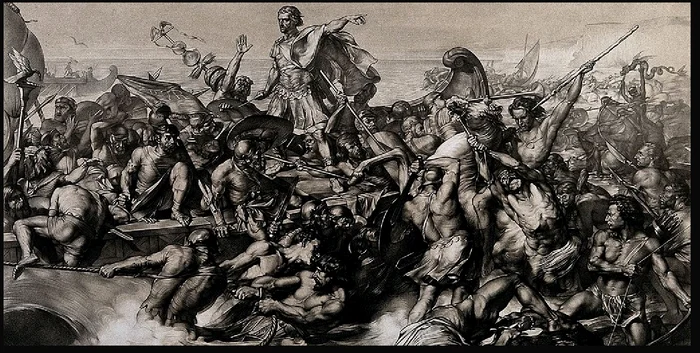
Alexandru Macedon in battle PHOTO wargamesworld.wordpress.com
Alexander the Great or Alexander the Macedon was one of the most famous military leaders in history.
A precocious young general, he began his career at the age of 18 in the armies of his father Philip II of Macedon and then by the age of 32 had become the master of a huge empire, one of the largest in history. Considered a great military commander, brave, temperamental and at the same time a perfect strategist, Alexander the Great won famous victories.
Who has not heard of his brilliant victories at Gaugamela, Granicus, Issus, or Hydaspes. Following these victories, the young Macedonian brought the great Persian empire to its knees. To top it off, all these victories were nowhere near as brilliant as the one at Jaxartes, known mostly to historians but little to the general public. This battle also represented a first in the military history of the world, actually proving the genius of Alexander the Great.
To the frontier at the “end of the world”
The Jaxartes were a river that ran through a large portion of Central Asia. Today it bears the name Syr Darya, a Persian name that simply translates to “Syr River”. The ancient Jaxartes originates in the Tian Shan Mountains of Kyrgyzstan and eastern Uzbekistan and flows over 2,200 kilometers through Uzbekistan, Sughd Province of Tajikistan and southern Kazakhstan to the northern Aral Sea. That is, to the eastern and northeastern border of the Persian Empire. The young Alexander Macedon had inherited the kingdom of Macedonia, an emerging political power that had taken advantage of the weakness of the Greek states to subdue them. However, Alexander's dream was to conquer the Persian Empire and create the largest empire in history. In 334 BC he crosses the Hellespont and begins his great epic. Alexander the Great successively defeated Darius III, king of the Persians in three decisive battles, at Granicus, Issus and Gaugamela.
The Achaemenid empire was collapsing and the Macedonian king advanced victoriously occupying satrapy after satrapy. Darius III had escaped with his life, but his days were numbered. Alexander the Great's main strategic objective was to secure the northern borders of his new empire threatened by nomadic steppe tribes. Among the most feared were the Saka Scythians, elite horsemen and archers who made many armies tremble. First of all because they were impossible to catch. Quick and lethal, they would strike and disappear until they completely subdued the enemy. This is how Alexander the Great arrived on the banks of the Jaxertes somewhere in today's Uzbekistan, a place whose existence no chieftain or king in the European area knew about.
Alexander had reached where no one could imagine. He had already decided to accept the Jaxartes River as the northeastern border of his empire, as it had been under the Achaemenid Empire he had defeated. A new city, called Alexandria Eschate, was to mark the border. While the Macedonians were starting the construction of the new city, the Sogdians, the natives of the area, revolted. Since the time of Cyrus the Great they had been left with increased autonomy, free to practice their semi-nomadic lifestyle.
The building of a city and the pressure of Hellenistic civilization seems to have been perceived as a threat. In addition, their leader was playing doubles trying to get rid of both the Persians and the Macedonians in order to rule the area himself. Alexander immediately retaliated against the rebels. Heavy fighting took place, and Alexander was wounded in the neck in one of them. In the end, however, the Macedonians prevailed. They seemed to be in control of the province. The ambitious Sogdian leader Spitamenes set about besieging Maracanda, a city in the south. Taking advantage of all the countryside, a powerful army of Saka Scythians appeared on the northern borders, waiting for the two sides to loosen up enough to become easy prey. If Alexander wanted to restore order in the south, he first had to defeat the nomads to secure his rear.
A brilliant strategy
The Saka warriors were well versed in steppe warfare. They used the river Jaxartes as a natural barrier. They stood on the banks and waited for the Macedonians to get on board to cross. In this way they effectively became fixed targets for the particularly skilled archers of the Central Asian steppes. The bows of the Scythians did not strike from one bank to the other because the river was wide. Instead they would wreak havoc on the troops in the boats or on the bellows. Alexander was aware of this. So he ordered the preparation of siege weapons, an artillery of the time. It was about catapults and some kind of scorpions.
Being much stronger than a bow, their projectiles only reached the other side. So under the covering fire of the Macedonian “artillery”, the soldiers had time to embark, cross the river and even make a bridgehead on the other side. The catapult fire was so well regulated that it made casualties among the steppe horsemen, killed one of their chieftains, and forced them to leave the banks. The Macedonians were free to roam. Alexander's archers were the first to land, positioning themselves as a covering force for the rest of the troops. They were the famous Cretan archers, fast, versatile, capable of serious damage. Once the heavy infantry arrived on the other side of the river, Alexander had to solve one more problem. The Saka Scythians were renowned for their ability to attack and retreat in waves, hurling a shower of arrows. With this strategy they physically and morally exhausted any army. Alexandru found a solution for this problem as well. He sent forth swift cavalry armed with lances to engage the Saka warriors.
The Macedonian cavalry seemed slaughtered. As the Scythians failed to penetrate Alexander the Great's strategy, they rushed upon the Macedonian spearmen. They seemed sacrificed and Alexander's strategic move a serious error. Alexander's spearmen were immediately surrounded and attacked by the Scythian horse archers. Once hired, their position became fixed. They could no longer execute those mock retreats for which they were famous. They had walked into the trap. Advancing on a wide front, Alexander's infantry and light troops closed in on the nomads, who were now trapped between the Macedonian horse lancers and the rest of the Macedonian army. The Saka tried to escape to the flanks, but here they were met by Alexander's infantry.
A first in military history and a brilliant victory
Alexander the Macedon was the first military commander to stop, pin down and destroy a nomadic army. No one else before him had achieved such a thing. The victory was total. About 1200 Saka warriors were surrounded and killed, including their commander, Satraces. Another 150 surrendered. The rest of the tribes, seeing what happened, decided to flee. Alexandru did not complicate his pursuit. He was wounded in the neck, tired during the fight and had also begun to suffer from dysentery. But it had been a splendid victory. About 1800 horses were captured.
Alexander's genius had made him succeed where even the Persian kings who had failed to subdue the steppe tribes of the Scythians had failed. He could claim to have succeeded where Cyrus and Darius I the Great had failed. Alexander's main goal, however, had never been to subdue the nomads. He wanted to go south, where a much more serious crisis demanded his attention. Now he could do so without worrying about the northeastern frontier. At the same time, in order not to maintain rivalry with the saka, he released all their prisoners without any ransom. This policy was successful: the northern frontier of Alexander's empire was never seriously threatened again. Tactically, the Battle of Jaxartes was certainly a more brilliant victory than any against Darius III.