When the website introduced the About This Account feature, it was intended to be another layer of transparency. It is now possible to check basic information about the profile, including its place of creation and location. In practice, the tool became a magnifying glass under which a much darker map began to emerge. Specifically, a network of accounts pretending to be American voters, but in fact spread all over the world.
Very quickly, users began to notice that some of the loudest, pro-MAGA accounts, i.e. those that flood discussions with aggressive comments, it doesn't look American at all when you look at the data from About This Account.
The next part below the video:
For example, a profile with a name like “ULTRAMAGA🇺🇸TRUMP🇺🇸2028” is created… in Nigeria. A verified account claiming to be former “border czar” Tom Homan shows traces to Eastern Europe. “America_First0”? According to data – Bangladesh. The entire network of “US independent women for Trump” actually operates from Thailand.
The Global Market for Anger
Internet users began to create threads in which they collected such discoveries. And new, supposedly American patriotic profiles kept appearing, which in fact come from completely different corners of the world.
The domino effect was immediate. Supporters of the right side of the political spectrum have started pointing to similar examples on the left – accounts that are also not what they claim to be. X was immediately flooded with posts in which users exposed trolls and false identities fueling political rows.
There is more to this confusion than just isolated incidents. The picture that emerges is this global anger market. Some of these accounts are likely to be linked to state influence campaigns. For years, Russia and China have been investing in operations aimed at sowing chaos in the American political system. Polarizing society, undermining trust in institutions, strengthening conspiracy theories – social media is an ideal tool for this.
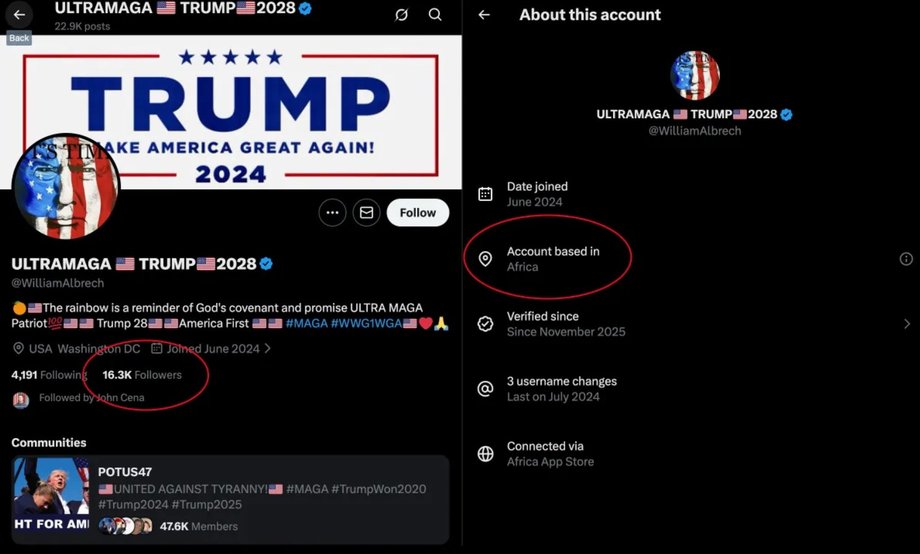
On X it was quite easy to check the location of users.
|
TheVerge.com
But state operations are only one side of the coin. The second is brutally prosaic: money. Today, X allows you to earn money on reach and ad impressions. Amounts that may seem ridiculously low to users from Western countries often become very attractive salaries in developing countries. It's no wonder that someone living in Lagos or Dhaka may decide that it's worth building an account of a “true patriot from Texas” and posting dozens of radical entries a day, evoking strong emotions. The rule is simple: the more anger and shares, the more arguments in the comments, the greater the chance for monetization.
At some point, even the platform itself apparently realized that About This Account shows too much. Shortly after the function was launched, the information about where to create the account disappeared. There were also messages that the location may be inaccurate due to the use of VPNs, proxies and user travel. Technically, this is true – individual cases can be misattributed. However, in light of the scale of the trolls exposed, it is hard to believe that this is just a coincidence on a massive scale.
It is important not only where the trolls write from, but also what emotions they are intended to evoke. Their goal is not to construct a debate, but to stoke anger. Posts are designed like digital weapons. They are short, sharp, based on memes, and often deliberately untrue. The point is not to convince your opponent, but to create another wave of outrage that will attract the attention of the algorithm and provide even greater reach. A real user from the US who enters the discussion, he often does not even realize that he is arguing with someone who does not live in the same country at all, and sometimes he does not even understand the context in which he himself ignites the conflict.
It is worth realizing that social media platforms are currently not a neutral marketplace of ideas, but a place where emotions can be intentionally cultivated and sold. Combined with the possibility of monetizing coverage, a mixture is created in which democracy becomes a by-product, and the main goal is either geopolitical profit or transfer from monetization.