OBI 2025 results. Who is the Polish investor and what would he like to do with Belka's tax?


The Polish individual investor is becoming an increasingly popular entity and, despite the aging society, is becoming younger and younger. He is usually an educated man who increasingly invests outside Poland and with retirement in mind. And its biggest enemy is Belka's tax – according to this year's National Investor Research.
The National Investor Research (OBI) prepared by the Association of Individual Investors (SII) aims to create a profile of the Polish investor. The survey is conducted every year at the turn of October and November. 6,009 respondents took part in this year's 23rd edition – 37% more than last year. This proves the increasing number and involvement of Polish individual investors.
Over 91% of the participants of the National Investor Survey (OBI) are men. This percentage has remained essentially unchanged for years, even though there are no legal, institutional or social barriers to entry for women in the market. And yet, the vast majority of them are not very interested in investing. Nearly three quarters of respondents declared higher education, including every sixth graduate of economics studies. Nearly two thirds of investors are employees (both full-time employees and contractors), and almost one fourth runs a business. Even among OBI participants, there were only 2% of professional stock investors.
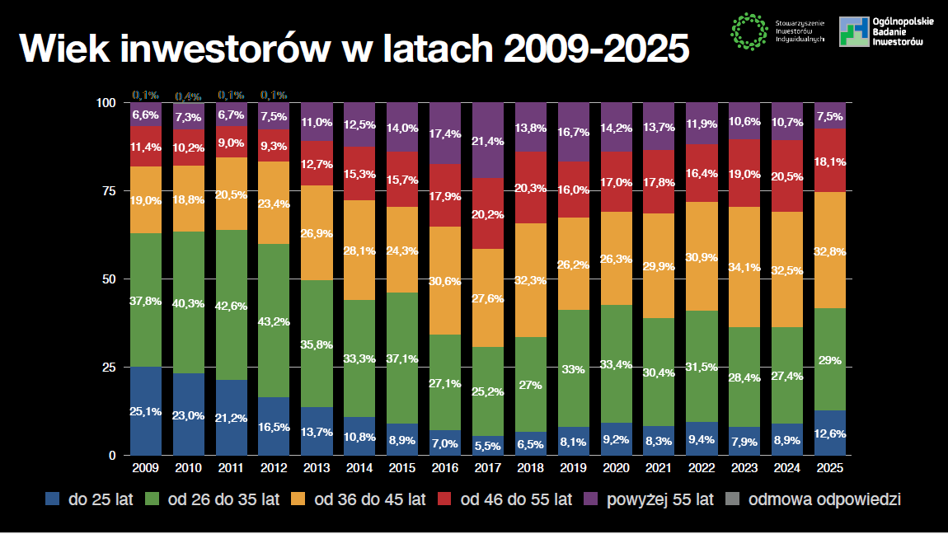
The average age of an investor participating in OBI decreased to 39 years. People aged 26-45 predominate, accounting for 61.8% of the study participants. Only 7.5% had more than 55 years of age. Compared to the previous editions of OBI, there is a clear increase in the percentage of the youngest investors (up to 25 years old), whose fraction increased by almost half (from 8.9% to 12.6%). The percentage of people aged 26-35 and 36-45 was also higher than last year. Therefore, there is a clear inflow of young and medium-old investors to the capital market.
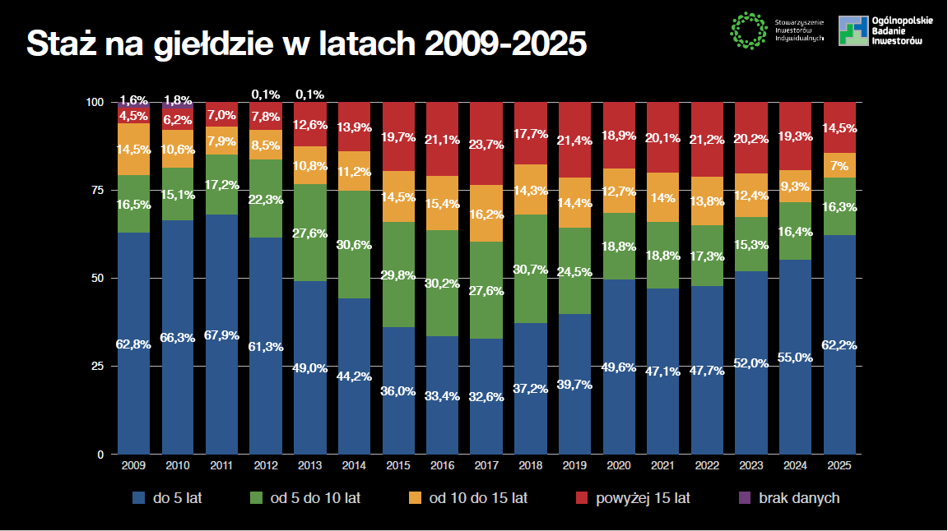
The Polish investor's “rejuvenation” is also confirmed by the statistics of his stock exchange experience. As many as 62.2% of OBI participants have been on the market for at least 5 years. This is the highest percentage of investment “newbies” since 2011. The trend of returning interest in investing among Poles, visible since 2019, has been maintained. The percentage of market veterans (investing for over 15 years) shrank from 19.3% to 14.5%, which can be attributed to the significant increase in the number of OBI participants.
The most important question: why are you investing at all?
Before entering the market, every investor must answer one very important question: why do they intend to invest at all and what do they want to achieve. For several years now, there has been only one main motivation: the desire to save for retirement. This year, for the first time in the history of the survey, more than half of the respondents declared such a goal. This is a continuation of the trend from previous years. From 2022 Investing with your own pension fund in mind has become the dominant motive among Polish investors.And this tendency has recently intensified.
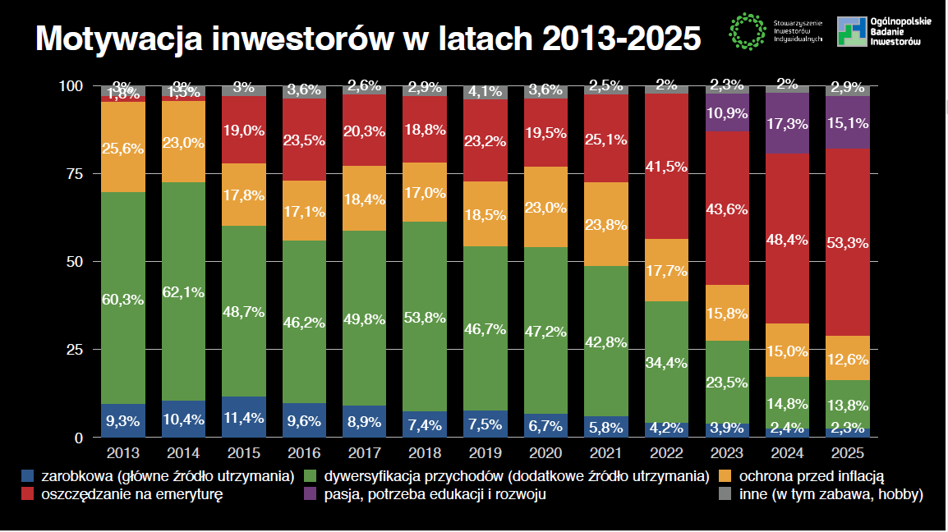
This trend has been visible since 2015. The cut-off date was 2014, when the previous government of Donald Tusk made the “leap into OFE” and deprived us of our last illusions about state pensions. It was therefore necessary to take matters into our own hands and stop treating the capital market only as an additional source of income.
The effects of these decisions can be seen in the increasingly thicker portfolios of Polish investors. In this respect, the post-Covid boom and the inflation wave of 2020-23 were a breakthrough. Wallets with a maximum value of PLN 50,000 were so popular 15 years ago. zlotys have become a thing of the past and today they constitute less than a quarter of the total. The chart below shows not only the impact of inflation, which reduces the purchasing power of the Polish zloty from year to year, but also the maturation of the portfolios of Polish individual investors. Accumulating dividends, capital gains and systematic own payments to brokerage accounts mean that stock market portfolios are getting larger. And with them, the power of the Polish “sweater” on the domestic dance floor grows,
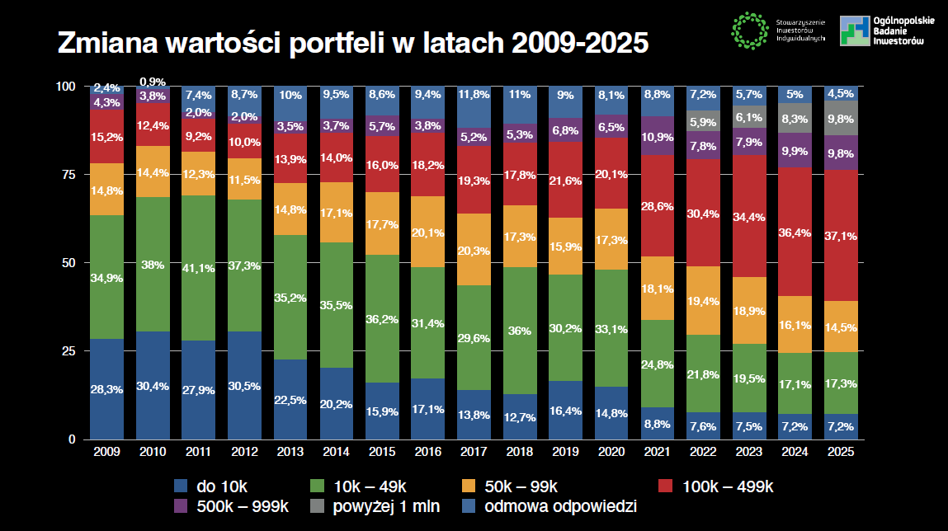
The OBI survey is dominated by investors with capital ranging from PLN 100,000 to PLN 500,000. zlotys – which is very serious money. Such a portfolio was declared by over 37% of respondents. Nearly 10% of them had portfolios of PLN 1 million or more. That is over half of the surveyed investors declared portfolios containing PLN 100,000 or more. It is worth noting that OBI participants stopped being self-conscious about their declarations – only 4.5% refused to answer about the size of their wallet. In previous years, this percentage fluctuated around 9-10%. It is quite likely that in a faction that values privacy so much, there is an advantage of “bigger wallets”.
Long term, diversified and abroad
More than half of the respondents declare that they regularly and monthly contribute to their investment portfolio. Another 27.5% do it several times a year, and 10.1% do it irregularly. Only a handful of investors do not pay extra (2.7%) or withdraw funds (1.6%). This shows that long-term investment portfolios designed with retirement in mind are still in the construction and growth phase.
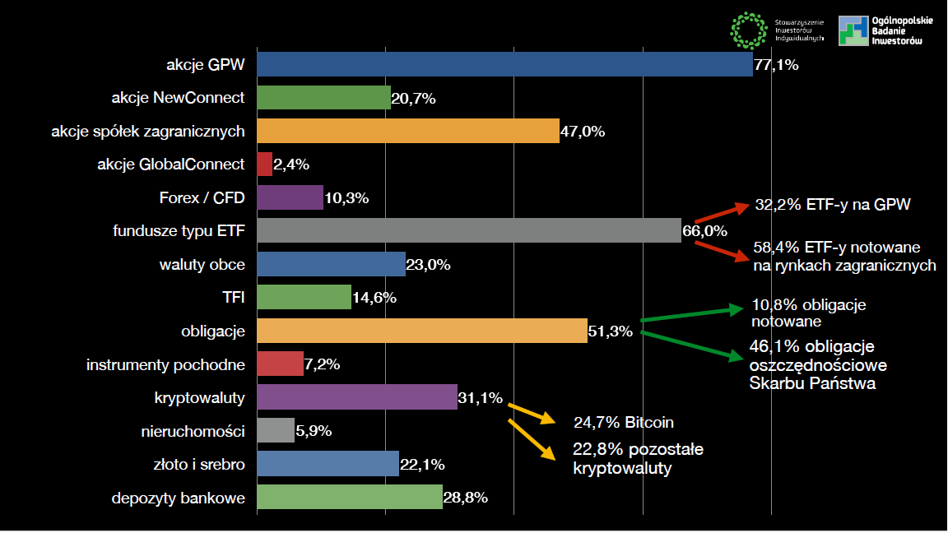
It is not surprising that the structure of Polish investors' portfolios is still dominated by shares of companies listed on the WSE – over 77% of respondents hold them. But second place came to ETF units, which are held by 2/3 of respondents in their portfolios. Bonds (mostly retail Treasury securities) moved to third place in the popularity ranking, outclassing shares from the NewConnect market (only 20.7% of responses). The shares of foreign companies were just behind the podium, which reflects the growing need for geographical diversification and investment beyond Poland (the same applies to the growing importance of ETFs).
Cryptocurrencies remain popular and are in the wallets of almost every third OBI participant. It is worth noting that gold and silver were appreciated only by the fifth investor and were even slightly less popular than “paper” foreign currencies. Shares of foreign companies purchased on the Warsaw Stock Exchange via the GlobalConnect platform were very low in popularity (only 2.4%). It can be seen that the vast majority of investors decided to purchase these goods directly on foreign stock exchanges.
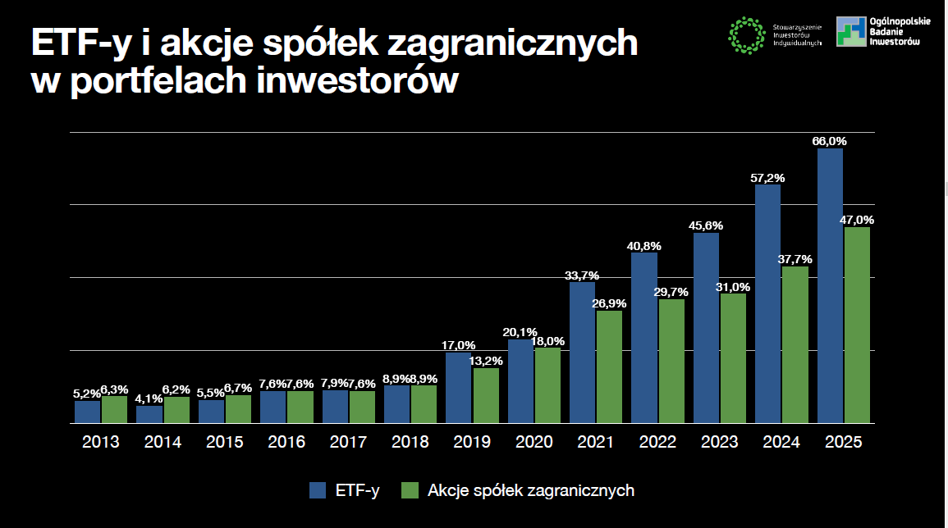
In 2025, two basic trends that we have been observing since the beginning of this decade continued. Firstly, it is a passive revolution manifesting itself in the increasing importance of ETFs. 66% of respondents have already declared such an instrument in their portfolio, while only 5 years ago it was one third, and 10 years ago only every 20th investor was involved in these instruments. The second trend is entering foreign markets. Both through ETFs and independent investments in shares of foreign companies. The latter are already present in the portfolio of almost every second investor, although 5 years ago they were in less than every fifth portfolio.
While in the case of shares, there were more and more well-diversified portfolios (i.e. those containing 15 or more securities), as many as 60% of those investing in ETFs limited themselves to a maximum of three instruments of this type. For comparison, only 11.5% of share portfolios were so concentrated. Of course, it is usually the ETF itself that provides wide diversification (e.g. by investing in the entire stock index), so this type of difference should not be surprising.
Moreover, there are no spectacular differences in the composition of portfolios depending on the investor's age. Yes, younger OBI participants invested in foreign assets and ETFs slightly more often than older ones and used the services of domestic investment fund companies (TFIs) less and less often. But there weren't any big differences. Only the oldest investors (56 and over) chose abroad and ETFs much less frequently and were more attached to the offer of investment funds. It is also not surprising that cryptocurrencies were most popular among younger investors (over 34%) and much less popular among the oldest ones (only 13.4%).
There has also been a fundamental change in the approach to investing in the stock market. Whereas in the past approximately 2/3 of investors held shares for no longer than one year, now 1/3 holds them for 1 to 5 years, and almost 35% for over 5 years. Therefore, over 2/3 of the study participants could be described as long-term investors. And the fraction of active speculators (i.e. with an investment horizon of less than a month) decreased to only 10%. This is even more visible in the case of ETFs, which 67% of investors hold for over 5 years, and only every seventh sells them before the end of the year.
Please abolish the Belka tax
Traditionally, the biggest problem for Polish individual investors is the capital gains tax, called the Belka tax after its infamous creator. 51.6% of OBI participants considered this tax to be the “greatest weakness of the capital market”. A slightly smaller percentage of investors than a year ago complained about the impact of politics (39.8% compared to 43.8% a year ago), therefore “low level of financial education” moved into second place, indicated by 45.6% of respondents.
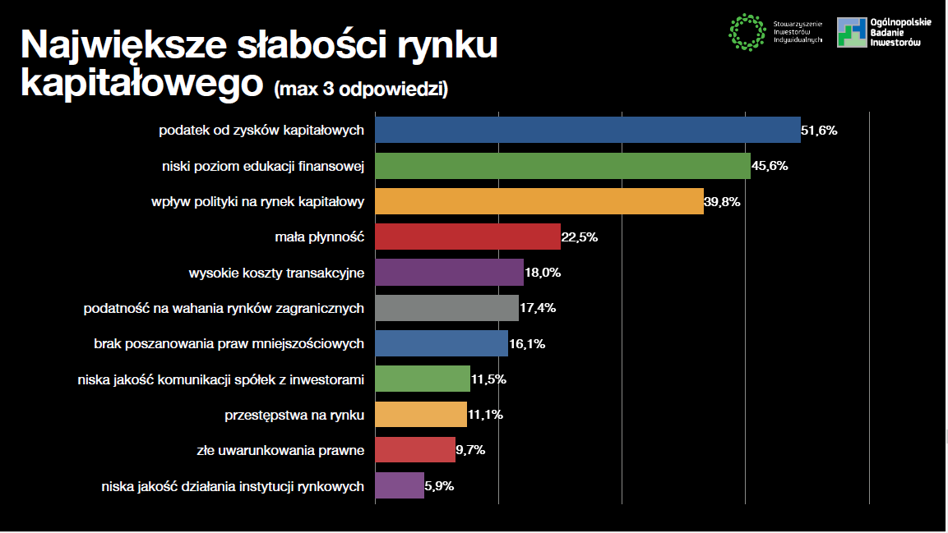
The good news is that only 5.9% of respondents considered the low quality of market institutions to be their biggest problem. Generally, we do not complain about the quality of investor relations or legal conditions – this was indicated by less than every 10th respondent. Even market crimes (11.1%) or lack of respect for the rights of minority investors were not as bad as the activities of domestic politicians.
Due to the fact that for the previous two years we had been discussing changes in Belka's tax (which ultimately will not be introduced), SII decided to ask what changes the investors themselves would like. Thus, more than half believed that this tax should be reduced regardless of the investment duration. One third wanted it reduced only for long-term investments.
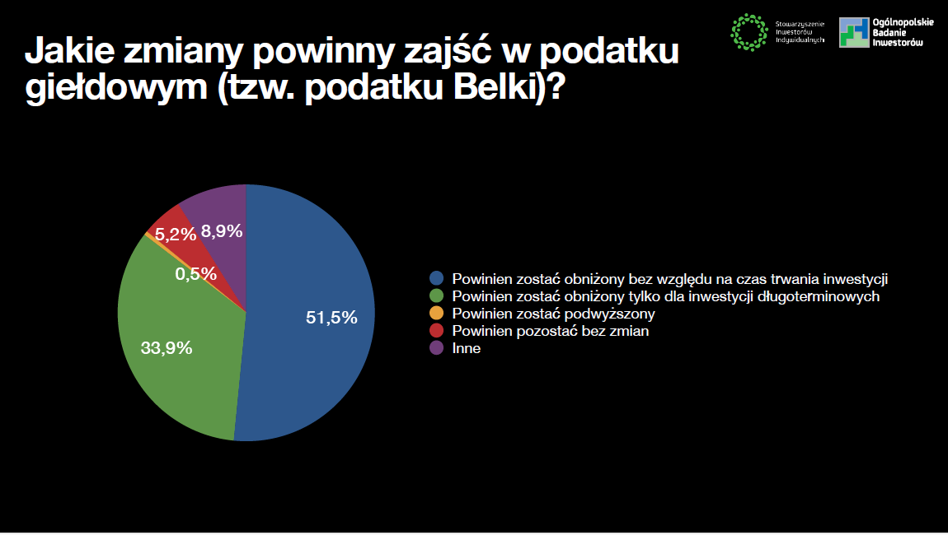
It is not surprising that the largest group of surveyed investors (38.6%) demanding a reduction in Belka opted for the complete abolition of this tax. Over 30% would like it to be reduced to 6-10%, and another 22% would like it to be no higher than 5%. The situation was similar among those who would see it reduced in the case of long-term investments. All these solutions remain a pipe dream, because we already know that the “beam” dimension will remain unchanged. And this is regardless of the type, horizon, profitability or size of the investment.