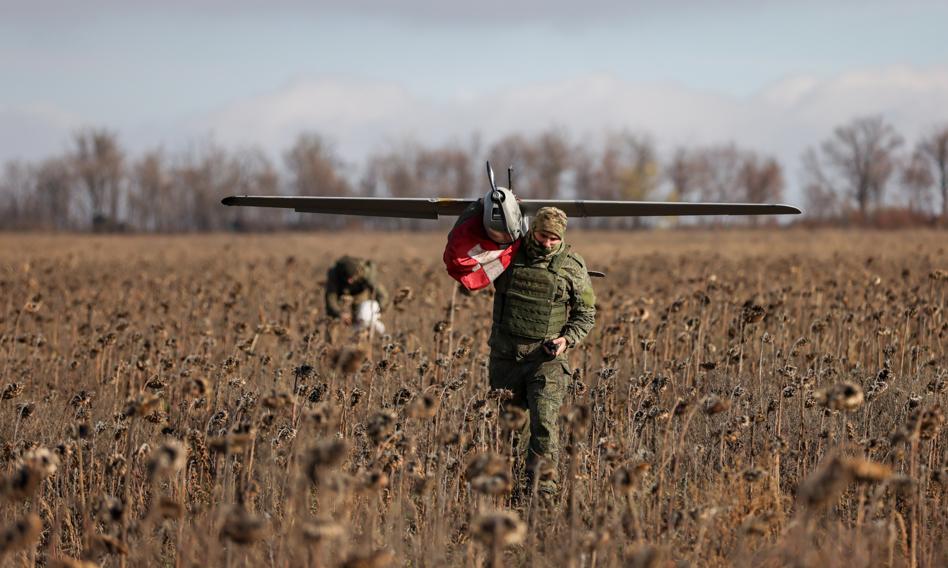
The sudden increase in the importance of drones in the Russian-Ukrainian war and numerous incidents related to drones in NATO countries have resulted in greater interest in systems that help combat this type of threats.
Unmanned aerial vehicles, primarily those operating in the air, have become the main means of fighting in the Russian-Ukrainian war. Who controls the so-called small sky – i.e. it controls the local airspace, which allows it to conduct offensive operations using its own drones – determines the advantage in a given section of the front line. In turn, the mass use of larger machines makes them an instrument of action at a strategic level.
Until mid-2024, Ukraine clearly dominated the use of drones on the front line – massively used kamikaze drones and drones used for precision bombing were able (with the support of artillery and relatively little involvement of infantry soldiers) to stop Russian attacks by armored-mechanized forces. Over time, the Russians also took steps to improve their own capabilities and by mid-2025 they were able to balance Ukrainian capabilities in some areas, including: thanks to the creation of specialized units, such as the Rubikon Center, dealing with the development and implementation of technologies and tactics for using drones in combat.
– Rubikon is a big problem for us, because it conducts activities mainly against the operators of our drones and logistics – admitted Taras Czmut, director of the Ukrainian foundation Powernys' Żywym (Wróć Żywy) in an interview with PAP. He drew attention to the fact that currently neither side has a clear advantage in terms of unmanned aerial vehicles.
This state of affairs has resulted in the rapid development of not only the technology for producing and controlling drones, but also the means to combat them. The problem concerns both small unmanned aerial vehicles operating on the front line and larger ones, e.g. the long-range Shahed-131/136 drones that Russia uses to attack Ukraine's energy infrastructure.
On the front line, the most popular solutions are the simplest ones: mechanical shields, mounted primarily on vehicles (usually in the form of nets, which are intended to prevent the detonation of the combat charge carried by the drone on the structure of the vehicle itself or to prevent e.g. the discharge of the charge into the interior, e.g. through a tank hatch). Their effectiveness is limited, especially when larger numbers of unmanned aerial vehicles are used.
A popular defensive measure is electronic warfare (EW) systems. They cause interference with the radio band used to control the drone. This usually also prevents the reception of images from the UAV's camera, which means that the crew cannot precisely guide it to the target. Both sides are trying to avoid this type of systems by using wire-controlled drones on the front line, i.e. using optical fiber. WRE systems, depending on their size and power, can combat various types of unmanned aerial vehicles.
– When it comes to FPV drones, electronic warfare systems are used for self-defense. They may be equipped with specific objects, vehicles, or infantry groups. There are also higher-level systems operating in brigades: several large jamming stations can protect an area, e.g. 20 km wide and 5 km deep – explained Taras Czmut in an interview with PAP.
Slowly but steadily, at the lowest level of the fight against drones, the number of kinetic means used, i.e. weapon systems allowing the destruction of enemy drones, is also increasing. Infantry soldiers and vehicle crews are increasingly using smoothbore shotguns equipped with shotshells.
Using missiles to combat larger drones is sometimes necessary, but it usually means using the weapon disproportionately to the threat. The optimal solution, which is currently under advanced work by most leading arms concerns and many smaller companies, is to combine electronic warfare means with kinetic systems, usually rapid-firing small arms and short-range missiles. Another solution is interceptor drones, which destroy the target by striking and detonating an explosive charge. Their advantage is the low production cost and low level of construction complexity, which potentially allows for mass production and use. The precursor of this solution is Ukraine, although Russia has also been implementing it for several months.
The development of technologies related to artificial intelligence and the introduction of the so-called drone swarms (i.e. formations of unmanned aerial vehicles controlled by one electronic decision-making center) provide wide possibilities of using this solution as an effective means of combating drones.
Work on technologies related to combating drones: both small FPVs and larger, long-range ones, such as Shahed-131/136, is also carried out by Polish and European defense companies – this includes, among others: result of the violation of Polish airspace by Russian drones on September 10, 2025. Similar incidents, although involving the activity of smaller unmanned aerial vehicles near critical infrastructure facilities, were also reported in many other European Union countries, including in Denmark, Germany, Sweden.
Importantly, the combat environment related to unmanned aerial vehicles is rapidly evolving. – All systems used by our army are manufactured in Ukraine on an ongoing basis, but the battlefield is changing rapidly and after a few months any solution may be obsolete – noted Czmut.
Anti-drone systems are also developing dynamically in Poland, which is influenced by the war in Ukraine and related incidents, such as the one on September 10, when about 20 Russian unmanned aerial vehicles entered Polish airspace. – We agree with the idea of strengthening the airspace defense of the entire European Union and we are ready to consider external proposals or solutions. (…) But we give priority to domestic projects, said Deputy Minister of Defense Cezary Tomczyk in an interview for Bloomberg on Tuesday.
Polish capabilities in this area are still insufficient, both in terms of research and development and production – although projects such as the SA-35 system (a self-propelled 35 mm anti-aircraft gun on the Jelcz truck chassis, developed by PIT-Radwar) or a lighter anti-unmanned aerial system, developed by ZM Tarnów and based on a rapid-firing machine gun of 12.7mm.
The Polish manufacturer of drone neutralization systems, Advanced Protection Systems, has been selected as a supplier of anti-drone solutions – the APS Sky Ctrl system – by Croatia as part of the implementation of the SAFE program, financed by the European Union. The Polish Ministry of Defense also plans to use SAFE funds to finance work on the drone defense system.
Dariusz Materniak (PAP)
mad/ kbm/ mhr/