The popular consensus among scientists is that the universe will continue to expand until the end of time, when the last stars die out. A team of researchers is now putting the brakes on this idea, writes Gizmodo.
After the Big Bang, our universe began to expand at an exponential rate, an acceleration that scientists have long attributed to a mysterious force known as dark energy. This 2011 Nobel Prize in Physics discovery has largely defined our understanding of cosmic expansion for decades. But new research is beginning to challenge this long-held assumption.
But a team of researchers has discovered new evidence that suggests the universe may already be slowing down, rather than continuing to speed up. The analysis, published on November 5 in the journal Monthly Notices of the Royal Astronomical Societycasts doubt on the dominant theories that suggest dark energy drives the universe's continued acceleration.
Because the findings contradict the prevailing view, the paper will likely face close scrutiny from the cosmological community. But if true, it would add further evidence to suggest that dark energy is changing and not constant – offering a different picture of the future of our universe. Specifically, the new research suggests that the universe will begin to shrink, culminating in a “Big Collapse” billions of years from now.
“If our results are confirmed, it would mark a major paradigm shift in cosmology since the discovery of dark energy 27 years ago,” Young-Wook Lee, co-author of the study and an astrophysicist at Yonsei University in South Korea, told Gizmodo.
A glimmer in the “standard light” of the Universe
The new analysis is based on observations of 'Ia' supernovae – a distinct class of starbursts whose constant intrinsic luminosity has made them 'standard lights' for measuring galactic distances. These standard lights have helped astronomers measure the speed at which different parts of the universe are moving away from us.
Because of their constancy, Ia supernovae were a key element in the Nobel Prize-winning dark energy calculations.
These supernovae were less luminous than scientists expected, leading to a surprising conclusion: galactic objects are moving away from Earth faster than anticipated. Something counteracts the force of gravity, that “something” being dark energy—hence the idea that the universe is not only expanding, it's doing so at an increasingly rapid rate.
However, the new findings, which include data from 300 galaxies, showed a strong correlation between the standardized magnitudes of these supernovae and the age of the stars that produced them when they exploded at the end of their lives.
Simply put, the actual luminosity of these supernovae would also depend on the age of the exploding star. Older stars produce somewhat fainter supernovae than younger ones. That would mean that the luminosity is no longer really “standard” and we can no longer automatically say “this supernova has luminosity X, so the distance is Y” without taking into account the age of the star.
The researchers say they got more accurate results
Lee and his colleagues first pointed to a possible problem with the stars' ages in a 2020 article for The Astrophysical Journal, although the study was criticized at the time for problems with sample selection. It also spawned a brief academic exchange between Lee and Adam Riess, an astrophysicist at Johns Hopkins University and one of the Nobel laureates who described dark energy.
The new article uses a larger data set and takes a more balanced approach; rather than rejecting dark energy, it suggests that this force may not be as constant as previously thought.
The continued expansion of the universe remains the prevailing theory among cosmologists, so this team will likely face criticism again. And indeed, the new results differ from more recent work by Riess and his collaborators, which argues for continued acceleration.
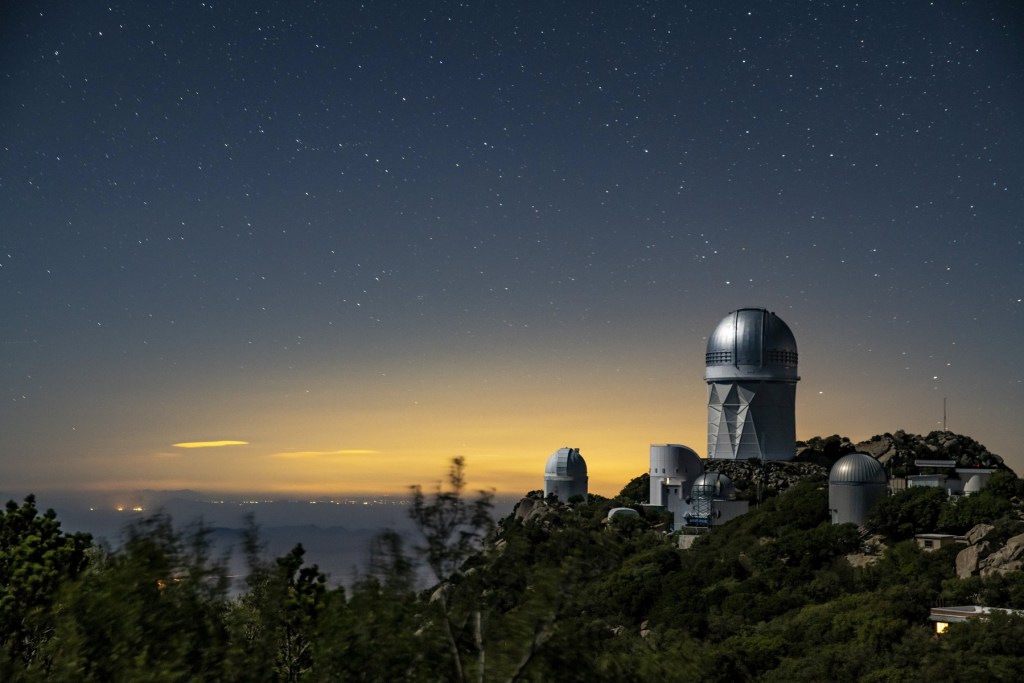
This time, however, the team is not alone in its conclusions. Earlier this year, independent findings by the Dark Energy Spectroscopic Instrument (DESI) observatory in the US state of Arizona suggested that dark energy – and its effect on the universe – may not be constant, but instead evolve and possibly weaken over time. In the new paper, the team also corrected the data to account for possible errors and found that the revised data aligns well with the DESI results.
Will the Universe end in a “Big Freeze”, “Big Collapse” or a “Big Rupture”?
Understanding exactly how dark energy works is crucial for cosmologists trying to predict the fate of the universe. These predictions differ depending on how scientists interpret the shape of the universe, the amount of dark energy, and its influence on the expansion of the universe.
For example, if the expansion of the universe continues to accelerate according to the prevailing view, the universe could reach a maximum chaos threshold and remain slightly above the temperature of absolute zero (−273.15 °C), the thermodynamic state corresponding to the cessation of all forms of particle motion. This “Big Freeze” would gradually extinguish all known stellar processes in the universe. Alternatively, the continued expansion of the universe could cause a “Big Rupture” that would cause matter as we know it to disintegrate down to the subatomic level.
These two scenarios assume that dark energy is accelerating the expansion of the universe. But what will happen if future investigations confirm the conclusions of DESI and the new paper, that dark energy is evolving – or decaying? This would require a complete overhaul of our cosmological models, Lee argues.
“If the universe is already slowing down, this will change the ultimate fate of the universe,” the researcher points out. “Instead of ending with a 'Great Rupture,' a 'Great Collapse' now becomes a possibility,” he argues.
Simply put, a “Big Collapse” scenario would lead to the universe collapsing in on itself, living out its final moments as an enormous fireball burning at near-infinite temperatures. However, the likelihood of one scenario over the other “depends on the actual nature of dark energy and the exact density of the universe, which we still don't have the answer to,” Lee admits.
Lee and his colleagues are currently awaiting the next data from the Vera Rubin Observatory and plan to conduct a similar investigation with samples of 20,000 galaxies.