The Bank of England is waiting for a budget with higher taxes. The cost of credits remains unchanged


publication
2025-11-06 13:16
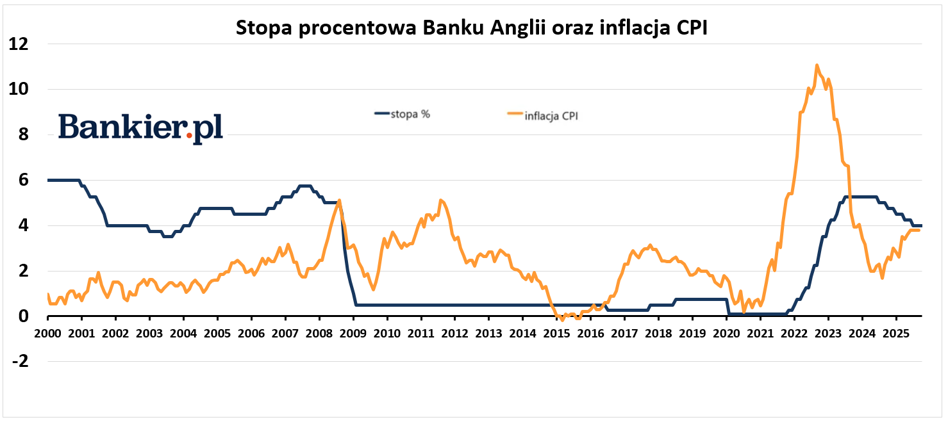
As expected, the Bank of England kept the interest rate at 4%, drawing attention to the potential impact of the new UK budget on subsequent decisions. The vote showed that there is a clear division on the shape of the Bank of England's current monetary policy.
The Monetary Policy Committee (MPC) of the Bank of England decided to leave the reference interest rate at 4%. The decision was made by a vote of 5 to 4, with four members in favor of cutting the rate by 25 basis points and five in favor of maintaining it at 4%.
The Bank of England's decision was not a surprise
The decision was predicted by economists as inflation stabilizes in the UK after its rebound, although the vote itself ended with less support for no change than expected. Economists expected a 6-3 split in favor of maintaining the current situation.
The UK's most recently reported inflation was 3.8%. in September, the same as in the two previous months and at the same time remains the highest among the seven largest developed economies in the world.
Although the inflation level is still almost twice as high as the Bank of England's target of 2%, the latest result surprised economists who had forecast a reading of 4%.
The widespread belief that the Bank of England will again refrain from changing rates also resulted from the fact that the new UK budget will include wide-ranging tax increases, which Chancellor of the Exchequer Rachel Reeves is expected to announce on November 26 during the presentation of budget assumptions.
“The Bank of England is tasked with monitoring indicators such as unused production potential, labor costs and inflation in the services sector, as well as forecasts regarding wage negotiations and the pricing power of companies. This information is key to assessing the risk of CPI inflation returning to the 2% target in a lasting and balanced manner. The Monetary Policy Committee will analyze all data over time, also taking into account upcoming important economic data releases. The British government budget will be announced on November 26 and may influence further decisions of the Bank,” the Bank wrote in a statement after meeting.
Second pause in a row by the Bank of England
This was the seventh MPC meeting this year. During this time, there were three reductions in interest rates. The current cycle of reductions began in August 2024, when the cost of credit was reduced by 25 basis points. In September last year, rates were left unchanged. The Committee did not meet in October. In November, rates were cut by 25 basis points. We had a pause in December.
In February this year, bankers cut rates by a quarter of a percentage point. In March they left the rate unchanged, in May they cut it by 25 bps, and in June there was another pause. At the meeting in August, after an extremely emotional vote (overtime was needed), rates were cut by 25 basis points. In September, the MPC paused again but decided to reduce the pace of its quantitative tightening (QT) program.
To sum up, in the current cycle the Bank of England cut rates by 125 basis points and decided to reduce its reserves of government bonds. The QT slowdown was the first since the Bank of England began reducing government bonds in 2022. However, in the years 2009–2021, the Bank, like other large central banks, purchased bonds worth £875 billion (mainly during the financial crisis and the COVID-19 pandemic).
The last decision of the Bank of England this year is scheduled for December 18.
Michal Kubicki