Ukrainians living in the occupied territories talk about the long way they have to travel to visit their relatives in Ukraine and what drives them to return to a life under Russian occupation, Kyiv Independent reports.
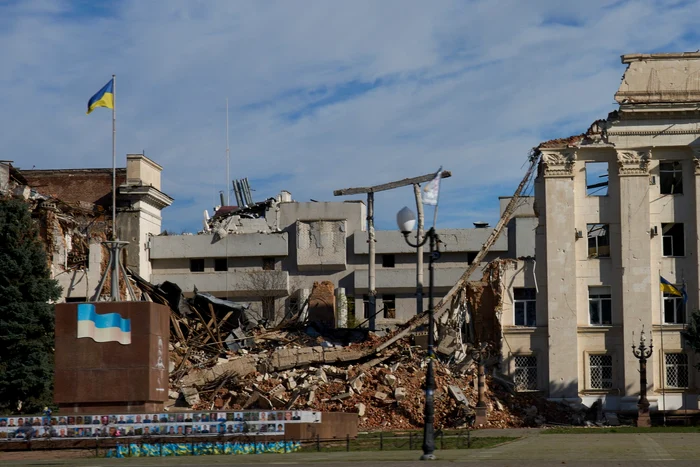
The building of the regional administration in Kherson, southern Ukraine, destroyed by the Russians PHOTO profimedia
“If you only knew how we live. We are constantly afraid of absolutely everything. There are more and more Russians in my area. God forbid I say the wrong thing to my neighbors,” Olena, a pensioner living in the Russian-occupied territory of the Zaporizhia region, confesses through tears.
Having gone to visit the children, she says that she still cannot abandon her home.
“We just built the house… How can we now abandon it and give everything to the Russians?” she says.
The humanitarian corridor Volîn
Located in the northwest of the Volyn region, the Volyn humanitarian corridor is the only functioning checkpoint between Ukraine and Belarus. It is used almost exclusively by people fleeing the occupied territories. The area is heavily fortified.
The last direct Russia-Ukraine route through the checkpoint in the Sumy region was closed in August 2024 amid escalating Russian attacks in the region.
According to the UNHCR report, which monitors the borders, 45% of those crossing the corridor did not intend to stay on Ukrainian territory – 85% of them said they planned to return to the occupied territories and 17% were planning to go abroad to EU countries.
“Currently, the situation at the border is completely under control,” spokeswoman for the 6th border guard detachment, Margarita Vershnina, told the Kyiv Independent. She emphasized, however, that the situation is constantly monitored, as “we do not exclude the possibility of provocations” from Belarus.
According to data provided by the NGO Helping to Leave, which helps those who want to leave under Russian occupation, the number of people using the corridor has increased ninefold since the beginning of the year.
Life under occupation
“People say they no longer have the strength to stay there. They are being pressured in every way,” Liubov Palivoda, administrator of the Helping to Leave organization, told the Kyiv Independent.
In the fall, trips are more frequent, he explains, due to issues related to water resources, energy and heating in the cold season.
“Living under Russian occupation is suicide,” says 20-year-old Andrii, who lives in the occupied part of the Zaporije region. He describes the harsh living conditions, exacerbated by the fear of being constantly surrounded by the enemy.
“It's scary to be on the street next to Russian soldiers — I don't know what's going on in their minds, they might shoot you or something.”
Ukraine has documented a long list of war crimes in the occupied territories: torture, forced conscription to fight against its own country, sexual violence, kidnapping of Ukrainian children to be adopted in Russia or trained to become soldiers.
While the Kremlin focuses on turning occupied Ukraine into a giant military base from which to launch attacks on the rest of the country, the basic needs of the population are being neglected. Some territories are experiencing drought and water shortages.
The reasons why most Ukrainians return to the occupied territories
At the checkpoint, a middle-aged woman who lives in the occupied part of the Lugansk region says that she came to visit her relatives in Ukraine. She says she has to return in a few weeks to take care of her mother, who is too ill to travel.
“Living under occupation, everyone is waiting for their homes to be freed so they can work their land, bake bread, plant watermelons, pumpkins and do everything they did before the war,” Serhii, coordinator of the Helping to Leave organization, explains to the Kyiv Independent.
A long way
An arduous journey awaits those who decide to leave.
An elderly couple from the Lugansk region, who were traveling for the first time since the beginning of the war to visit their children in Kharkiv, reported that they had been on the road for three days.
Before the full-scale invasion of Russia, the same route took five hours.
To reach Ukrainian-controlled territories, Ukrainians living under occupation travel by private buses organized by volunteers or by train.
But not only the road itself is a chore, but also the passage through the Russian and Belarusian checkpoints.
“I was afraid that the Russians would stop me somewhere and find out that I was going to Ukraine,” reports Andrii, who failed on the first attempt.
“You have three months to reflect and not go there,” the Russian border guards told him. But he persevered. He could choose the easy way: ask for a Russian passport. Only that would have meant mandatory military service and the risk of being sent to fight against one's own country.
“When we got closer to Ukraine and saw our flag in the distance, I realized I was going home. I felt so calm because there was no threat from Ukrainian soldiers. Then I realized everything will be fine and I have nothing to fear,” he says.
The sense of relief at escaping Russian-occupied Ukraine, if only temporarily, is palpable among those who have passed the checkpoint.
A woman from the Luhansk region beams with joy as she calls her children to let them know she made it through.
Serhii is loading people's belongings into the vehicles in which they will continue their journey when he comes across numerous large, heavy jars of canned food. Confused, he asks why anyone would carry such bulky luggage when they have a long journey ahead of them.
“Because they're homemade, by mom,” replies a woman in the crowd.