Nobel Prize for “creative destruction”. How Mokyr, Aghion and Howitt explained innovation-driven growth [KOMENTARZE]


Nobel Prize winners combine economic history, growth theory and empirical research on innovation. Joel Mokyr (Northwestern University) in his historical works convincingly described the cultural and institutional conditions that made the technological revolution possible and its perpetuation – from the culture of growth to the role of scientific practices. Mokyra University reminded today that his achievements concern the long duration of the innovation process and the sources of modern prosperity.
Philippe Aghion (Collège de France, INSEAD, LSE) and Peter Howitt (Brown University) built a mathematical model of “creative destruction” – a Schumpeterian mechanism in which new products and technologies displace old ones, changing the structure of markets and demand. Their groundbreaking 1992 work showed how competition for innovation and the expectation of further improvements shape companies' decisions to invest in research and development and, consequently, the rate of productivity growth.
Comments from Poland
The scale of the impact of this research on thinking about public policy is well reflected in the opinions of the Polish academy. “They built an entire conceptual apparatus that allows us to look for appropriate economic policies… to think about the innovation process,” says Prof. Joanna Tyrowicz, adding that is today a “mainstream concept” of teaching about innovations and their consequences. He also draws attention to Joseph Schumpeter's inspiration and the tension between the value of new technologies and the “destruction of demand” for older solutions.
“Researchers… have shown that innovation is the cause of growth,” emphasizes Prof. Michał Brzeziński, recalling that the first model of qualitative technological leaps became the foundation of a whole wave of research on how public policies can stimulate innovative growth.
“It's creative destruction,” adds Prof. Paweł Kaczmarczyk, combining Mokyr's historical approach with Aghion and Howitt's models and emphasizing the role of institutions and culture in promoting technological breakthroughs.
This year's decision of the Academy comes in the context of today's concerns about slowing productivity, geopolitical tensions and technological race in areas such as AI or biotechnology. Aghion himself has repeatedly warned that trade protectionism and the dominance of technology giants may weaken the dynamics of innovation — strong competition rules and wisely designed industrial policy are needed. It is at the intersection of competition and support for strategic areas that Nobel Prize winners today see room for action by decision-makers.
The award ends this year's Nobel week and is part of the longer history of the distinction established by Sveriges Riksbank in 1968 and first awarded in 1969 to Ragnar Frisch and Jan Tinbergen for their contribution to modeling economic phenomena. It's a reminder that for decades, Nobel economics has rewarded tools that help us better understand and measure change – today, especially those brought by a wave of innovation.
Full comments
We also publish comments from Polish experts:
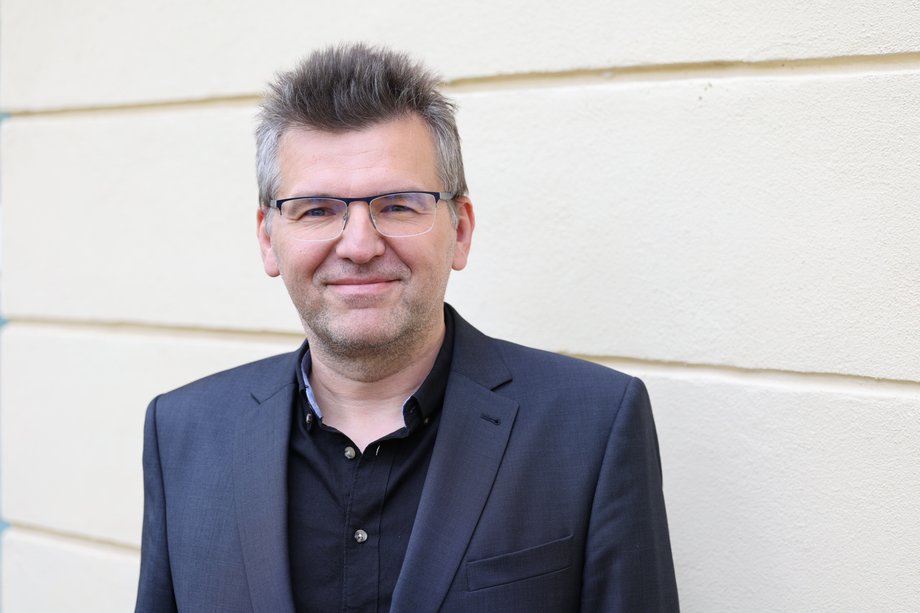
prof. Ph.D. Michał Brzeziński, Department of Political Economy, Faculty of Economic Sciences, University of Warsaw.
|
Photo Krystian Szczęsny, source: CWiD UW
“Researchers who began to model economic growth as a phenomenon caused by innovations showed that innovations are the cause of growth” — prof. Ph.D. Michał Brzeziński, Department of Political Economy, Faculty of Economic Sciences, University of Warsaw. Prof. Michał Brzeziński also adds:
- The award is both expected and somewhat surprising because it consists of two parts. Part one: two researchers – theoreticians and empirics of growth, creating mathematical models of the causes of growth and the impact of public policies.
- Part two: Joel Mokyr, an economic historian who deals not with mathematical models but with the history of technological progress.
- Makyr's thesis: Europe's “culture of growth” – a broad belief in the importance of science and scientific practices – fueled technological progress. The work of this year's winners provides a theoretical basis for the intuition that innovation drives economic growth.
- Key theoretical contribution: first model in which growth comes from introducing better quality new products. Further research shows how different public policies stimulate innovation-driven growth.
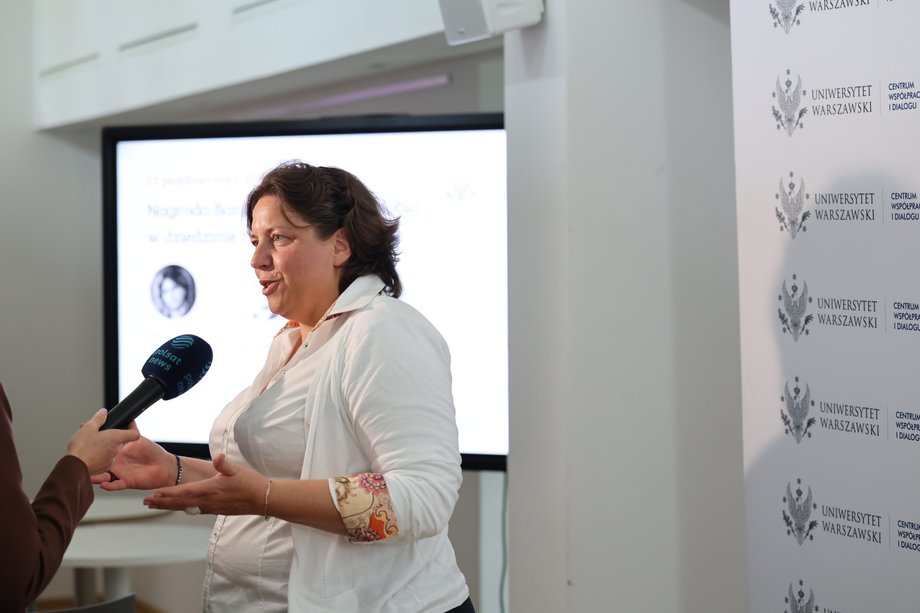
prof. Ph.D. Joanna Tyrowicz, Faculty of Management, University of Warsaw.
|
Photo Krystian Szczęsny, source: CWiD UW
“It's not that they said: growth comes from innovation – they just built a whole great conceptual apparatus” – prof. Ph.D. Joanna Tyrowicz, Faculty of Management, University of Warsaw. Prof. Joanna Tyrowicz also emphasizes that:
- This is one of the most obvious Nobel Prizes in recent years. At the turn of the 1980s and 1990s researchers were dissatisfied with the then understanding of the sources of growth.
- There was a lack of mathematical rigor in showing how innovations arise and translate into growth.
- Two rounds of research: first by Paul Romer (continuous creation of new types of products), but the model did not describe the entire nature of innovation. Aghion and Howitt referred to Schumpeter: innovation increases value for users, but at the same time destroys demand for the older product (example: ballpoint pen vs. ink pen).
- They built a mechanism in which companies invest in innovations, pricing in the risk that someone will introduce something better. They determined the optimal level of investment in innovation; this allows us to ask about its compliance with the social optimum.
- They enabled a discussion on optimal economic policy and solutions on the business and financing sides. The conceptual apparatus allows for analyzing the prospects of the labor market, influences on other areas of the economy and side effects of innovations.
- The concept is mainstream today, and the Aghion–Howitt model is discussed already in the second year of macroeconomics.
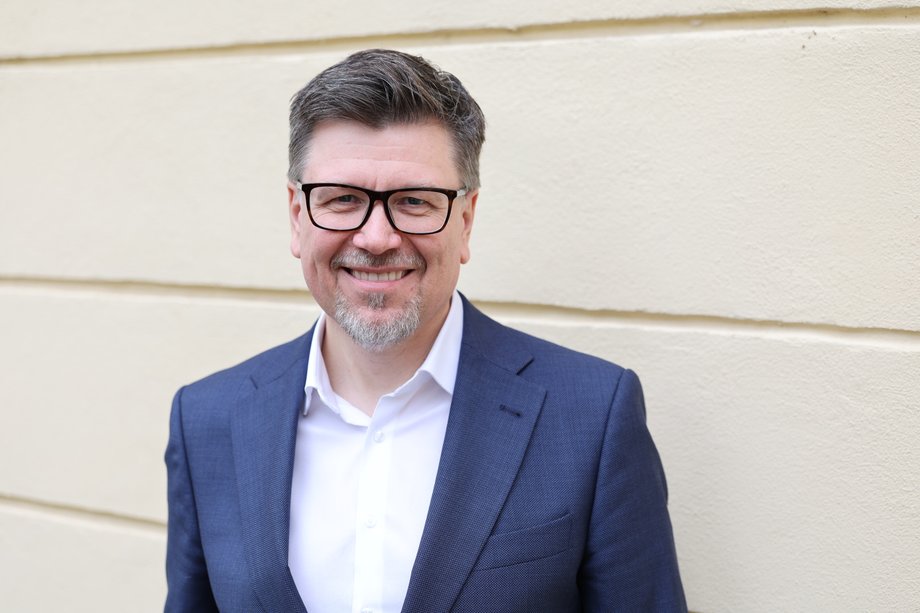
Ph.D. Paweł Kaczmarczyk, prof. student, Department of Population Economics and Demography, Faculty of Economic Sciences, University of Warsaw
|
Photo Krystian Szczęsny, source: CWiD UW
“This is the creative destruction mentioned in the Nobel Committee's justification” — Dr. hab. Paweł Kaczmarczyk, prof. student, Department of Population Economics and Demography, Faculty of Economic Sciences, University of Warsaw. Prof. Paweł Kaczmarczyk added:
- It is a combination of two aspects: economic history and a long-term view of growth with very current research.
- There is a visible reference to Daron Acemoğlu and the role of culture and institutions in the works of Joel Mokyr.
- This is the fundamental importance of innovation for the economic growth process. We have two approaches: the impact of innovation on growth and how market structures shape innovation and how innovations change these structures.
- The duo of laureates as an example of successful cooperation between American and European science.