Romanians harvest almost one million tons of grapes annually, and most is used for wine production. But these seasonal fruits are also recognized as “superfoods”, due to their spectacular effects on health.
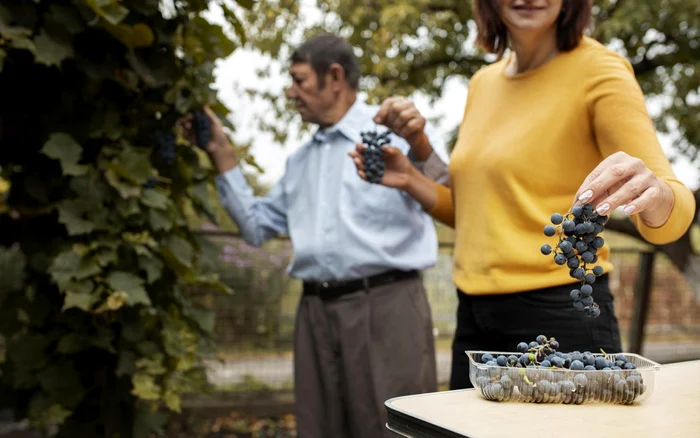
Grapes are considered by some scientists as a superficial. Photo: freepik.com
Romanians have always had a special relationship with vines. The grapes have been cultivated for millennia on the territory of Romania and became part of the identity of some regions, such as Vrancea, Dobrogea, Oltenia and the hilly lands of Transylvania.
Grapes, older than legends
The Viei culture has found favorable climatic conditions here, especially on the sandy soils in the hill areas. Along with the appreciated qualities of the grapes and their use in wine production, the cultivation of vineyards also represented a way to capitalize on less favorable lands, such as sandy slopes.
Historic ad xenopol noted that “The old homeland of the Geto-Dacians, Thrace, was a wine region, a cause for which it was considered as the birthplace of the god of wine, Dionysos”.
Other poets and authors of Antiquity, such as Ovidius and Vergilius, wrote about the way of life of the ghettos in Dobrogea and their inclination to wine.
A known legend has King Get Burebista as a hero, who would have forced his subjects to give up wine, ordering the destruction of the vineyards.
“As a proof for the obedience that the ghettos were giving it is the fact that they were able to cut the vines and live without wine,” informs the High History Strabo, two millennia ago.
Since the Middle Ages, the hilly regions of Moldova, Oltenia, Banat, Transylvania and Dobrogea have developed strong wine -growing traditions, and their vineyards have become famous.
In the 1990s, the area cultivated with vines on fruit in Romania amounted to about 250,000 hectares, the reports published by the National Institute of Statistics show. It has gradually decreased since the 2000s, reaching 203,430 hectares in 2024, according to INS data. Over 95 percent of the vineyards in Romania are intended for wine production, and among the counties with the largest areas covered by Viracea, Buzău, Vaslui, Iași and Dolj, the same statistics show.
In the 1990s, in Romania there were over one million tonnes of grapes, with a record of over 1.3 million tonnes of grapes in 1993. The last few years were less prolific for harvests, in 2024, the production registered, according to statistics, being just over 700,000 tonnes. And here, Vrancea ranks first, with over 160,000 tonnes, made in 2024.
Cure with grapes and its effects on health
Over time, scientists have recognized both the nutritional value of the grapes and the curative. The therapeutic effect is due to the content rich in water, potassium and carbohydrates, but poor in salt and protein, notes the doctor George Theodoru. It recommends to Romanians, since 1986, “grape cure”, intended for adults, provided they do not suffer from fermentation or diabetes.
“Grapes are recommended in kidney disease, but also in cardiovascular diseases. Their diuretic action is well known: increase the volume of urine and the amount of urea, uric acid and sodium chloride eliminated in 24 hours. They also reduce your blood pressure, easing the heart work and improving the circulation. And they reduce its absorption in the blood ”, explains the doctor.
The cure of grapes consists, according to the specialist, in the gradual consumption of grapes as the main food, for a long enough period to produce significant changes in digestion, metabolism, circulation, tension and even in neuropsychic state.
“The grapes are consumed before meals (in the morning on the non -tin, then at 11 and 18 hours). It starts with a few bunches (150–250 g), increasing progressively up to 1-2 kg per day, depending on tolerance, appetite and weight, and after 5-6 weeks the quantity is gradually reduced. Followed by the nature of the disease: a little meat, an egg, cheese, pasta, and the physical exercise remains mandatory ”said the doctor, in the magazine Health.
Even at daily dessert consumption (150–200 grams), the general health improves, adds the specialist.
The grapes, the superfood in the Romanian gardens
The positive effects of grape consumption are confirmed by numerous recent studies. One of the most notable was published this year in the American scientific journal Journal of Agriculture and Food Chemistry and explores the concept of “superfood”, arguing that fresh grapes deserve an important place in this category.
The author of the research is John M. Pezzuto, a scientist specialized in the study of resveratrol, a natural compound in the family of polyphenols, present in the grape peel. The conclusions of his work show that grapes are a natural source for over 1,600 compounds, including antioxidants and polyphenols such as flavonoids, anthocyanidins, catechins, phenolic acids and resveratrol.
“Polyphenols are considered responsible for the benefits of grapes on health, through their antioxidant activity and by influencing cellular processes. But the biological effects come from the whole grape and the unique matrix that it contains, not from a single isolated ingredient,” He is shown in the study, quoted by Science Daily.
According to the scientist, the role of grapes in maintaining cardiovascular health is well documented: they contribute to the relaxation of blood vessels, to a healthy circulation and to regulating cholesterol level.
Clinical studies also show that grapes support brain health (by maintaining a healthy brain metabolism and improving cognitive functions), skin health (increasing resistance to UV radiation and reducing cell DNA damage), intestine health (by modulating microbiome and increased diversity) optical density of macular pigment).
Grapes, benefit for memory
Other recent medical studies complete the existing data and suggest a positive influence on grape consumption on cognition, especially in areas such as memory, learning, general cognitive function and emotional state. These conclusions appear in a scientific research entitled “The efficiency of interventions based on grapes on cognitive and mental health: evidence from people's clinical studies”, published by the National Center for Biotechnological Information in the US.
The publication shows that grapes contain compounds with antioxidant and anti -inflammatory properties, which can have a protective effect on the brain. They contribute to reducing inflammation at the brain level and protects the nerve cells from the damage caused by free radicals – unstable molecules responsible for premature aging and the onset of neurodegenerative disorders.
“Evidence from current research suggests that grape interventions can improve cognitive performances through several neuroprotective mechanisms; however, additional investigations are needed to fully understand the protective effects of these interventions on brain functions and mental health,” says the authors of the medical school. (India).
Whole grape juice or red wine
Grapes are among the most cultivated and consumed fruits in the world, but they also have interest through their derivatives, especially natural juice and wine. Although both come from the same fruit, the whole grape juice and red wine differ considerably in the chemical composition, production methods, post-harvesting handling and health effects, a recently published research shows on the Sciencedirect platform, which compares the two drinks.
According to its authors, grape juice is processed by the body through specific absorption and digestion mechanisms, influencing the metabolism and activity of digestive enzymes, while red wine, due to alcohol, is metabolized in the liver through oxidative paths that, in the long term, can be risky in the event of excessive consumption.
However, both drinks have a beneficial effect on the intestinal flora, contributing to balancing the relationship between intestinal bacteria and increasing the number of “friendly” bacteria, such as Lactobacillus, which supports a healthy digestion and a general well -being.
“The grape juice has a higher symbiotic potential, while the wine provides greater content of phenolic compounds and increased bioactivity, supporting cardiovascular health. Consumer preferences are determined by multiple factors, including sensory characteristics, such as aroma and taste. Both drinks can be part of a balances Moderation ”, concludes the research conducted by university institutions in Brazil.