President Maia Sandu has been successful again. Her pro -European Action and Solidarity Party (PAS) won over 50 percent on Sunday. votes in the parliamentary elections in Moldova, securing the majority again.
For the Kremlin it is a serious blow. Moscow tried everything to influence the result of the election: she bought votes for millions, led disinformation campaigns, threatened with bombings to polling stations. However, Moldovan voters remained adamant and They sent a bright signal to Moscow: We want to be part of Europe. Experts explain why Putin will not give up and what is going on for him.
– This result is a geopolitical failure for Russia – says Russian expert Ulrich Schmid from the University of St. Gallen. Moscow focused on the “Georgian script”, in which the pro -Russian parliamentary majority indirectly sabotage to join the EU. – Now, however, the following picture is drawn: Moldova is becoming more and more away from Moscow, supported by Romania as a strong spokesman in Brussels – he notes.
Continued article under video material
For a Russian dictator, this is a bit bitter failure. For years, Russia has been investing huge funds in Moldova – not in infrastructure or economy, but in influence. Through the separatist region of Transnistria Moscow has a military pressure in his handfinances pro -Russian parties and organizes propaganda campaigns. Goal: stop or at least delay joining the EU.
“As long as the question of Transnistria is not resolved, Moscow can block the West,” says Schmid.
From troll factories to fighter troops
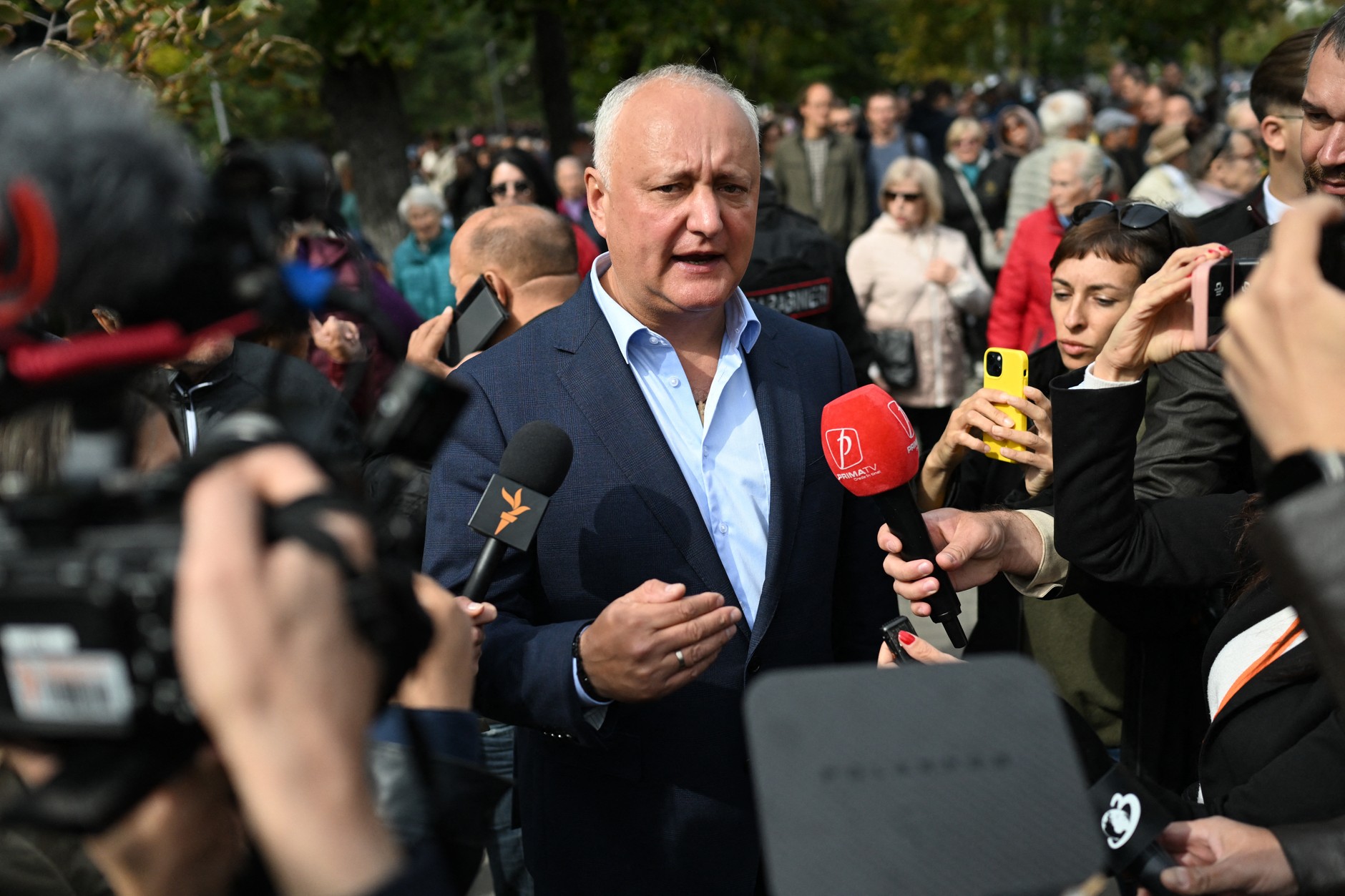
How will the Kremlin react? According to Marcel Hirsiger, an expert on Eastern Europe from the University of Applied Sciences in Switzerland “Russia will continue to increase pressurepolitical, economic and with the help of hybrid means. “Already on an election, pro -Russian politician and former president Igor Dodon called for mass protests. The same evening a few people were arrested – two of them had connections with the Transnistria. – This is only a foretaste of what awaits us – warns Schmid.
Former President of Moldova Igor Dodon during a protest before the parliament in Chisinau, September 29, 2025.Artur Widak / Agencja Anadol / Agencja Anadol Via AFP / AFP
– the scenario cannot be ruled out similar to the one from Donbassin which the Russian minority feels discriminated against and turns to Moscow for help – says Hirsiger. Cyberrataki for infrastructure and state institutions is also possible to challenge public trust in the state.
Experts now believe that the open war, such as in Ukraine, is not very real. – Russia's resources are related to the war in Ukraine, and the armed conflict for Moldova would not find support among the Russian people – emphasizes Schmid. Nevertheless, the threat has not been eliminated: in Transnistria it is stationed to 1.5 thousand. Russian soldiers who can be used as a means of pressure at any time.
Signal for post -Soviet countries
Why is the Kremlin so fierce? – Moldova has less economic importance for Russia, but great symbolic meaning – explains Hirsiger. – If a country with such close historical connections with Moscow successfully enters the road to the EU, this may encourage other countries to similar activities – he adds. So Putin is about more than just Moldova – it's about a message for the entire post -Soviet environment: who turns to the West, he must take into account the consequences.
For Brussels, the election victory is triumphant, but it will also be a test test. The EU must now prove that he not only sends telegrams with congratulations, but is ready to support Moldova politically, economically and in security. This means targeted energy supply investments, support in the fight against corruption and disinformation, as well as help in creating defense mechanisms against cyber attacks and hybrid threats. Only when society feels a specific improvement, the pro -European course can remain stable.
Hirsiger sums up that Putin has suffered a painful defeat and probably will not leave it unanswered. So it's not about will Moscow react, but how it reacts – And will Europe be able to answer it.
I’m Ashley Davis as an editor, I’m committed to upholding the highest standards of integrity and accuracy in every piece we publish. My work is driven by curiosity, a passion for truth, and a belief that journalism plays a crucial role in shaping public discourse. I strive to tell stories that not only inform but also inspire action and conversation.