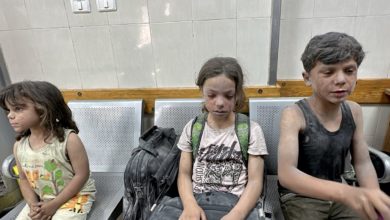
“We have localities where almost all children are unvaccinated.” The disease that killed 30 Romanian children


“We have accumulated a very large amount of anti-vaccine opinions. Those who suffer the first are the children,” says Dr. Gindrovel Dumitra, the coordinator of the vaccinology group of family doctors in Romania.
- The article is part of the PULSE project, an international journalistic consortium in which Hotnews is a part and providing the public documented and diverse perspectives, with information from several countries, about issues of great public interest. The article was written by Alina Neagu (Hotnews – Romania), along with Justė Ancevičiūtė (Delphi – Lithuania) and Julie ŠaFová (Deník Referendum – Czech Republic).
30 children have died of measles in Romania in the last 2 and a half years – between January 2023 – June 2025, the data centralized by the National Institute of Public Health shows.
Between September 2023 – August 2024, Romania went through the second measles epidemic over 7 years.
Even Kazakhstan's under us
Our country registered more than three quarters – 77.8% – of all measles cases in Europe, during this period, according to the “Health at Glance: Europe 2024.
Last year, Romania reported 30,692 measles cases, the data of the World Health and UNICEF organization shows. Our country was followed by Kazakhstan (country also by WHO in the European region) with 28,147 cases.
Europe registered, in 2024, the largest number of measles for the last 25 years – 127,350 cases, according to the data of the World Health Organization. Romania has a quarter of these cases.
Although globally, the number of illnesses is increasing, there are countries that have almost managed to eliminate the disease.
Lithuania registered, in 2023, only 3 cases of measles. In 2024, he had 10 cases. The highest incidence of measles in Lithuania was in 2019, when there were 834 diseases.
The large number of diseases at the global level is attributed, first of all, to decrease the vaccine coverage during and after the Covid-19 Pandemic, it indicates a report published in March by UNICEF and the World Health Organization.
Decreasing vaccination
Vaccine immunization is the only safe way to prevent measles illness-a more contagious viral disease than Covid-19, say doctors. However, the data available at the National Institute of Public Health at this time indicate a decrease in vaccine coverage, says Dr. Gindrovel Dumitra.
In the field of vaccination, Romania is at the tail of the European standings, together with Bosnia and Herzegovina and Montenegro, countries where vaccination rates were between 50% and 70%, in the last 5 years, the data of the World Health and UNICEF organization shows.
And the illnesses and deaths are directly correlated with the degree of vaccination.
Only 6 out of 10 children are vaccinated at 5
If before the pandemic, our country had managed to reach an 80% vaccine coverage in terms of the first dose of ROR vaccine, now “the figures are somewhere at 70% or slightly over,” says Dr. Gindrovel Dumitra.
The first dose of ROR vaccine (against measles, mumps and rubella) is administered from one year. For the second dose of vaccine, which is administered at the age of 5, the vaccination rate is even lower: around 60%. The vaccine is given free in the family doctor's office.
This is when the vaccination rate considered safe to avoid the spread of the disease is 95%: “and not as an average at national level, but on each county,” says the doctor.
It was not a supply issue
By comparison, Hungary has a vaccination rate of almost 100%, being closely followed by Portugal, Slovakia, Austria, Germany, France, Slovakia, Germany and Sweden.
If at the previous epidemic, declared in 2016, there were Syncope supply with the ROR vaccine, “in recent years we have had access to vaccines, and this problem has not existed,” says the coordinator of the vaccinology group of family doctors, in the dialogue with HotNews.
Barriers in the way of vaccination
However, ROR is the vaccine with the highest refusal rate in Romania, according to the data of the National Institute of Public Health.
“The story comes from 1998, from that alleged connection with autism. It is the vaccine to which the Romanian parents have the greatest reluctance. From there everything is drawn, although it has been demonstrated countless times that there is no connection. But it is just to induce the slightest doubt in the general population,” explains the doctor Gindrovel.
The study “Barriers in the way of vaccination in the rural area of Romania”, published in March this year by the Save the Children's Organization, identified four main types of barriers in the path of vaccination, from the perspective of family doctors and community nurses:
- Attitudinal and behavioral barriers include post-Covid-19 reluctance, the categorical refusal of communities and the fear of adverse reactions.
- Socio-cultural barriers are represented by cultural, linguistic, religious and high mobility of families.
- At the informational level, the negative impact of the media, misinformation on social networks and myths about vaccination are major obstacles.
- In addition, there are systemic barriers such as excessive bureaucracy, lack of material resources, abolishing vaccination in schools and lack of transport.
“We have localities where almost all children are unvaccinated”
Family doctor in Sadova commune in Dolj County, Gindrovel Dumitra became known after convincing all his parents in his locality to vaccinate their children, during the measles epidemic erupted in 2016.
The second recent measles epidemic, broke out in 2023, found the doctor without any measles among his patients in the last 17 years and with all the children in the vaccinated list.
Gindrovel Dumitra says he had no cases of parents who failed to convince them to vaccinate their children. He admits that he had, instead, cases of parents “who had reluctance”. But who, after explaining them, chose to immunize their children.
Asked what he thinks would be the solution for several reluctant parents to be convinced, the environment says he does not believe in a general solution, which works at national level. He talks about rather specific, specific solutions.
“If children who are not vaccinated will be analyzed, we will see that we have a feature: in certain areas, in certain localities, almost all children are unvaccinated. Why? Because this is the social norm in the respective area: non -vaccination.”
Continuation of the subject that affects the lives of Romanian children, the following days in Hotnews.

The PULSE project is a European initiative to promote cross-border journalistic partnerships, co-financed by the European Commission (DG Connect) within Multimedia actions by Grant Agreement LC-0272862. HotNews.ro collaborates in the project with other prestigious publications in Europe: Delfi (Lithuania), Deník Referndum (Czech Republic), the largest Austrian newspaper Der Standard (Austria), some of the largest publications in Greece – Efsyn, El Confidential, Spain, the largest Polish newspaper Gazeta Wyborcza, the oldest analytical and information site. MediaPool, one of the largest HUVG HUVG and Italian newspaper with economic profile for 24 hours, one of the oldest and most powerful publications in the peninsula.
Three renowned transnational media organizations-OBCT (Italy), N-OST (Germany) and Voxerop (France) will coordinate the project activities.