Over half of the Romanians say that all the parties now have to disappear and replace, according to an Inscop survey


A percentage of 55% of Romanians agree with the claim that all the parties in the country must disappear and replace, according to an Inscop survey that showed and that half of the respondents said they would vote for a new party.
“The high level of dissatisfaction of the population towards the current political parties, highlighted by the 55% of Romanians who declare that they would like their disappearance and replacement with new parties and 50% who declare that they would vote a newly established party suggest not only a trusted crisis in the traditional political class, but also to the political system, Remus Stefureac, director of Inscop Research.
Moreover, he emphasized, the share of those who would vote for a new party increased from 30% in 2015 to 50% now, “which confirms, at least declarative, a very high availability of Romanians transforms the dissatisfaction and frustrations into political action.”
“The demographic profile of those who want to replace the existing parties and would be willing to vote new ones show that young people in particular (18-29 years, but also 30-44 years) are more dissatisfied with the existing parties and willing to vote with new parties.
Most Romanians agree with the disappearance of all current parties
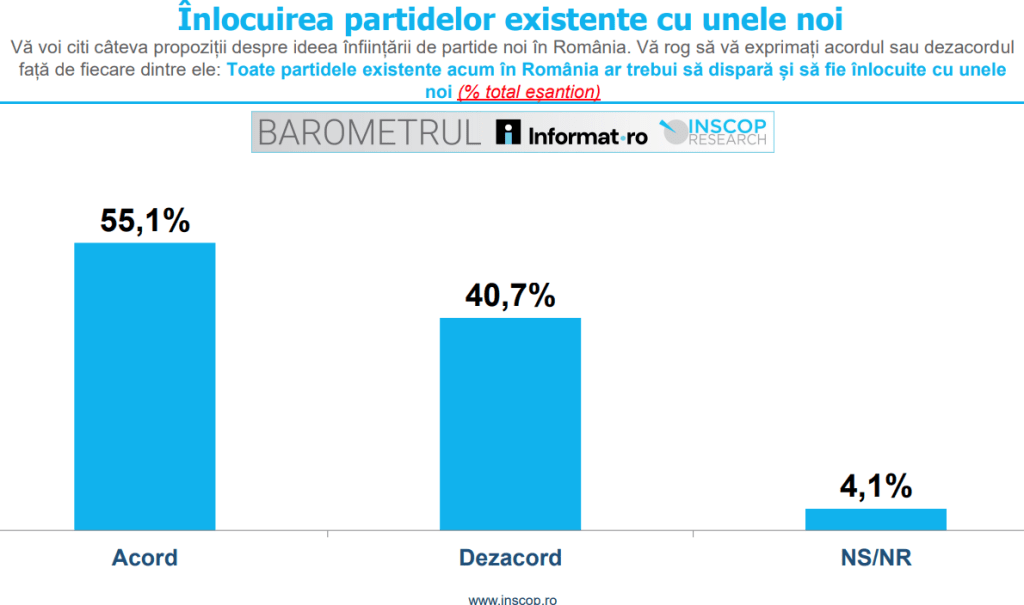
I agree with the statement “All parties existing in Romania should disappear and be replaced with new ones” 45% of PSD voters, 34% of PNL voters, 33% of USR voters and 71% of gold, respectively 58% of men and 53% of women, 62% of young people up to 30 years old, 58%, 58%, 58%, 58 between 45 and 59 years and 52% of over 60 years. 72% of people with primary education, 55% of those with high school education, 35% of those with higher education, 44% of the residents of Bucharest, 49% of those in Urban with over 90 thousand inhabitants, 61% of those in the small urban and 58% of the rural, respectively 43% of the employees in the state and 57% of those who work in private.
It expresses its disagreement with the statement “All the existing parties in Romania should disappear and be replaced with new ones”: 46% of PSD voters, 64% of PNL voters, 65% of USR voters and 27% of gold, respectively 39% of men and 43% of women, 37% of young people up to 30 years old, with 37%, 37%, 37%, 37%, 37%, 37%, 37%, 37%, 37%, 37%, 37%, 37%, 37%, 37%, 37%, 37%, 37%, 37%, 37%, 37%, 37%, 37%, 37%, 37%, 37%, 37%, 37%, 37%, 37%, 37%, 37%, 37%, 37%, 37%, 37%, 37%, 37%, 37% of 44% People between the ages of 45 and 59 and 43% of those over 60. 22% of people with primary education, 41% of those with high school education, 64% of those with higher education, 55% of the residents of Bucharest, 49% of those in Urban with over 90 thousand inhabitants, 35% of those in the small urban and 36% of the rural, respectively 53% of the employees in the state and 42% of those who work in private.
Gold voters, the most willing to support a new party
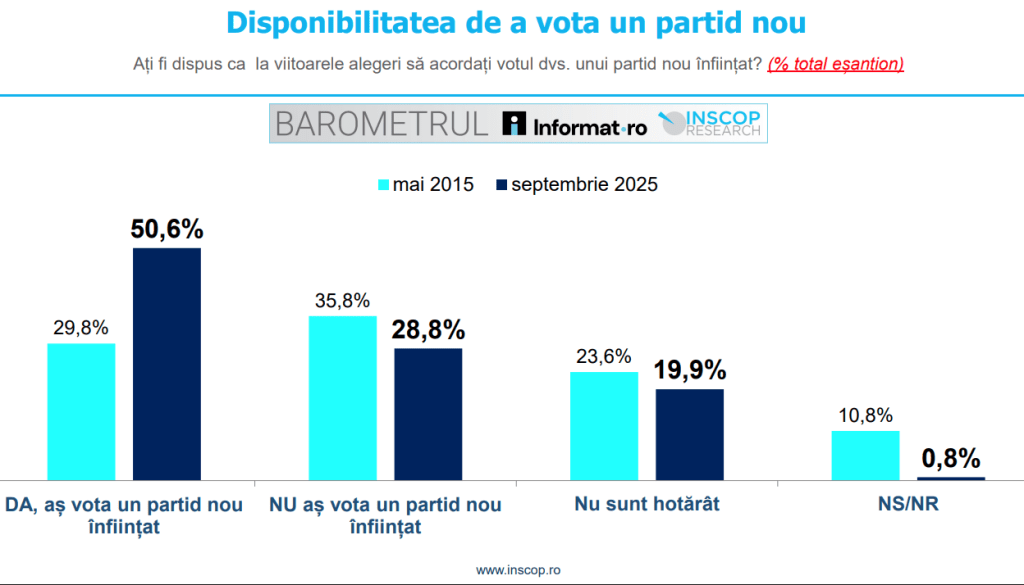
Would be willing to give their vote to a newly established party: 38% of PSD voters, 44% of PNL voters, 50% of USR voters and 60% of gold, respectively 54% of men and 48% of women, 64% of young people up to 30 years old, 57% of those between 30 and 44 years old, 53% of people between 45% and 59% 60 years. 53% of people with primary education, 50% of those with high school education, 49% of those with higher education, 46% of the residents of Bucharest, 52% of those in Urban with over 90 thousand inhabitants, 54% of those in the small urban and 49% of the rural, respectively 46% of the employees in the state and 60% of those who work in a new party would be ordered to a new party.
They would not be willing to give their vote to a newly established party: 42% of PSD voters, 34% of PNL voters, 34% of USR voters and 21% of gold, respectively 27% of men and 30% of women, 18% of young people up to 30 years old, 23% of those between the ages of 30 and 45 years, 27% of people between 45 and 40% of 40%. 26% of people with primary education, 31% of those with high school education, 25% of those with higher education, 26% of the residents of Bucharest, 31% of those in Urban with over 90 thousand inhabitants, 28% of those in the small urban and 29% of the rural, respectively 25% of the state employees and 22% of those who work in a new party would not be ordered.
They are not determined: 20% of PSD voters, 22% of PNL voters, 16% of USR voters and 19% of gold, respectively 18% of men and 22% of women, 17% of young people up to 30 years old, 19% of those between 30 and 44 years old, 18% of people between 45 and 59 years old and 23%. 20% of people with primary education, 18% of those with high school education, 24% of those with higher education, 27% of the residents of Bucharest, 17% of those in Urban with over 90 thousand inhabitants, 17% of those in the small urban and 22% of the rural, respectively 28% of the employees in the state and 17% of those who work in private.
- Inscop survey methodology: The data were collected between September 1-9, 2025. The research method: interview through the questionnaire. The data were collected by the CATI method (telephone interviews), the volume of the simple sample, stratified by 1103 persons, representative on the significant socio-demographic categories (sex, age, occupation) for the non-institutionalized population, aged 18 years and over. The maximum admitted error of the data is ± 2.95%, to a degree of 95%.