The trial of Serhii Kuznetsov, a former Ukrainian military officer alleged to have orchestrated the September 2022 attack on Russia’s largest gas pipeline to Europe, commenced in Germany on Wednesday with a surprising defense argument presented by his lawyers.
Kuznetsov is accused of leading a group of Ukrainian agents, including divers and an explosives expert, who executed the sabotage of the Nord Stream pipelines, marking one of the most significant infrastructure sabotage operations in modern history.
This case presents the first opportunity for public examination of evidence gathered during a multi-year investigation that has strained diplomatic relations for the German government, which continues to staunchly support Ukraine despite evidence linking Kyiv to the attack.
Nicola Canestrini, one of Kuznetsov’s attorneys, requested the case be dismissed, arguing that the pipelines, which accounted for half of Germany’s natural gas imports before Russia’s invasion of Ukraine in 2022, were a “Russian weapon.”
Consequently, he maintained, the pipeline could be considered a legitimate target. “Is it illegal to destroy the infrastructure of an aggressor without harming any human beings?” asked Canestrini rhetorically.
Ukrainian Officer Remains Silent in Court
Prosecutors contend that Kuznetsov, who was arrested in Italy last year under an international warrant, collaborated with members of the Ukrainian military to plan the clandestine operation on behalf of unidentified Ukrainian state entities.
The 50-year-old former officer, previously referred to only as Serhii K. in accordance with German privacy laws, has denied any involvement in the explosions that damaged the pipelines in the Baltic Sea.
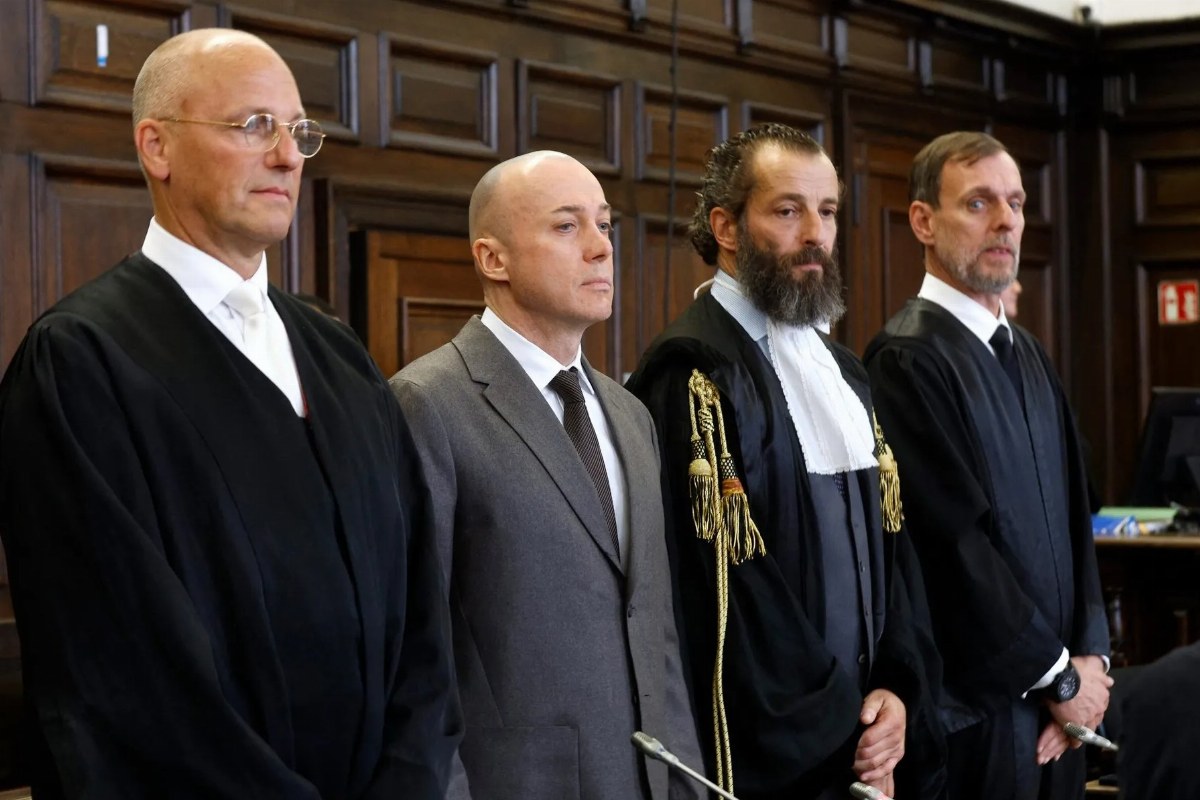
Dressed in a gray suit and shaved head, he exercised his right to remain silent in court without covering his face. His lawyers claimed he cannot prepare an adequate defense, as he is bound by Ukrainian state secrecy.
“He must prepare his defense with his hands tied,” said Canestrini.
The Ukrainian government has also denied any involvement in the sabotage, a sensitive issue given its relationship with Germany, the largest European military aid provider to Ukraine.
On Monday, Russia expressed hope for a “just verdict” that would reveal the identities of those who committed and ordered the operation.
German Prosecutors’ Stance
The prosecution argues that the actions attributed to Kuznetsov—attacking civilian targets and causing explosions that destroyed infrastructure and disrupted public services—constitute a war crime.
Protesters gathered outside the Hamburg court to show support for the defendant, with one sign reading: “What are war crimes?”
“Russia is the only war criminal that should be in the dock,” declared one of several dozen demonstrators.
Kuznetsov is the only individual on trial, although Croatian authorities have arrested another man, identified as Vladimir Z., believed to have been one of the divers.
The Nord Stream pipeline explosions marked the end of Germany’s long-standing dependence on Russian natural gas, although Moscow had already reduced supplies in response to Berlin’s support for European sanctions imposed after the invasion.
Nord Stream’s capacity was set to double with the activation of a twin pipeline, Nord Stream 2, which had already been constructed. However, Berlin canceled the necessary approval for its launch shortly before the Russian invasion.
When Will the Verdict on the Nord Stream Bombing Be Delivered?
Defense attorneys expect the trial could extend until February of the following year.
In the months immediately following the attacks on Nord Stream, Western officials primarily pointed fingers at Russia. Moscow has consistently denied any involvement and dismissed as absurd the notion that it would sabotage its own pipelines.
The Nord Stream system, situated between 80 and 110 meters deep in the Baltic Sea and constructed by Russian company Gazprom to supply Germany with up to 110 billion cubic meters of gas, previously stood at the center of economic relations between the two countries.
The explosions on September 26, 2022, damaged three of the four steel pipelines encased in concrete, creating a massive whirlpool in the sea, while immense columns of methane gas rose into the atmosphere.
Prosecutors allege that Kuznetsov traveled to Germany via Poland approximately three weeks prior to the attack, using a forged Ukrainian passport. Subsequently, he and his team reportedly utilized a rented sailboat from Rostock, northern Germany, to reach a location near the Danish island of Bornholm, where they installed specialized military-grade explosives on the seabed.
Weekly magazine Der Spiegel and public broadcaster ZDF previously reported that five men and one woman were aboard the rented yacht “Andromeda,” which departed Rostock on September 6 and returned on September 23, 2022.