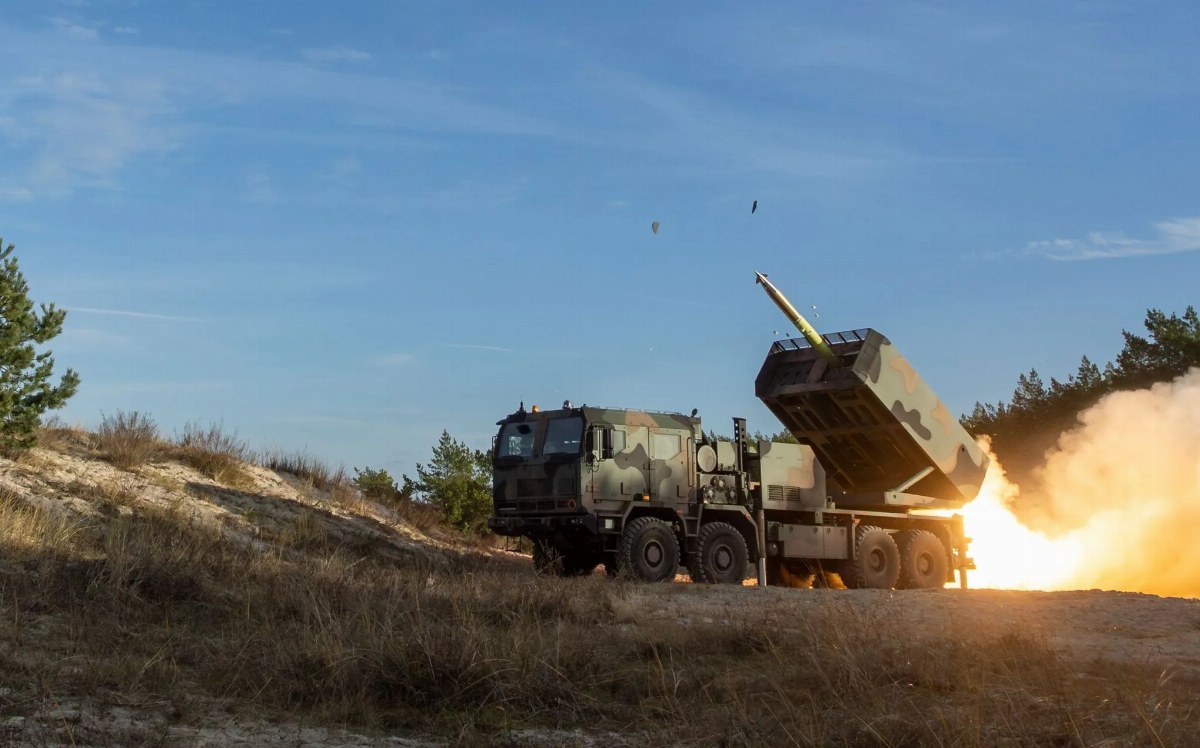
Poland is contemplating the sale of its 20 M142 HIMARS rocket launchers, which a Polish analyst describes as “white elephants,” in order to reallocate funds towards purchasing additional K239 Chunmoo systems from South Korea. This potential move raises questions about its impact on Romania and the wider European landscape.
The HIMARS systems were acquired by Poland concurrently with Romania’s purchase of similar U.S. weaponry. Reports indicate that Poland’s analysis of its M142 HIMARS systems reflects a broader trend: even staunch U.S. allies like Poland are reevaluating their reliance on American military equipment.
Understanding the “White Elephants” of HIMARS
Currently, the Polish Armed Forces operate 20 M142 HIMARS launchers alongside 150 K239 Chunmoo (Homar-K) systems. Antoni Walkowski, a journalist at Defence24.pl, criticizes the U.S. for not permitting local production of the launchers and guided missiles when supplying Poland. He notes that it took over five years for complete delivery of the systems, with the contract signed in 2019 and fulfillment expected by 2024.
Challenges with Ammunition Supply
In the event of a Russian invasion, Poland anticipates utilizing U.S. stocks of HIMARS-compatible missiles, such as ATACMS and PrSM, capable of reaching targets from 300 to over 500 km. However, these stocks have been depleted due to intense military operations in the Middle East. While Poland cannot produce missiles for HIMARS, it can manufacture ammunition for the K239 Homar-K system.
According to reports, South Korea is promising Poland favorable cooperation conditions, including local production of Homar-K launchers and guided missiles. This flexibility has led other European nations, including Norway, Croatia, and Estonia, to opt for the K239 over HIMARS.
Implications for Romania and Europe
If Poland relinquishes its HIMARS systems, it could prompt Romania to reflect on its own much larger fleet. The Romanian Army currently possesses 54 HIMARS launchers, acquired from the U.S. through a government-to-government agreement valued at $1.25 billion. This contract includes 81 M31A1 Unitary missiles, 81 M30A1 Alternative warhead missiles, and 54 ATACMS weapons that have an operational range of up to 300 km.
The Romanian Ministry of National Defense asserts that these systems are fully operational and can be utilized without external authorization. However, similar to Poland, Romania also does not locally produce either the launchers or the missiles.
South Korean Investment in Romania
Meanwhile, Hanwha, the South Korean manufacturer of the Chunmoo system, has signed a contract with the Romanian Army for K9 Thunder self-propelled howitzers, with production set to commence at a factory currently under construction in Petrești, Dâmbovița County. In March 2026, Hanwha announced a €1.3 billion investment in the Romanian defense industry, emphasizing long-term localization and technology transfer. Their proposal included selling and locally producing Redback combat vehicles, a contract that Romania ultimately awarded to Germany’s Rheinmetall for the KF-41 Lynx vehicles.
During the Eurosatory 2026 military exhibition, Hanwha highlighted Chunmoo launchers as a viable option for NATO countries modernizing their artillery. The offer of local production, which has already attracted Poland, Norway, Croatia, and Estonia, could also be appealing to Bucharest.
The trend away from American systems is not limited to South Korea. By the end of 2025, Bulgaria announced plans to purchase 12 EuroPULS launchers from Germany’s KNDS Deutschland, funded through the European SAFE program. This deal is valued at approximately €350 million, with Sofia citing high costs and lengthy delivery times for HIMARS as motivation for this shift.
Consequently, a fragmented market is emerging on NATO’s eastern flank, as neighboring countries opt for different systems. Poland’s potential decision would further amplify the push towards locally produced military capabilities across Europe.