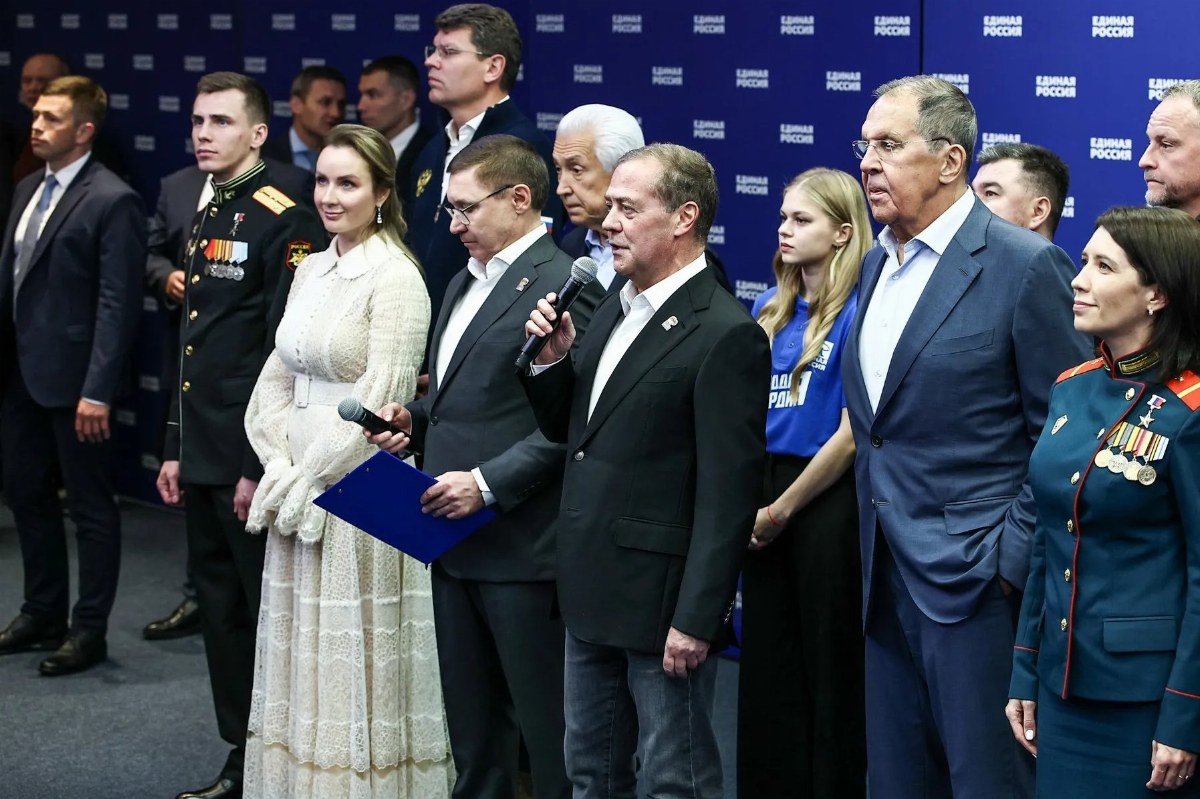
In the wake of the parliamentary elections in Russia, data reveals that the pro-Kremlin party “United Russia” has secured 57.83% of the vote, an increase from the 49.8% it achieved in the previous election in 2021, according to reports.
The ruling party has retained its majority in the national parliament, with nearly complete results announced on Monday. Meanwhile, the anti-war party “Yabloko” has reportedly gained minimal representation in a regional parliament.
President Vladimir Putin characterized the three-day elections for the State Duma—the first since the onset of Russia’s full-scale war in Ukraine—as a test of public support for the conflict.
However, confidence in the electoral process’s integrity is low among the populace.
Critics allege that the political system is tightly controlled, leaving little room for genuine dissent, and many candidates from “Yabloko” were excluded, resulting in a lack of surprises.
Nonetheless, political analysts maintain that it was crucial for the authorities that the election process be perceived as relatively smooth.
355 Seats Out of 450
With over 95% of the votes counted, Ella Pamfilova, head of the Central Electoral Commission, announced that “United Russia” achieved a sweeping victory with 57.83%, up from 49.8% in the last parliamentary elections.
As a result, “United Russia” is expected to hold 355 seats, accounting for nearly 80% of the 450 total seats in the Duma, which allows it to maintain a constitutional majority. This majority enables the passage of laws and the initiation of constitutional amendments without support from other parties.
Pamfilova noted that three other parties have entered the parliament: the Communists at 13.81%, the ultra-nationalist LDPR at 8.98%, and the “New People” party at 7.96%.
The “Fair Russia” party fell slightly below the 5% threshold needed for parliamentary entry but has “good chances” to succeed, according to her.
All these parties have aligned with “United Russia” on major issues over the past few years.
Pamfilova estimated that voter turnout among Russia’s 111 million eligible voters was 59.3%, a record for such an election—held despite a significant drone attack from Ukraine on Moscow on the final voting day.
She described the election as “clean,” despite claims of widespread electoral fraud by exiled opposition activists.
The Only Real Opposition
“Yabloko,” the only registered anti-war party in Russia, failed to secure any seats at the national level.
However, in Novgorod, located about 480 kilometers northwest of Moscow, it seems to have surpassed the 5% threshold by one percentage point, thus entering the regional parliament.
“Over 12,000 residents of Novgorod supported the Yabloko party,” the group stated, which advocates for a ceasefire in Ukraine, in a press release.
A Major Setback for Russian Democracy
The European Union responded on Monday with criticism of the Kremlin.
The parliamentary elections in Russia, whose results have never been questioned, represent merely an “appearance of democracy” that excludes any opposition to the war in Ukraine, stated the EU’s chief diplomat, Kaja Kallas.
“The so-called elections for the Duma mark a significant new failure for Russian democracy. Their outcome has never been in doubt,” Kallas asserted.
She added, “The Kremlin has silenced dissenting voices, banned the only registered party opposing its war in Ukraine, and removed international electoral observers. In Russia, there is only an appearance of democracy left,” she emphasized.
The EU’s foreign policy chief also mentioned that she has proposed measures against those facilitating the sham elections in occupied Ukrainian territories.
The EU has already sanctioned approximately 3,000 officials and entities involved in the conflict in Ukraine, including Vladimir Putin.