Romania, in the top of the European countries with most young people who do not study, work / a chapter where our country differs through “aberrant” values


In 2024, 11% of people between the ages of 15 and 29 in Europe did not have a job and did not follow any education or vocational training program. The share of these young people ranges between 4.9 % in the Netherlands and 19.4 % in Romania, according to Eurostat data.
Young people are key factors of social and economic change, but nevertheless, in Europe, many of them are “neither employees, nor classified or training,” writes Euronews.com, who cites Eurostat data and an organization for cooperation and economic development (OECD).
Although the Europan Union says it wants to reduce the 11 % below 9 % until 2030, only 11 out of 34 European countries have already achieved this objective in 2024. In some countries, as is the case of Romania, not only the share of young people who do not have a service is high, but also that of sex differences.
The country with the highest rate of young people “who are neither employees nor fit in the education system”
In general, South and Southeast Europe have much higher these rates called NEET, while North and Western Europe generally records better results.
If we include candidates for accession to the EU, the United Kingdom and the states, Turkey register the highest rate: more than 1 in 4 young people (25.9 %) are unharmed or no form of education. Follows Bosnia and Herzegovina (22.2 %), Romania (19.4 %), Italy (15.2 %), Serbia (14.9 %), Lithuania (14.7 %), Greece (14.2 %) and Bulgaria (12.7 %).
The 2025 OCDE report on Romania shows that 1 in 5 young Romanian young people do not work and study. “The weak school results of young people are a major concern in Romania and are one of the main factors that determine the high percentage of young people who are not employed, do not follow studies and do not participate in training programs,” according to the quoted source.
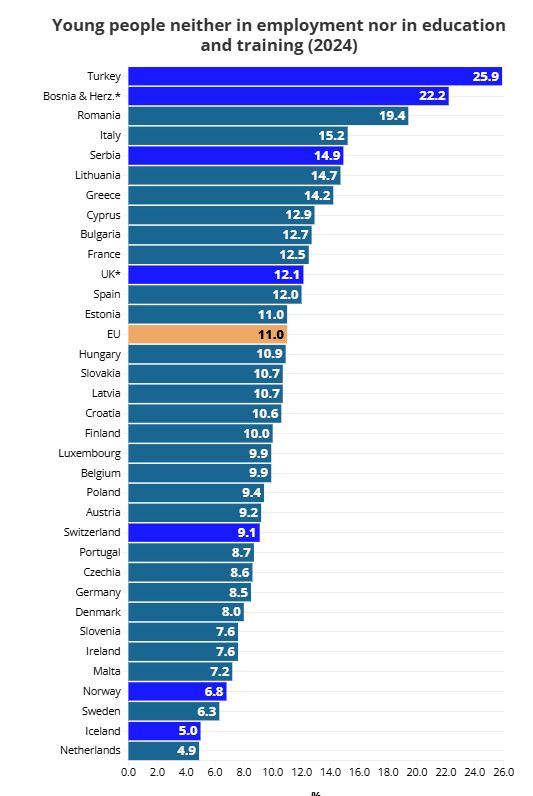
Of the five largest economies in Europe, four registered rates above the EU average: Italy (15.2 %), France (12.5 %), the United Kingdom (12.1 %) and Spain (12 %). Germany has the lowest rate, with 8.5 % of young people who do not work and do not study.
In addition to the Netherlands (4.9 %), other countries with good performance are Iceland (5.0 %), Sweden (6.3 %), Norway (6.8 %), Malta (7.2 %), as well as Ireland and Slovenia (both with 7.6 %).
Turkey, Romania and the Czech Republic, “aberrant” values of the difference between sexes
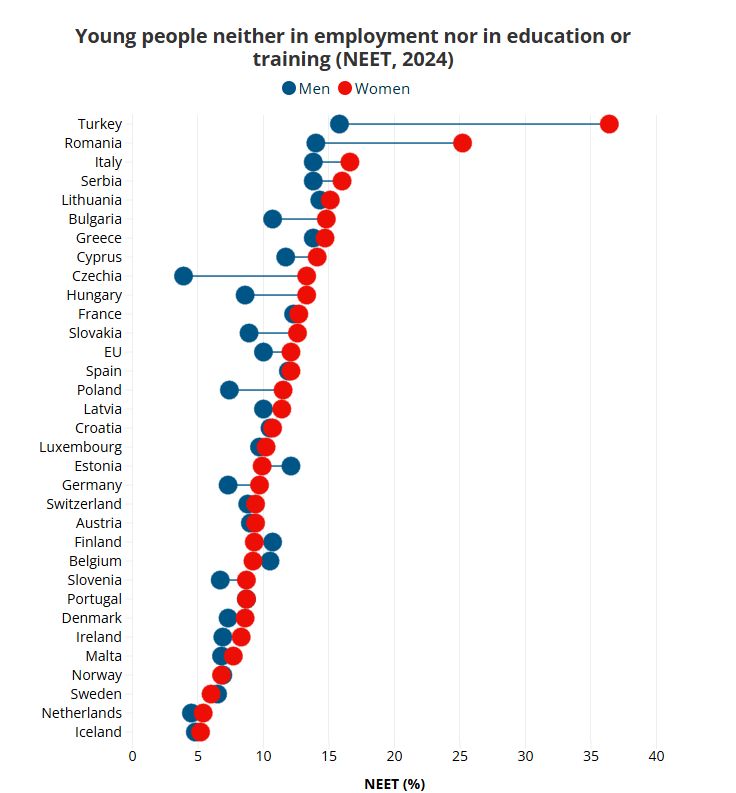
The difference between sexes regarding the rates of young people who do not work and do not follow studies is striking in some countries, writes Euronews.com. On average, in the EU, 10% of young men do not work and do not study, compared to 12.1% of young women.
Three countries are clearly detached. In Turkey, 15.8 % of male young people are unlawful or no studies, compared to 36.4 % of female young people.
In Romania, rates are 14% for men and 25.2% for women, and in the Czech Republic 3.9% of young men and 13.3% of women.
Of the 32 countries, the rate of young people without a job and no studies are higher among men than among women in just five countries. These include Sweden, Finland, Norway, Estonia and Belgium. Nordic countries dominate this trend.
In Hungary, Poland and Slovakia, NEET rate among women is also over 40 % higher than among men.
Unemployed or out of workforce?
There are two main reasons underlying the NEET rates: young people are either unemployed or outside the workforce. In most countries, the share of those outside the labor is greater than that of the unemployed, with only three exceptions. In the EU, the average is 4.2 % unemployed, compared to 6.9 % outside the labor.
Outside of the workforce it refers to people who are not employed and who either do not actively seek a job or are not available to work. They are also known as the inactive economic population, according to the International Labor Organization.
The higher proportion of young people outside the labor force determines the increase of the non -rate. In Turkey, one in five young (20%) is outside the labor. This causes Turkey to have the highest global non -rate, even though the official unemployment rate among young people between the ages of 15 and 29 is only 5.9 %.
The same model can be found in Romania, where 5.4% are unemployed, compared to 14% outside the labor. In Italy, Lithuania and Bulgaria, the share outside the labor is 10 % or higher.
In the EU, the percentages are 8.5 % for women and 5.3 % for men. In Turkey, the difference is dramatic: almost one in three young people between the ages of 15 and 29 who do not follow studies are not part of the active population. The rate is also high in Romania, reaching 21%.
Main Photo Source: Dreamstime.com