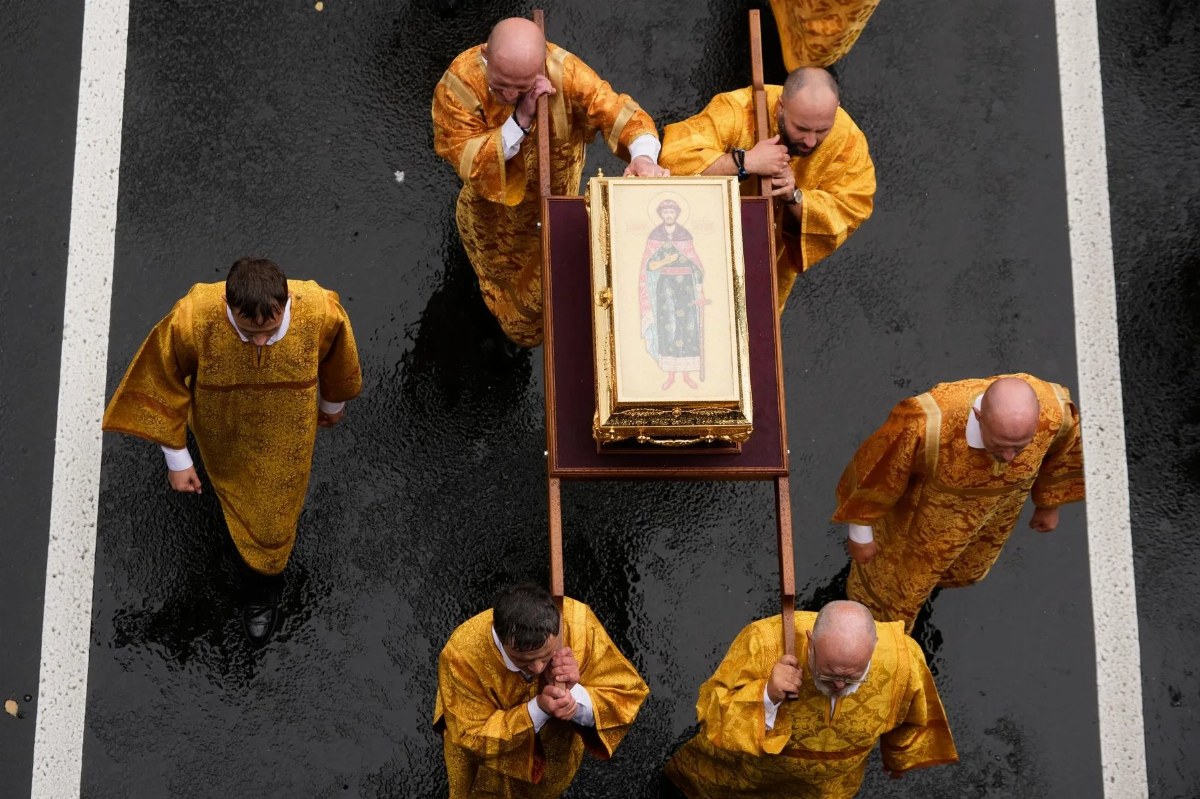
The remains of a medieval Russian leader, known for his victory over the Mongols, have been dispatched to the front lines in Ukraine to uplift the spirits of soldiers. This move represents the latest gesture of support from the Russian Orthodox Church for President Vladimir Putin’s ongoing war, as reported by Reuters.
The stone coffin of Grand Prince Dmitry Donskoy, who passed away in 1389 and is celebrated by Russian nationalists for defeating the Golden Horde at the Battle of Kulikovo in 1380, was unearthed this summer during restoration work at the Cathedral of Archangel Michael within the Kremlin.
Putin personally inspected the remains, which experts have confirmed belong to the prince and are in remarkable condition. In August, the Russian President described the discovery as “an absolutely unique and wonderful find,” asserting that it reinforces the foundations of Russian history.
The Russian Orthodox Church, a steadfast supporter of Putin throughout the war, has announced the dispatch of a fragment of Donskoy’s right hand to Donetsk. This area is one of four Ukrainian regions that Putin claimed to annex in 2022, a move denounced by Kyiv as illegal territorial seizure.
The Moscow Patriarchate referred to Donskoy as the “holy commander” and stated that a portion of his relics was sent to be with Russian soldiers on the battlefield. “A fragment of the great prince’s right hand, the same hand that wielded his sword at Kulikovo, has been sent to the front to bolster the morale of our troops,” the Russian Orthodox Church said in a statement.
The relic, housed in a small ornate coffin and protected by secure glass, will be presented to Russian military units along the front line, which stretches over 1,000 kilometers, according to the announcement.
Donskoy, whose name was given to a column of Soviet tanks funded by the Church during World War II, was canonized by the Russian Orthodox Church in 1988.
Patriotic Offensive
Russian officials from both the military and the Church have heralded the discovery as providential, believing it could assist Russian forces in achieving victory in Ukraine, where the grinding conflict has now entered its fifth year.
Relics of Donskoy were paraded through the streets of Moscow over the weekend during a large Orthodox procession.
At a ceremony held on Tuesday at a World War II memorial in Donetsk, Sergei Kiriyenko, the first deputy head of the Kremlin’s presidential administration, joined military commanders and the Russian-installed regional leader. They kissed the relic and made the sign of the cross while a priest offered prayers.
“Both our military personnel and the people living in Donbas need reinforcement from above, divine assistance, and the blessing of our saints,” said Metropolitan Vladimir of Donetsk and Mariupol, a high-ranking cleric appointed by Moscow. Donbas is the broader region encompassing Donetsk and the neighboring Luhansk, which is nearly entirely under Russian control.
In other areas, commanders have showcased Donskoy’s remains as evidence that God is on Russia’s side.
However, critics accuse the Church of violating religious traditions and protocols to appease the Kremlin. They also question why Donskoy’s remains, whose location has been broadly known for decades, were only recently recovered and elevated to veneration, 38 years after his canonization.
“In the fifth year of war, the leadership of the Moscow Church has begun to wonder what else it can do to demonstrate its support for what Russia terms the ‘special military operation’,” wrote Alexander Zanemonets, an Orthodox priest and historian based outside Russia.
“It has already sent priests to the front lines, introduced mandatory prayers for Russia’s victory in all churches, and flown icons over cities. A state engaged in war will attempt to compel all institutions, including religious ones, to participate in it,” he added.