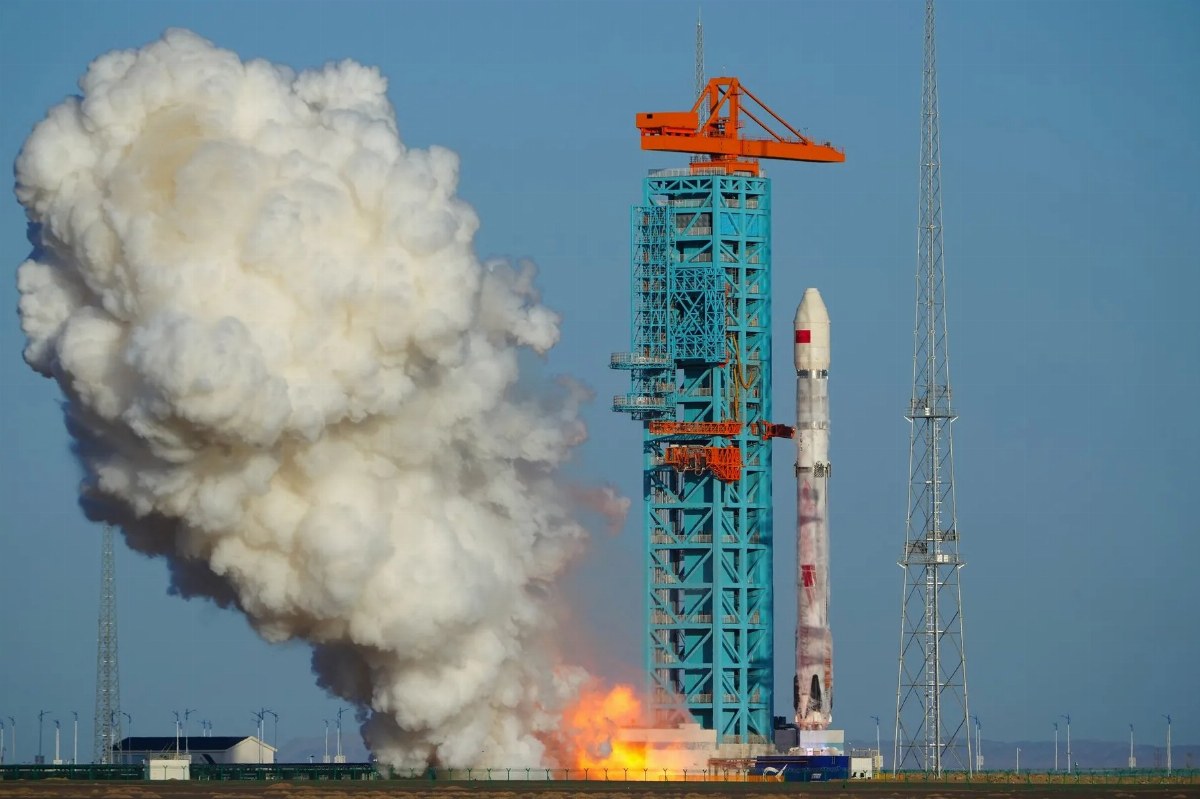
Chinese startup LandSpace achieved a significant milestone on Wednesday by successfully recovering the first stage of its Zhuque-3 rocket. This accomplishment places LandSpace alongside SpaceX and Blue Origin as one of the few private companies capable of landing an orbital-class booster, thereby narrowing China’s technological gap with the United States in reusable rocket technology, according to reports.
The ability to recover and reuse a booster is crucial for reducing launch costs and facilitating satellite placement into orbit, transforming space exploration into a commercially viable endeavor akin to civil aviation. The booster, equipped with rocket engines, is considered the most valuable component of the rocket.
This latest success occurred during LandSpace’s second attempt to land the Zhuque-3 rocket’s first stage, which the company describes as a response to SpaceX’s Falcon 9 rocket. The Zhuque-3 stands at 66.1 meters tall and was launched from northwestern China. The first stage, equipped with nine engines, landed at a designated site in Gansu province, approximately 390 km southeast of the launch pad, as reported by state media in Beijing.
The successful landing is expected to boost investor confidence, especially as LandSpace prepares for an initial public offering (IPO) on the Shanghai Stock Exchange’s STAR Market. The company aims to raise 7.5 billion yuan (about $1.11 billion) through this IPO to support the development and expansion of reusable launch services.
Earlier in June, LandSpace submitted an updated IPO prospectus, outlining its goal to achieve profitability by 2029.
Differences Between Zhuque-3 and SpaceX’s Falcon 9
LandSpace has stated that the Zhuque-3 is made from stainless steel, which offers greater heat resistance and potential for lower production costs compared to the aluminum-lithium alloy used in Falcon 9. The Chinese rocket runs on liquid methane and liquid oxygen, which allows for a cleaner burn than the kerosene-oxygen combination used by Falcon 9.
The Zhuque-3 has a payload capacity of 14.2 metric tons to low Earth orbit in a one-way flight, compared to Falcon 9’s 22.8 metric tons. LandSpace aims for the Zhuque-3 booster to be reused up to 20 times, while SpaceX conducts approximately 150 Falcon 9 launches annually, reusing its boosters multiple times.
China’s Second Successful Rocket Recovery in Two Months
Wednesday’s launch marked China’s fourth attempt to recover an orbital booster. In December 2025, LandSpace made history as the first Chinese entity to conduct a test of a reusable rocket. While that rocket successfully reached orbit, the first stage did not achieve a controlled landing.
Weeks later, China launched the Long March 12A, developed by state-owned CALT, which also reached orbit but failed in its recovery attempt. However, just last month, China successfully tested an experimental booster recovery system using a net capture system installed on a floating maritime platform. This made China the second country after the U.S. to successfully land and recover an orbital-class rocket.
The Long March 10B rocket has also drawn comparisons to SpaceX’s Falcon 9. A significant difference is that the Chinese rocket does not autonomously land on retractable legs on a landing pad or drone ship. Instead, it used four lightweight hooks to latch onto steel cables in the net system on the platform where it landed. Beijing claims this innovation simplifies the onboard structure of the rocket, reduces vehicle mass, and increases payload capacity.
Third Company to Successfully Recover a Launched Rocket Stage
With this latest successful landing, LandSpace has achieved China’s first successful recovery of an orbital booster from ground level using leg-based landing. The company plans to reuse the recovered first stage within the next six months, a step it claims will lay the groundwork for future high-frequency, low-cost commercial launches.
SpaceX first recovered a Falcon 9 rocket after an orbital flight in December 2015, and Blue Origin, founded by Jeff Bezos, achieved the same with its New Glenn rocket in November 2025. Over the past decade, China has been developing reusable rocket technologies, advancing from initial low-altitude flight tests to recent attempts to recover orbital-class boosters.