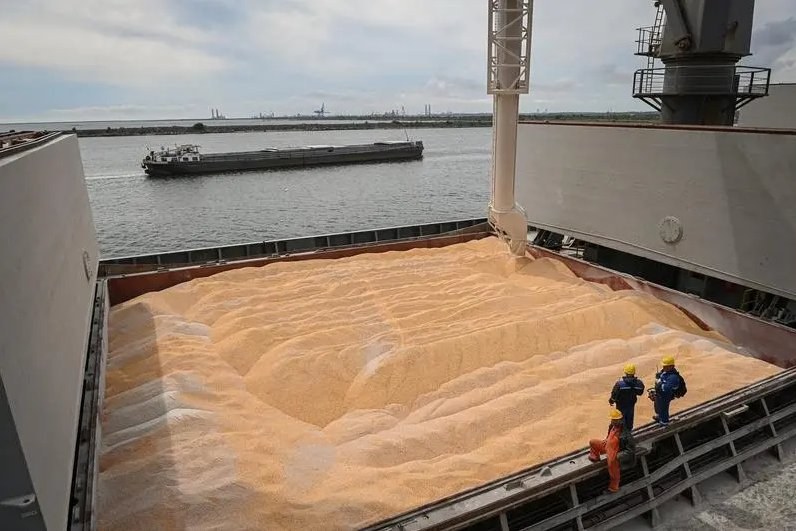
Ukrainian farmer Serhii Rybalko has lost two-thirds of his land since Russia occupied much of southern Ukraine at the outset of the 2022 invasion. He now faces a potential disaster as a promising harvest is jeopardized by Russian attacks that have nearly halted agricultural exports through Black Sea ports, according to reports.
Ukraine ranks among the world’s largest producers of wheat, corn, and sunflower seeds, with approximately 90% of its agricultural exports passing through the Black Sea.
The situation is exacerbated as wheat harvesting is currently in full swing. Rybalko’s grain storage is nearly full, and corn harvesting is set to begin next month.
“We have nowhere to send these grains. It’s a total disaster for farmers,” the 57-year-old stated.
Previously, he sold his produce to major Ukrainian grain exporter Nibulon and local processing plants, but now no one is buying: “Everything has simply stopped. Finances have reached a dead end. Income sources have dried up. There are no exports,” he lamented.
Impact on Ukraine and the Global Economy
Agriculture accounts for nearly 60% of Ukraine’s export revenues, and the blockade adds further pressure to an economy already strained by war.
Ukraine has intensified its attacks on Russian ships in the Black and Azov Seas as both sides in the prolonged conflict seek to cripple each other’s economies. As Russia is also a significant agricultural exporter, this escalation has major implications for inflation, especially as record heatwaves and conflicts in the Middle East have contributed to rising global food prices.
“Ukraine supplies about 6% of the world’s wheat and approximately 11% of global corn,” said Denys Marciuk, deputy head of the Ukrainian Agricultural Council, the main farmers’ organization in Ukraine.
He warned of potential famine risks in several African and Middle Eastern countries that rely on imports and are significant buyers of Ukrainian grains if supplies do not arrive in time.
Current Blockade Could Have Long-Term Effects
Ukraine anticipates a grain harvest of approximately 60 million tons this year, similar to 2025 levels. However, farmers have little hope for next year’s crops. Without exports, they cannot generate sufficient funds for the next agricultural cycle.
While Chicago wheat prices reached their highest point in over a year in July due to disruptions in Black Sea transport and fears of global shortages, domestic prices in Ukraine have plummeted as local supply has piled up.
Assessments indicate that farmers will only be able to profit from wheat exports and will struggle to cover production costs for other grains.
“These funds are necessary to continue purchasing fuel, paying salaries, and preparing for autumn crop planting,” Marciuk explained.
Ukrainian Agricultural Exports Through Black Sea Plummet
Before the Russian blockade, Ukraine exported approximately 4 to 5 million metric tons of agricultural products monthly through the Black Sea, according to the Ukrainian Ministry of Agriculture.
Transportation was also disrupted at the start of the war, prompting the United Nations and Turkey to mediate an agreement allowing Ukrainian grain transport through the Black Sea due to fears of a food crisis.
Although Russia withdrew from this agreement in 2023, Ukraine established its own “grain corridor” along the western Black Sea coast through the territorial waters of Romania and Bulgaria.
However, transport has nearly ceased again after Russia launched over 70 attacks on Ukrainian port infrastructure in the Black Sea and 62 on ships in July and early August, according to Ukrainian sources.
Data from the first two weeks of August indicated that grain exports had dropped by 75% compared to the same period last year.
Urgent Need for Export Routes
Grains can be stored for several years if kept and dried properly, but the Ukrainian Ministry of Agriculture has warned that the storage capacity deficit could reach 11 million tons. Officials have requested that Ukraine’s partners help supply specialized bags for temporary storage directly on farms.
They also stressed the urgent need for alternative export routes, which may prove more challenging to find than in the past.
At the beginning of 2022, when the Black Sea ports were blocked, agricultural exports were redirected via rail and road through Ukraine’s western borders.
Oleh Nivievskyi from the Kyiv School of Economics noted that negotiating alternative routes has become more difficult, partly due to deteriorating relations with neighboring Poland, whose farmers previously opposed competition from cheaper Ukrainian grains.
A stricter trade regime with the European Union, lower water levels in the Danube, and Russian attacks on railway infrastructure have also limited Ukraine’s options.
“Ukraine should prepare for the possibility that the economic effects of the port blockade could be as severe or even worse than last time,” Nivievskyi warned.