The recent decision to ground President Donald Trump’s new Air Force One aircraft, gifted by Qatar, is likely aimed at enhancing its security features, experts suggest. However, there are doubts over whether a month is adequate for substantial upgrades to the aircraft’s defense systems, as reported by Reuters on Monday.
On Sunday, Trump announced that the Boeing 747, which began transporting him on July 1, will soon be sent for comprehensive enhancements. He indicated that this process is expected to take approximately one month.
The aircraft’s security readiness came into question after Trump suddenly switched back to an older Air Force One model for his trip from Turkey to the United Kingdom on July 8, amid rising tensions with Iran.
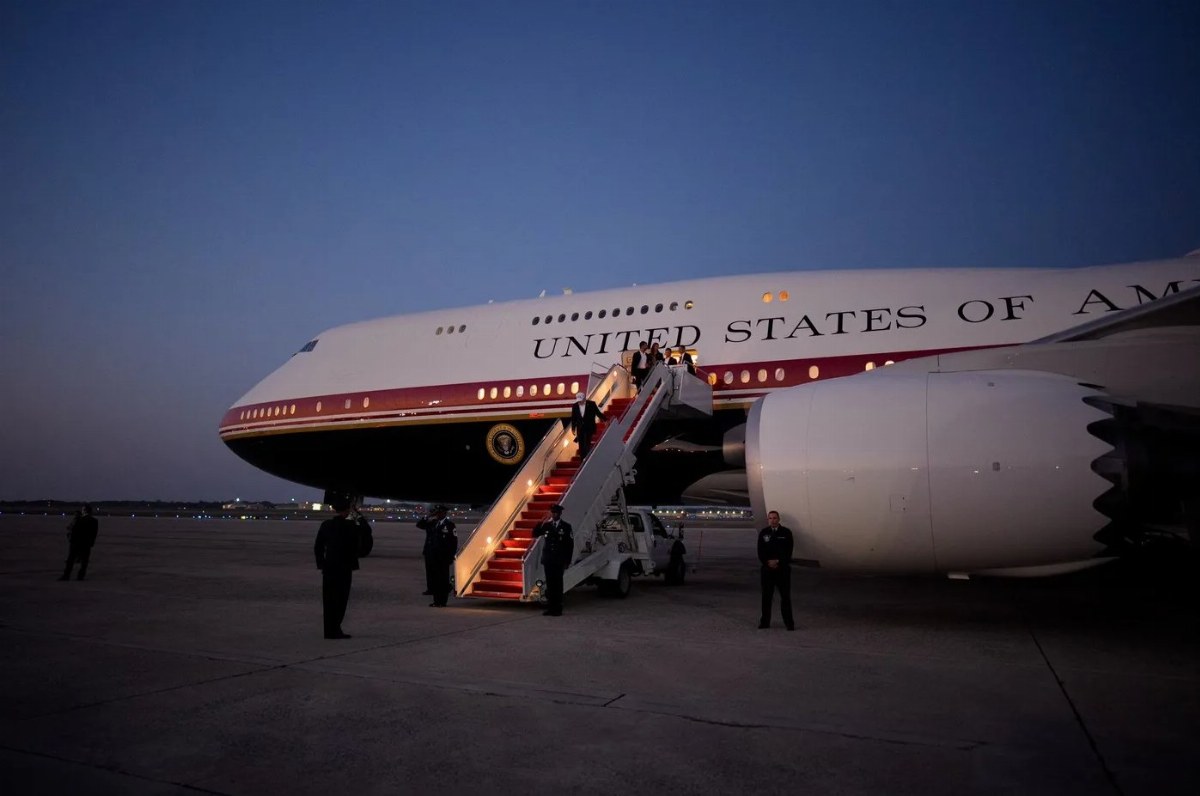
The new plane, featuring a design in red, white, dark blue, and gold chosen by Trump, was a Boeing 747 provided to the United States by Qatar last year and upgraded by defense contractor L3Harris Technologies. This aircraft was intended to serve as a temporary replacement due to ongoing delays in the delivery of next-generation Air Force One aircraft by Boeing.
According to Douglas Birkey, executive director of the Mitchell Institute for Aerospace Studies, the standard Air Force One fleet is equipped with a sophisticated array of protection systems, including missile defenses. However, the White House appears to have accepted a lower level of protection for the Qatar aircraft to expedite its deployment.
Birkey noted that the plane was likely configured for environments with “neutral or low-level” threats, and authorities are currently working on adding additional defense systems. Any upgrades completed within a month will likely be limited to non-kinetic systems, such as electronic jamming devices and infrared “dazzlers” designed to confuse heat-seeking missiles, as well as possibly adding “chaff”—tiny strips of metal released to disrupt radar signals and mislead guided munitions.
Infrared-guided missiles have become a growing concern for military planners, Birkey stated, as they are more challenging to detect than traditional radar-guided threats and “can emerge unexpectedly.”
The U.S. Air Force has not commented on the situation. White House press secretary Karoline Leavitt stated, “The new Air Force One is perfectly safe for the president’s travels, but it will receive additional upgrades and enhancements this fall, which will take about a month. In the meantime, the president will fly on the older Air Force One.”
Mark Cancian, a senior advisor at the Center for Strategic and International Studies, expressed skepticism about the feasibility of significant upgrades within a month, suggesting that the work might be limited to software updates or additions like signaling rockets or chaff.
Cancian also indicated that the decision to switch the presidential aircraft in Turkey likely followed updated intelligence on threats from Iran, leading officials to conclude that the risk level exceeded what the Qatar aircraft could handle.
Democrats have questioned the speed at which the aircraft was put into service, arguing that more time is necessary to complete security-related improvements. Senator Jeanne Shaheen remarked at the Farnborough International Airshow that the U.S. Congress needs to review the aircraft’s safety. “We were aware that there were some security issues with the aircraft from the outset,” the Democratic lawmaker emphasized.