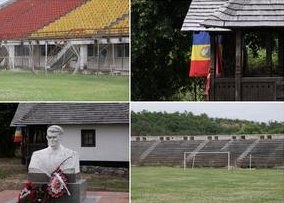
GSP recently visited one of the most controversial sports venues in Romanian football history: the stadium in Scornicești. Built during the communist era for the team backed by Nicolae Ceaușescu, this structure remains intact nearly 40 years after the fall of the regime.
Today, the aging stands and a pitch resembling more of a pasture than a football field still bear traces of a project where football and politics were deeply intertwined.
Photo Gallery: Current State of the Scornicești Stadium
The stadium is in a significant state of disrepair, yet it is not abandoned. Local authorities are awaiting support from the National Investment Company (CNI) for a potential modernization of the facility. The playing surface is in extremely poor condition, resembling a grazing field rather than a football ground. In contrast, the stadium’s interior, while showing signs of age, is surprisingly well-maintained, with no litter strewn in the locker rooms or around the field, unlike many other neglected venues from the same period.
Constructed in Ceaușescu’s hometown, the stadium is one of the most notable sporting legacies of the communist regime. It was inaugurated in 1987, replacing a stadium built in 1975, and initially had a capacity of about 25,000 seats. At that time, it was a remarkable investment, featuring all plastic seats, a modern drainage system, a sauna, and a swimming pool, now filled with rainwater, making it one of Romania’s most advanced arenas.
The estimated cost of the stadium was $22 million at the time.
The Base of Romania’s Most Corrupt Football Team
Numerous legends have emerged surrounding the stadium. One of the most famous suggests that a relative of Ceaușescu was the main architect behind the project, convincing the communist leader to fund the investment.
The arena has become a symbol of the privileges enjoyed by Scornicești, with the rapid rise of FC Olt in the top division historically linked to the political influence of the regime. The 1981-1982 season was FC Olt’s most successful in Liga 1, where they finished fourth, behind teams like Dinamo, Universitatea Craiova, and Corvinul Hunedoara.
The team remains associated with numerous allegations of favoritism and match-fixing, with the most notorious incident being their 18-0 victory against Electrodul Slatina, a result deemed necessary for promotion. Following the fall of the communist regime, the club lost its political protection, was administratively relegated, and has never returned to the heights of Romanian football.
After the 1989 Revolution, both the club and the stadium entered a period of significant decline. The capacity was reduced to approximately 13,500 seats, and some areas beneath the stands were converted into social housing. Entering the arena today, few signs indicate that it once hosted sporting events, with PVC balcony structures, clothes hanging on wires, refrigerators on balconies, and wooden cabinets present near a rusted and weathered sign reading “Future Stadium.”
Access to the stadium is complicated by a pack of dogs that have made the area their home, barking and chasing away any curious onlookers. Currently, two small businesses operate within the stadium: a printing shop and a tailor.
Photo Gallery: The Artificial City of Olt – Scornicești Today
Beyond the stadium, the true legacy of Nicolae Ceaușescu is visible on the streets of Scornicești. The former dictator lived here until he was 11, when he left for Bucharest to train as a shoemaker. Until the 1970s, the town was an ordinary village in Olt County. Once Ceaușescu rose to power, it was transformed almost overnight into a city, complete with wide boulevards, entire neighborhoods of apartment blocks, high schools, a sports hall, factories, and plants—all built to showcase that the birthplace of this leader could become a “showcase” of socialism.
Nearly four decades after the Revolution, Scornicești appears suspended between two worlds. The blocks built during communism, with their tiled roofs and wooden balconies, still dominate the city’s center. At ground level, there are a few shops, pharmacies, second-hand stores, one or two supermarkets, and some gas stations. The side streets retain a predominantly rural character.
According to the last census in 2021, Scornicești had 11,766 inhabitants.
At the end of these blocks, near the town’s exit, stands the house where Nicolae Ceaușescu was born. This late 19th-century property is family-run and can be visited only occasionally, with no permanent schedule. In recent years, it has been closed for extended periods, including during GSP’s visit, due to damage from water infiltration and lack of funds for maintenance.
Nearby, there is a cornelian cherry tree and an old conifer. In front of the house, the plaster bust of the former dictator is visibly chipped and cracked, while within the property, a flag of the defunct Socialist Republic of Romania still flutters. A panel mounted by members of the Romanian Socialist Party, featuring a quote attributed to Petre Țuțea praising Ceaușescu as “the father of the nation” and crediting him with modernizing Romania, can still be seen, even when the house is closed.
This panel was placed in January 2020 to commemorate the former communist leader’s birthday, remaining visible even when the house is not open to visitors.