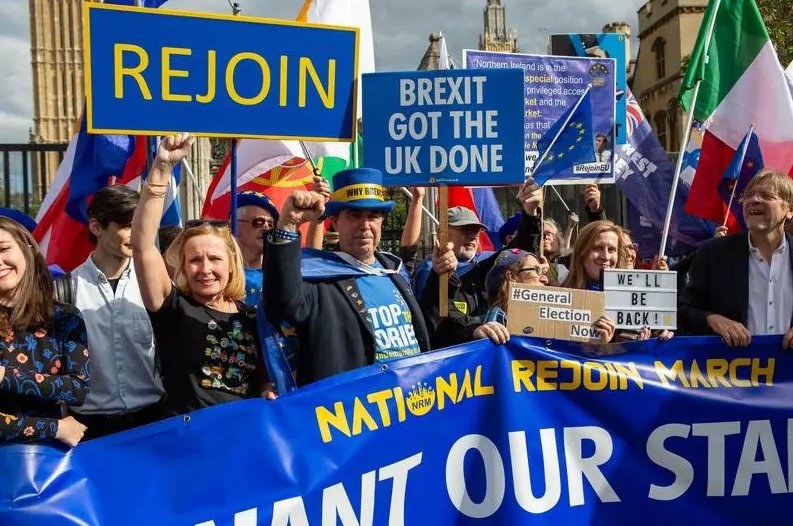
As the UK marks ten years since the historic Brexit vote, reports indicate that the economy is significantly smaller than it would have been had the country remained in the EU. Numerous businesses have struggled, and Brexit has been a catalyst for ongoing political instability, according to analyses by The New York Times and The Guardian.
The economic toll of Brexit has been accumulating over the past decade, and economists argue that the costs have far exceeded any potential benefits. The turmoil has contributed to a political climate where the UK will soon see its seventh prime minister within ten years, following Keir Starmer’s recent resignation announcement.
Surveys reveal a growing sentiment of regret among the British populace, with nearly half of respondents indicating that the outcomes of Brexit have been worse than anticipated. Additionally, a recent poll showed that just over half support rejoining the European Union, though few consider this a realistic option.
Estimating the true cost of Brexit is complicated due to concurrent crises, including the COVID-19 pandemic and geopolitical tensions. However, analysts have attempted to quantify the impact, which is not favorable for Brexit proponents.
A Smaller Economy
In 2016, the UK government anticipated that a vote to leave the EU would lead to an immediate severance of trade ties with the other 27 member states. Instead, the UK officially exited the EU only in January 2020, following years of negotiations and an 11-month transition period that obscured the economic effects until 2021.
A study led by Stanford University professor Nicholas Bloom suggests Brexit has reduced the UK’s GDP by up to 8%, with effects compounding over time. While some economists dispute the methodology of this analysis, there is general consensus that the UK economy is 4% to 6% smaller than it would have been if it had remained a member of the EU, marking a substantial loss in output.
The UK’s Office for Budget Responsibility predicts Brexit will lower the nation’s long-term productivity by 4%, a significant concern given that the UK has lagged behind other major economies since the global financial crisis.
Insufficient Trade Agreements
Brexit has led to a 12% decrease in British exports to the EU and a 16% drop in imports from the bloc, according to the Centre for European Reform (CER). Agricultural and food exports have been particularly hard hit, suffering nearly a 30% decline. Small businesses, in particular, have reduced their efforts to attract European customers, grappling with increased costs and delays due to additional border checks.
While the UK’s service trade performed better, largely attributed to a surge in demand during the pandemic for online services, it has not fully compensated for losses in trade with the EU. The UK has since signed 39 new trade agreements covering 72 countries, but these have not alleviated the damage caused to its relationship with the EU, which remains the UK’s largest trading partner, accounting for over 40% of trade.
Negative Effects on Businesses
One immediate economic consequence of the Brexit vote was the freeze on business investments, as companies curtailed spending amid uncertainty from prolonged trade negotiations and political instability. Although investments eventually increased, economists suggest the recovery was less vigorous than expected, with a recent report from the National Institute of Economic and Social Research estimating Brexit-related uncertainty has reduced long-term business investments by about 4%.
Beneficiaries of Brexit
Despite the overall negative impact, some sectors have found opportunities. According to Anton Spisak of the Centre for European Reform, consultants, lawyers, and customs agents have benefited. However, he noted that Brexit has had a “very negative effect” on the economy overall.
In 2016, the financial services sector strongly opposed Brexit due to its potential threat to London’s status as Europe’s financial hub. A decade on, while London retains its position as the largest financial center in Europe, it has nevertheless lost substantial activity, with some stock transactions moving to Amsterdam and asset management shifting to Dublin.
Migration Trends
Brexit’s impact on migration has also been significant. Contrary to expectations of reduced immigration, there has been a surge of individuals from non-EU countries, resulting in a transformed labor market with diverse skill sets. Sectors such as hospitality, food processing, and health care are facing additional costs and disruptions after losing their traditional workforce.
“An Absolute Nightmare”
During a recent visit to areas that voted for Brexit ten years ago, journalists from The Guardian found many residents dissatisfied with the situation. Tony Rutherford, a local business owner, described Brexit as a disaster from day one, noting that the British fishing fleet has seen no increase in fishing opportunities while facing soaring export costs to the EU. “An absolute nightmare, complete chaos, and it’s still like that today,” he said from Torridge and West Devon, where 57% of residents voted to leave the EU.
Local Perspectives on Brexit
Dilip Patel, a local conservative group vice president in Romford, who campaigned for Brexit, now expresses “conflicted feelings” about the decision. In Romford, 69.2% of locals voted for leaving the EU. Patel, influenced by his role on a school board, highlighted the pressures schools face to integrate children from Bulgaria and Romania. He also discussed the pressures on the National Health Service (NHS) and the housing market.
Michael White, a former local council leader, stated he voted for Brexit to ensure policies beneficial to Britons are crafted in the UK, not Brussels, hoping that the money saved could improve the NHS. However, he is skeptical about whether the health service has actually benefited from any financial savings promised as a result of Brexit, noting that “the NHS situation has worsened.” Both Patel and White lost their council seats last month to the Reform UK party, which they believe was partially influenced by Brexit.