The “Capital of Maramureș” forgets its industrial past. How to reinvent Baia Mare, the city of former factories, bypassed by highways

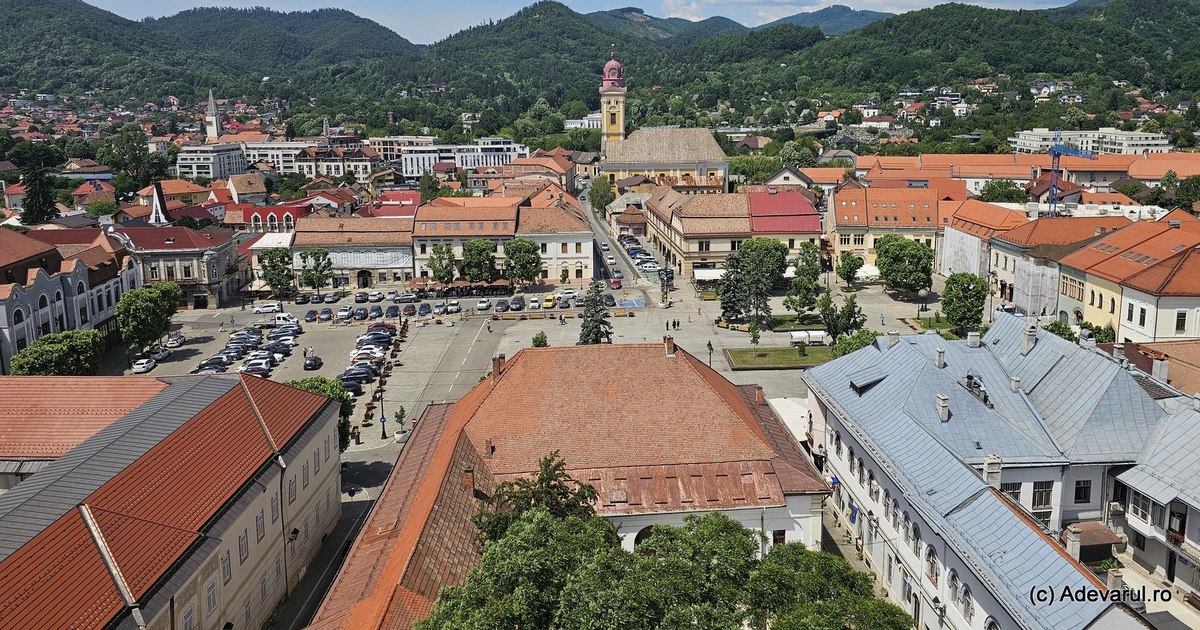
Baia Mare, a former large metallurgical center, is trying to change its image, with European funds attracted for investments of hundreds of millions of lei in urban regeneration. The city in northwestern Romania still bears the scars of heavy industry and remains isolated from the highway network.
Baia Mare, seen from the Stefan Tower. Photo: Daniel Guță. TRUTH
Almost two decades after the closure of Baia Mare's large metallurgical plants, the community is trying to leave behind the industrial legacy and environmental problems that marked the city's recent history.
Several regeneration and urban development projects, financed with European funds, are currently taking place in the “capital” of Maramureș, in an attempt to transform it from a former center of heavy industry, with a gray appearance, into a more accessible and attractive city for tourists.
“The reality is that, at this moment, in Baia Mare we have investment projects worth billions of lei, in various stages”, informed the mayor Ioan Doru Dăncuș recently.
Baia Mare, developed with European funds
According to the local administration, the largest amounts are attracted through the National Recovery and Resilience Plan (PNRR), for projects estimated at 583 million lei, and through the Northwest Regional Program 2021–2027, for investments of approximately 886 million lei.
The PNRR mainly finances the urban mobility corridor in the Historic Center area, worth approximately 10 million lei, which includes over 5.5 kilometers of bike lanes, and the corridor on the left bank of the Săsar River, estimated at 15 million lei, with over six kilometers of lanes. Both projects have a completion date of July 31, 2026. Upon their completion, the river banks that cross the downtown area will be transformed into a promenade.
The Northwest Regional Program finances urban regeneration projects aimed at the modernization of Revolution Square, worth approximately 41 million lei, the development of University Square, estimated at nearly 56 million lei, the reconfiguration of Pieta Izvoare, approximately 36 million lei, and the rehabilitation of Dacia Park, worth 10 million lei. In the case of Pieta Izvoare, the signing of the financing contract depends on the resolution of some disputes.
Other investments aim at modernizing the city's boulevards. The works on the main Traian and Unirii arteries are estimated at approximately 90 million lei, and those on Bucuresti and Republicii boulevards and on Gării street at approximately 160 million lei. The modernization of Independence and Decebal boulevards costs approximately 85 million lei. The projects have deadlines for completion in 2028. Local residents are also waiting for the purchase of electric buses, through another European project financed by the EU.
Several historic buildings in the central area of the city have also been rehabilitated, but Baia Mare still retains areas bypassed by investments and tourists. Some are around former factories, among blocks of flats inhabited by low-income families and the ruins of old industrial platforms, where locals still scavenge for scrap metal.
Baia Mare, bypassed by highways
The city's biggest challenge remains its isolation from the Romanian highway network. For the community, two of the most anticipated infrastructure projects are the construction of the bypass belt and the Baia Mare – Satu Mare expressway.
Image 1/15:
City of Baia Mare, Maramureș Photo Daniel Guță THE TRUTH (24) jpg
The first stage of the Baia Mare bypass option is in the tender for design and execution. It comprises two sectors, with a total length of almost 20 kilometers and an estimated value of over 1.3 billion lei, excluding VAT. The route will bypass the municipality in the west-south-east direction and will ensure the connection between DN1C and DN18B, leading to the removal of heavy traffic from the city. The project is financed through the Transport Program 2021–2027 and from the state budget.
The Baia Mare – Satu Mare expressway, with a length of approximately 60 kilometers, is in a less advanced stage. In March 2026, the Government approved the technical-economic indicators of the investment, estimated at almost five billion lei. The next step is to launch the tender for design and execution by CNAIR. The future expressway, financed through the Transport Program 2021-2027 and from the state budget, will connect the two municipalities, located about 50 kilometers from each other, and bring Baia Mare closer to the European transport network.
The most polluted cities in communist Romania. “Every place looked like it had been dipped in ink” VIDEO
Baia Mare is approximately 140 kilometers from the Nădășelu junction of the Transilvania Motorway (A3), one of the city's closest links with the motorway network. With the completion of the works on the Nădășelu – Poarta Sălajului section, the distance to the highway network will be reduced to approximately 90 kilometers.
Baia Mare, the medieval fair of the Huniazis
Baia Mare, a city with over 100,000 inhabitants in the northwest of Romania, has a history of almost seven centuries, in which it developed thanks to the large mineral resources in the surroundings.
Its historical emblem is the Stephen Tower (video), the old bell tower of the former church dedicated to “Saint King Stephen”, built in the 15th century with the support of Iancu de Hunedoara. At the foot of the tower, in the historic center of the city, is Casa Elisabeta, a former property of the Huniaz family.
In the 20th century, the former medieval fair became one of the largest industrial centers of Romania.
The metallurgical plant “Phoenix” was established in 1907 for the processing of copper and precious metals, but also for the production of chemicals. In a short time, it became one of the best performing plants in Europe, both in terms of production and technological equipment. At the beginning of the 20th century, more than 300 kilograms of gold and more than three tons of silver were produced here annually, as well as sulfuric acid, copper sulfate, lead oxides and other chemical compounds.
Image 1/15:
City of Baia Mare, Maramureș Photo Daniel Guță THE TRUTH (38) jpg
In the 1970s and 1980s, the municipality of Baia Mare expanded rapidly around the large non-ferrous metals complex, reaching almost 150,000 inhabitants in 1990. More than 10,000 people worked in the Phoenix complex, and several thousand more worked in the plants and factories around it.
At Phoenix, gold, lead, zinc and copper ores were processed, mainly from Apuseni and the nearby mountains, Gutâi and Țibleș.
In the 80s, copper, selenium, lead, gold and zinc were obtained here, as well as numerous chemical products: sulphides, sulfuric acid compounds, inorganic salts, bleaching earths, reagents and liquefied oxygen.
The Romplumb plant, where lead concentrates were processed and cut lead was produced, and factories for mining equipment, cement, building materials, cans and light industrial products completed the industrial landscape. In the past, Romplumb also had a facility for the production of sulfuric acid, where the sulfur dioxide resulting from the technological process was used.
Phoenix Baia Mare, the combined team buried in its own ashes. What does the forbidden place in northwestern Romania look like now?
The deep wounds left by heavy industry
After 1990, heavy industry went into a deep decline, which led to the closure of mining operations and most factories in Baia Mare. At the end of the 90s, the Phoenix complex was privatized and sold by the Romanian state to the company Allied Deals, led by the Indian businessman Gautam Majumdar and his associate, Viren Rastogi. In the 2000s, the two and their accomplices were arrested and convicted in Britain of frauds of more than £300 million.
Image 1/18:
City of Baia Mare, Maramureș Photo Daniel Guță THE TRUTH (9) jpg
Meanwhile, the metallurgical complex, surrounded by the city's neighborhoods, went bankrupt and gradually disintegrated. In recent years, the former industrial platform has turned into an expanse of ruins, guarded by the highest chimney in Romania, with a height of over 350 meters.
The factories and mines in Maramureș provided tens of thousands of jobs over time, but they turned Baia Mare, for many decades, into one of the most polluted cities in Europe, with costs difficult for the locals to bear. The Phoenix and Romplumb plants were responsible for massive sulfur dioxide emissions and heavy metal pollution, especially lead.
The collapse of the metallurgical industry in Maramureș reduced the atmospheric pollution around the city, but did not remove the traces of the old industrial and mining activities. There are over 300 tailings dumps and almost 20 settling ponds left in the county. Some were no longer greened, and in recent years the problems related to pollution have been frequently brought back to the present. The platforms of the former Phoenix and Romplumb plants also retained the toxic legacy of the metal industry, with land contaminated with heavy metals and degraded surfaces, left largely unused.
The Phoenix plant, which became Cuprom, ceased its activity in 2008, and the production of the Romplumb plant was stopped in 2012, after the company failed to comply with European environmental standards.