Hospital parking, a luxury in Romania. The case of “Mavromati” Botoșani and the sufferings of people from the countryside who bring their relatives to the hospital

Hospital parking lots in Romania are mostly a real nightmare for those who have to bring relatives or friends by car, for check-ups or consultations. In some cases there are almost no parking spaces, and no alternatives are offered around the health facilities.
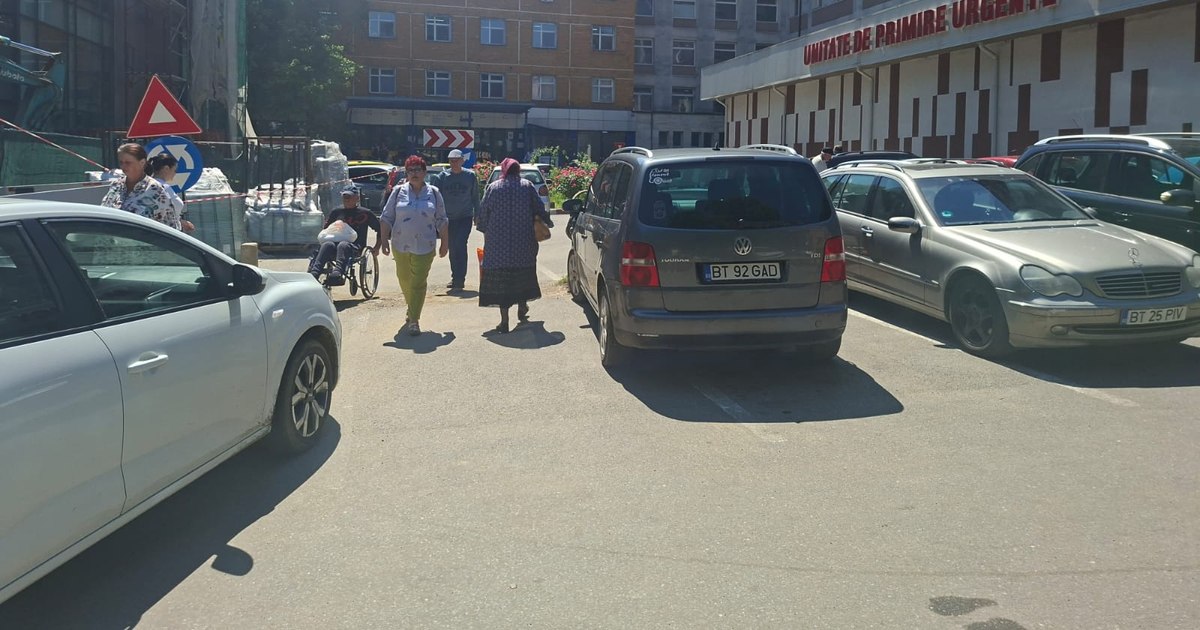
The lack of parking spaces is an acute problem at Botoșani County Hospital PHOTO Cosmin Zamfirache
The healthcare system in Romania has enough syncopes, paradoxes and absurdities. One of these is the problem of parking spaces. To top it off, although mostly county or regional hospitals are mammoth institutions, with over 1,500 beds, with numerous departments and specializations and, implicitly, with huge addressability, parking spaces are a huge problem. They are very few, insignificant compared to the real needs. In this context, for the relatives of a disabled patient who must be brought from a significant distance, by car, to the hospital, finding a parking space becomes an impossible mission.
And this in the conditions where these hospitals are located in very congested areas, without many alternatives to park or park legally. At some hospitals, the parking spaces, which are few, are overcharged, which makes a visit to the hospital a real nightmare for some people who are already worried or grieving. There are few cases in which hospitals have solved the situation with the help of above-ground parking lots, such as the one at the Emergency County Clinical Hospital in Oradea.
Hospital with 10,000 patients per month and parking spaces counted on the fingers
A good example, regarding the chaos and frustration created by the lack of places, is the “Mavromati” County Hospital in Botoșani, one of the largest health facilities with beds in Moldova. In short, it has around 1,500 beds, in different departments and specializations. Although in the last decade the hospital in Botoșani has been considerably modernized, with a visible improvement of the medical act, the problem of parking spaces remains a critical point, which becomes more acute from one year to the next. The “Mavromati” hospital has always had few parking spaces, a few dozen. Some of them were intended for staff.
Well, with the works on the new Specialty Outpatient Clinic, their number has been considerably reduced. There is almost nowhere to park your car at the “Mavromati” County Hospital. And this in the conditions where, monthly, there are 10,000 patients both in the Emergency Room, in the Outpatient Clinic, and in the hospital wards, with different forms of presentation and hospitalization. Sometimes, on average, there are 300-400 patients per day, depending on the period or epidemiological context. Anyone can realize that people actually have no way to drive to the hospital. If they are lucky, they manage to park in the 15-20 free parking spaces. The management of the hospital admits that the problem is nerve-wracking and is waiting for solutions from the County Council, the one under which the health unit is located.
The work at the ambulatory also reduced the capacity of the parking spaces PHOTO Cosmin Zamfirache
“The limited space in front of the County Hospital, on Marchian Street, number 11, cannot satisfy the need for parking spaces. The situation behind the “Mavromati” County Hospital is similar. And this parking lot is quite small and can only provide a very limited number of parking spaces. So, at this moment, any solution from the County Council is welcome in solving this problem”says Corneliu Prepelita, director of the “Mavromati” County Hospital.
Worry, despair and bitter people
The hospital in Botoșani is one of those mammoth health facilities that serves a large population, but with a special feature. That is, for the most part, an aging population with chronic conditions and predominantly rural. Because of this, the most requested areas of the hospital are the Emergency Department and the Outpatient Department. If the overwhelming majority of patients arrive at the Emergency Department by ambulance and there is no need for a personal car or other means of transport, in the case of the Specialty Outpatient Clinic, most of the patients have to come with accessible means of transport.
Most of them are elderly people from the countryside, who come with chronic cardiovascular, digestive, neurological or orthopedic diseases. There are also those from surgery, to change bandages or actually for consultations. These people usually arrive at the Outpatient Clinic by car. Either of the family, or of the neighbors in the village, who, out of compassion or in exchange for a piece of cake, do it for the carters. The reasons for traveling by car are simple. A sick old person, a disabled person or actually with various health problems that partially incapacitate him (fractures, operations) cannot come from the country by public transport. First of all, some come from 70 kilometers away, and the schedule of the buses does not coincide with that of the doctors and especially the appointments.
Many people from the countryside enter only to exit, with many maneuvers PHOTO Cosmin Zamfirache
Alexandru Rogobete: “Hospital food is not a fad, but nutritional therapy and respect for the patient”
“I come with my mother from Coțușca. We go for diabetes and kidneys, for prescriptions, consultations. To the Outpatient Clinic, to the hospital. How can my mother come with the rate (no bus), because she doesn't make it to the appointment? And it's difficult. I have to drive. I volunteer to take her from work”says a Botošan resident who brings his grandmother to the hospital at least once every three months.
“This citizen from my village had an operation on his leg. We go to the hospital. He has no one to help him. The woman is at work. So I take him. We've been neighbors for 20 years. You can't help it without a car. Does he drag himself to the hospital?”says a Botošan resident.
When all these neighbors, sons, grandsons or simply villagers arrive to take the patients to “Mavromati”, the nightmare begins. First, after an hour's drive in the heat, they are struck by the image of an extremely crowded place, full of cars parked on the sidewalk. You don't even have room to throw a needle. Then I arrive at the hospital gate. There they come across a construction site and an entrance guarded by an employee of a security company hired by the hospital. He stops them and tells them dryly that they have to go back: there are no parking spaces. Many country people, confused, after a few insistences, begin to wander aimlessly, looking for a place to leave their car. I see with despair that they are getting further and further away from the hospital and that the patient from Rădăuți-Prut, Coțușca, Săveni or who knows where else has to be carried on their arms until they enter the hospital.
The luckiest ones get to enter the hospital yard with a car. There, chaos. Some go backwards, others face forward, horns, roadblocks, traffic jams. I roll over the bridge, an ambulance with sirens struggling to enter. Another ambulance wants to leave. The employee from the security company runs away desperately and directs one driver or another not to do any damage and to get out of there once. Those who solemnly promise to only leave the patient on the scale and exit are usually allowed to enter through the maze of machines. By the time he gets out of the car, a patient is sick.
“Because of the heat, sir, I put a little water on his face. That's good. I'll take a drink and go out. God forbid”says a driver coming from the county with a patient.
“I suddenly lose my temper and leave it in the middle of the street, literally!”
In a short time the nerves appear. The most outraged are the townspeople. They naturally lose their temper the fastest. Those in the countryside are quieter. First of all, because they don't know the surroundings and they want to escape quickly. But when they actually realize that they have no way to park, some and others lash out. The most difficult is for the relatives of patients from rural areas. They can't just put the man on the scale and walk away. He has to stay for two or three hours to take him back home. And here things get phenomenally complicated. There are paid parking spaces within a radius of 100-200 meters. But even these are few and serve a wide range of activities, not just those who need hospital. So including a paid place 50-100 meters from the hospital can prove to be mission impossible during peak times, i.e. between 9.00 am and 4.00 pm.
“I suddenly lose my temper and leave her in the middle of the street, literally! I can't take it anymore. I'm coming from 30 kilometers away, sir”confesses a villager who came with his father to neurology.
“It is effectively a joke. So many people come and bring sick people. You have nowhere to leave your car. Parking is prohibited everywhere, but full of cars”says another Botošan resident who came to the hospital from the countryside.
Romania and the fight against stroke: from 14 hospitals to a national rapid treatment network
Many choose to park on the curb, but it is prohibited. At least that's what the signs show and risk fines from the Local Police.
“We're lying in wait! When we see the Local Police car show up, we quickly move the car. We go where we can… like madmen”confesses a woman who came to the hospital with her mother.
“Cannot enter”
The situation is particularly difficult for ambulances. Because of the crowding, the continuous maneuvers, the cars sneaking in, going in, going out, trying to get into all kinds of corners, the employees on the ambulance say that they actually get stuck. From the entrance to the hospital yard to the Emergency Department, which is about 50 meters, they are covered by the ambulance in as long as it takes them to reach the other end of the city.
“The problem is really serious. You can't get in. You have a serious patient and you have to wait for maneuvers to be carried out, for him to be released, especially since the new cars, which recognize all kinds of signs, stop in place, they don't give you permission. The course must be resumed. To get to the Emergency Department, it takes you at least three minutes from the entrance to the Emergency Department. We, who in three minutes arrive somewhere at the end of the city with the ambulance”says Tiberiu Roman, chief medical assistant at the Botoșani County Ambulance Service.
“We thought of a solution”
The representatives of the Botoșani County Council, the institution under which the hospital is located, say that they have already thought of some solutions, but it is not safe and it takes a while. That is, they want to move the County Ambulance Station, located next to the hospital, to make parking spaces.
“We thought of a solution in which we would ask the Ministry of Health for the space from Salvare. Let's find a solution to move the Ambulance to an external, nearby area. Let's identify an area. And in that space we can ensure accessibility to the hospital”says Constantin Bursuc, vice president of Botoșani County Council.