Romania, between PNRR and the future EU budget. Victor Negrescu: “After 11 months of government, only now have the nine laws related to the PNRR been discovered”

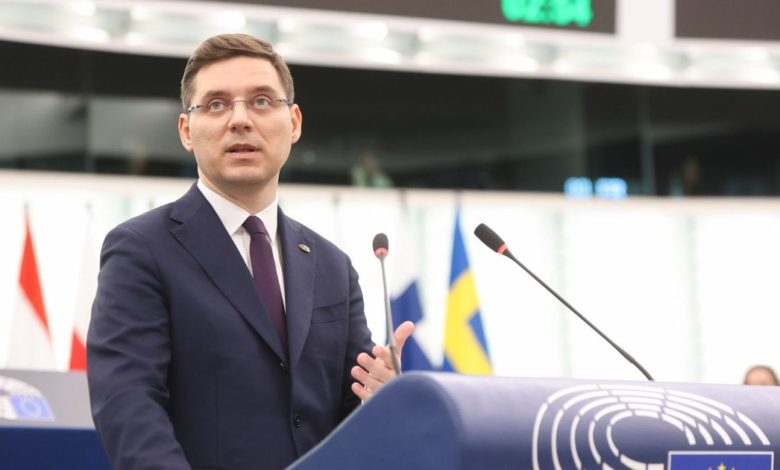
Internal political instability risks affecting, in the next period, Romania's strategy regarding accessing European funds, attracting investments and the country's image at the level of the European Union. In an interview given to “Adevărul”, PSD MEP Victor Negrescu, vice-president of the European Parliament, detailed the directions that the authorities should not ignore in order to ensure the absorption of European funds.
Victor Negrescu, PSD MEP, EP vice-president Photo: Adevărul
“The Truth”: How serious is it for Romania that the PNRR is coming to an end? If we do not manage to absorb all available funds by the deadline, are we missing a unique opportunity or are there other European programs through which we can attract funding in future years?
Victor Negrescu: It is somewhat of a tragedy that Romania continues to have so many difficulties in attracting European money. And that we see government officials who, every time, complain about the heavy legacy, without actually acting on it. Here, in the last 100 meters, Romania is looking to do, for example, what has not been done in recent years, to acquire as much money as possible from the PNRR, where there are serious difficulties and problems. I, for one, do not understand why we only now discovered that we have to make nine laws, although these laws could very well have been approved six months ago, maybe some of them even ten months ago.
And everything is done on the fly, somewhat on the fly, including the meetings of the last few weeks. I find them out of place in the context where everyone knew the responsibility they had and the efforts that had to be made. In this context, Romania still has access to the funds that will come in the future, post-2027. I am referring here to the financial cycle 2028–2034, where there will be, broadly speaking, two categories of funding.
There will be the funds allocated for each individual state, the structural funds, where, for the first time in the history of Europe, these funds will occupy only 45% of the European budget. So far it was over half. I am now working on a recommendation to be approved by the European Parliament and I have requested that, at the European level, from all these funds, not only for Romania, but from the funds in the plan, at least 20 billion go to health.
Romania, according to the proposal made by the European Commission, should receive somewhere around 60 billion euros. But to access this money, we will have to make reforms again and we will have to draw up a national plan. We have one more fund, the European Competitiveness Fund. Most of the European programs are to be merged into this fund. There will be European competitions here and there will be much more money. But we have to fight with regions, applicants and companies from Western Europe. Traditionally, we have not been very competitive for such programs.
Employed in the IT sector Photo: Freepick,com
“There are major risks for the Romanian digital sector”
“Truth”: In the context in which AI is changing the labor marketand the big technology companies are making layoffs, can Romania capitalize on this human resource by supporting start-ups and research and innovation projects?
Victor Negrescu: The digital companies in Romania rather outsourced. And then we must learn to make this transition from outsourcing to products and services, to applications for European funds, including using the new technological developments. Maybe even more focus on the cybersecurity area, the defense area, the dual systems area. That is, if we do not make this transition, the digital sector in Romania, which is very important in the national GDP, somewhere at 8% of Romania's GDP, risks suffering.
I organize “Romania Digital Day” annually in Brussels. We just had an event with over 400 participants and 70 speakers and they said that there are major risks for the Romanian digital sector. And here we must actively use European funds.
These sectors also employ IT people, but they also employ people with diverse backgrounds. Whether we're talking about people with other qualifications, or whether we're talking about people diversifying their strategy. No one will tell us what to do. We as a country have to choose what we can do.
And often, again, the public system expects from entrepreneurs, from the private system. In the United States, the IT and artificial intelligence industries are heavily subsidized. In Germany we see how the car industry, which is suffering now, is receiving billions of euros in aid to transform and modernize. We see in Italy how the industry is automating itself with European funding, including through the Recovery and Resilience Mechanism. We see Spain innovating using regional development funds.
That is, it is a competition, and the competition cannot be carried by only a few successful entrepreneurs. It must be carried out by the state and, in this sense, a state policy that overcomes political divisions is needed.
PSD harshly attacks Ilie Bolojan after he announced that the liberals are not voting for the Tomac Government: “They are blocking all of Romania because it has lost power”
Programs for health and local development
“Truth”: Developed countries have long since solved their major infrastructure problems. Romania still has access to funds that will allow it to recover this gap through the construction of highways and hospitals, after the end of PNRR?
Victor Negrescu: There will continue to be funding on the health component, and I was saying what we did here, at the level of the European Parliament, where we offered the member states the opportunity to use European money for health. In the area of highways, funding will be less numerous and will rather be connected with local development projects, that is, a local and regional development strategy. You need to explain the place of the freeway in this strategy, the freeway being a vehicle for development. For the infrastructure area, things need to be connected and thought much more integrated. Here, regional development agencies and county councils need to be much more involved in thinking of such solutions.
It is not enough to simply develop a single project and that's it. Things will not work that way and this is where the approach needs to be changed.
MAE reform, specialists employed by the Government and a more effective foreign policy
“The truth”: In the context of discussions about how Romania is represented in Brussels, do you think that a clear regulation of lobbying activity would be necessary? Could this help Romania promote its interests more effectively in the European Parliament and the European Commission, including by creating an internal market of specialists in the field, as other states do?
Victor Negrescu: Perhaps it would be ideal to copy the German model, the French model or even the Polish model, where there are people dedicated to European affairs at the level of the prime minister's office. A coordinator, whether it is a specialized secretary of state or a delegated minister, is very important. At least in relation to European issues you need to have a point of contact, a good coordinator and strategic thinking, in such a way that you have the desired impact. We managed to do this in the area of OECD accession and it worked.
We should replicate the model of the presidency of the Council of the European Union, the model of the OECD and the model of accession inclusively on all important diplomatic topics, whether we are talking about the relationship with the US or about European issues. First of all, I think that the Ministry of Foreign Affairs needs to be reformed. Because the Ministry of Foreign Affairs, today, and our diplomatic action do not correspond to the current needs and the way in which foreign and European politics are done today. We need people who work on objectives and with better coordination at the national level, because it is not enough for the diplomat to say something on behalf of the country.
European Parliament Photo: Unsplash.com
Internal instability affects external strategy
“The truth”: Is the technocrat government a viable solution for Romania or does it remain just a transitional option, with no real chance of long-term stability?
Victor Negrescu: First of all, it must be said that Romania is going through a complicated period, having a fragmented Parliament. However, democracy and the country's Euro-Atlantic path must remain essential landmarks. The political parties received the vote of the citizens, and this is fundamental for the functioning of democracy. You cannot replace political legitimacy only with a technocratic formula. At the same time, Romania's strategy, including the negotiations regarding the future budget of the European Union, may be affected by the current political tensions.
The first “resignation” from Eugen Tomac's team before the investiture vote. Adrian Papahagi retires: “It surpasses me”
The fact that, after 11 months of government, only now the nine laws needed for PNRR have been identified and many other measures that have not been implemented shows that things did not work as they should have and that those responsible for these files did not fulfill their duties properly. The Social Democratic Party does not shirk responsibility, it is willing to participate in governance, and the main objective must remain the protection of the social component.
Decisions are also needed in the fiscal field, as well as measures to stimulate the economy. At the same time, we must understand that the functioning of the state does not depend on a single person. Romania can have a government even without Ilie Bolojan, and after his reign there will be other political leaders. Also, if the right-wing parties manage to form a majority and have a credible offer, they should try. We, at least, are willing to return to the negotiating table with the parties with which we governed, provided that the discussions are centered on solutions, not on individuals.
I believe that in the coming weeks a solution will emerge that will allow the rapid installation of a new government, even if it will be different from the formula currently under discussion.