Netanyahu's risky bet against Trump: the attack on Iran and the ultimate test of the Israeli-American alliance

Between Trump's diplomacy and Netanyahu's offensive, the Iranian crisis is becoming the decisive test of the American-Israeli alliance and the stability of the Middle East.
Rarely in the history of the special relationship between Israel and the United States has an Israeli prime minister so openly defied the will of an American president. In June 2026, under intense internal pressure and with parliamentary elections on the horizon, Benjamin Netanyahu ordered attacks against Iran despite Donald Trump's stated objection – a gesture that the Swiss press, through the daily Tribune de Genève, qualifies as a risky bet, capable of testing the very foundation of the alliance between the two countries. The question now dominating Western chancelleries is simple and at the same time troubling: Has Netanyahu permanently distanced himself from the American president, or are we witnessing only a strained episode in a partnership that has survived many crises?
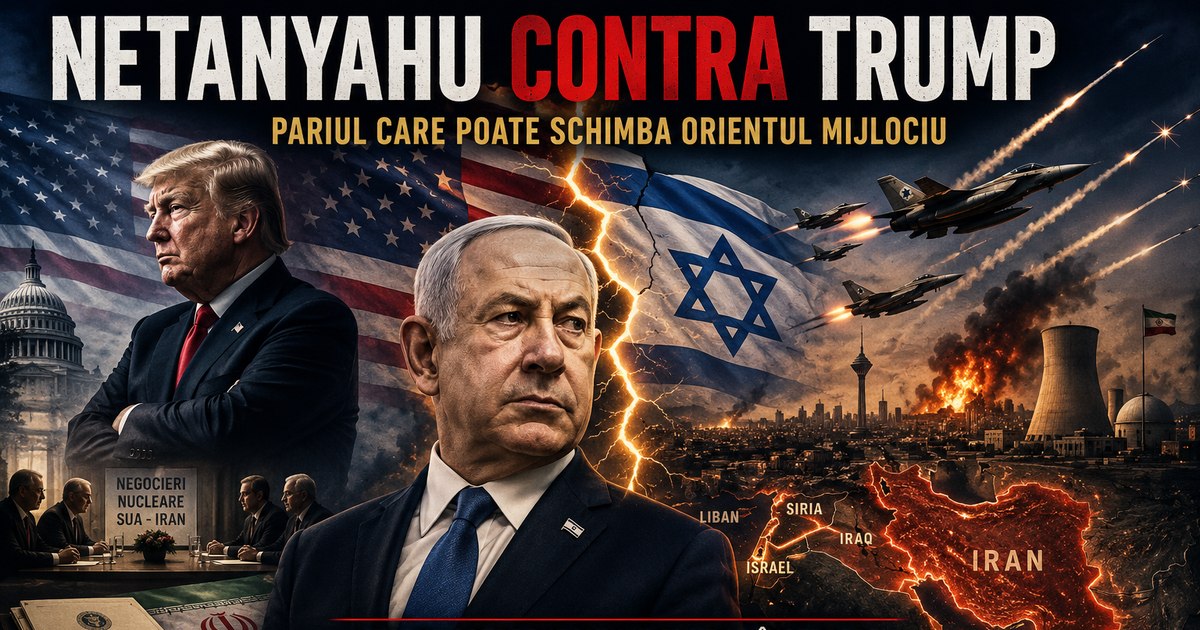
Image generated with AI
I. Breaking the Armistice: Timeline of an Escalation
To understand the gravity of the moment, the sequence of events must be reconstructed. Israel and Iran were, since April 8, under the regime of a fragile truce, obtained after the offensive launched against Iran on February 28. Donald Trump, engaged in advanced nuclear negotiations with Tehran, appeared determined to give diplomacy a chance and had explicitly called for restraint from his Israeli ally. However, the threats materialized on Sunday, June 7. After firing on its territory, Israel announced that it had struck a headquarters of the Islamist movement Hezbollah – Tehran's Lebanese ally – in Beirut. The Iranian response came the same evening: 11 missiles fired at Israel, all intercepted by air defense systems. Although the attack produced no casualties, it triggered an avalanche of demands within the Israeli cabinet for a swift and decisive response. The tone was set by National Security Minister Itamar Ben Gvir, the prime minister's far-right and often problematic ally, who publicly called for “Tehran to burn tonight.” For his part, Naftali Bennett – former prime minister and candidate for the parliamentary elections scheduled for the end of October at the latest – spoke of “a decisive moment”, demanding that “no restraint” be shown. Caught between pressure from allies, an offensive by electoral rivals and warnings from Washington, Netanyahu made a choice: even though Trump had told reporters he would ask the Israeli prime minister not to retaliate, he gave his approval for the attack.
II. First time Netanyahu has so openly sidestepped Trump
The significance of the gesture goes far beyond its military dimension. According to independent geopolitical analyst Michael Horowitz, quoted by AFP, this is the first time that Netanyahu has bypassed President Trump in such an open way – an act that the expert describes without hesitation as “a gamble”. The Israeli prime minister tried to cloak the defiance in the language of legitimacy: Addressing Israelis and “his friend President Trump,” he said Monday that his country has “the full right to defend itself” and that it exercises that right whenever necessary. The self-defense argument also finds supporters among military experts. Adi Bershadsky, a retired Israeli colonel and defense expert, told AFP that when ballistic missiles are fired at civilian areas, it is difficult to expect a sovereign state not to react. Moreover, according to the same expert, a certain degree of coordination with Washington is likely to remain even under these conditions: the Israeli army confirmed that the Chief of Staff remained “in permanent contact with his American counterpart”, despite the opposition of President Trump, who later called for an “immediate” cessation of hostilities. This ambiguity – political defiance at the top, doubled by military coordination at the operational level – in fact defines the paradoxical nature of the crisis. The message to Iran, summarized by Yaakov Katz, an analyst at the Jewish People's Policy Institute, is clear: even if Trump wants a deal with Tehran, “Israel is acting independently.”
III. Electoral calculus: domestic politics behind the decision
Beyond the security rhetoric, Netanyahu's decision cannot be separated from the domestic political context. Israel is heading for parliamentary elections, and the prime minister knows that any sign of weakness vis-à-vis Iran would be immediately imputed to him. “No Israeli leader would have agreed to let an Iranian attack go unanswered,” Horowitz argues, adding that the election may have played a role: Netanyahu's opponents would likely have used the opportunity against him if Israel had not reacted. The irony of the situation is that both opponents and political allies of the prime minister have constantly reminded him of his own phrase, uttered in 2024, amid disagreements with Washington on the Palestinian issue: “An Israeli prime minister should be able to say no, even to our best friends.” By advocating a resumption of hostilities rather than a US-Iran deal perceived as necessarily unfavorable to Israel, the Israeli political class has effectively pushed Netanyahu to apply its own principle – this time against the country's most important ally. Commentator Anna Barsky of Maariv newspaper captures the delicate balance of this calculation: the Israeli decision “was risky as it could lead to further Iranian attacks and the possible involvement of Iranian intermediaries”, but remains “understandable as restraint would have quickly set a precedent”. In other words, Netanyahu chose the risk of external escalation to avoid the certainty of internal erosion.
IV. The Structural Dilemma of the Israeli-American Alliance
The current crisis brings back to the fore a decades-old Israeli foreign policy dilemma, articulated by Barsky with remarkable clarity: how to maintain Israel's alliance with the United States without losing its own ability to act independently. What makes the episode of June 2026 particularly dangerous, according to the commentator from “Maariv”, is the asymmetry of status: this time, the American president is not talking to Netanyahu as an equal, but as a secondary player – and from the Israeli point of view, this is precisely the risk. There are, however, factors that limit the rupture. Since launching the offensive against Iran on Feb. 28, the two leaders “have been engaged in this war together,” Horowitz notes, and broader public tensions could hurt both of them — especially as both have elections coming up. Electoral interdependence works, paradoxically, as a safety net: neither Trump can afford the image of a broken alliance, nor Netanyahu can politically survive a real break with Washington.
V. An escalation kept, for now, under control
Surprisingly for the intensity of the rhetoric, the escalation seems under control for now. Iran announced on Monday afternoon the “cease of military operations” against Israel – a signal that Tehran, itself engaged in delicate negotiations with Washington, does not want an all-out conflagration. At the same time, however, the Israeli military continues its attacks against Hezbollah in southern Lebanon, keeping a front burning that can reignite direct confrontation with Iran at any time. This tentative outcome confirms the measured nature of the exchange of blows: each side demonstrated the ability to fight back, without pushing the threshold beyond which the war would become uncontrollable. But the question remains whether such a balance can be maintained in an environment where decisions are increasingly dictated by electoral calendars and pressure from radical factions in both camps.
ConCluSIonS
Netanyahu's bet summarizes, in a single episode, all the tensions that cross the Middle East today: the friction between American diplomacy and Israeli military reflexes, the pressure of domestic politics on strategic decisions and the fragility of a truce that separates the region from a generalized war. By openly defying Trump, the Israeli prime minister perhaps gained an immediate electoral advantage and avoided the dangerous precedent of an unanswered Iranian offense. The price, however, could be paid in the long run: a US president who treats him as a side player, an alliance in question and a region where each new exchange of blows threatens to shatter both the US-Iranian nuclear negotiations and the last vestiges of the April truce. The bet was made; the winner remains unknown.
PostScript: US President Donald Trump announced on Thursday (June 11) that he was canceling planned strikes against Iran, saying an agreement to end the war could be signed in the coming days. He claimed that the negotiations had reached the highest level of the Iranian leadership and that the final points of the deal had been approved by the US, Israel and the Gulf states. Iran's position, however, remains unclear. Foreign Ministry spokesman Esmaeil Baqaei said Tehran “has not reached a final conclusion” on the deal. Tasnim agency noted skeptically that Trump announced an imminent deal 38 times in the past two months. Trump's announcement sent stock markets higher and oil prices down more than 3 percent, even though just a day earlier he had threatened to escalate attacks and seize control of the oil terminal on Kharg Island. The World Bank has revised down its forecast for global growth, to a level not seen since the pandemic. On the ground, tensions persist: Kuwait reported an Iranian attack that damaged an airport's radar, Iranian General Ali Abdollahi threatened a “tougher response” in the event of a US attack, and the Strait of Hormuz — critical for oil and gas shipping — remains closed “until further notice.”